 Add to Chrome
 Add to Firefox
 Add to Edge
OPD+: Rethinking the Advantage Design for On-Policy Distillation
May 31, 2026
On-policy distillation (OPD) is a widely used technique to transfer capabilities from capable teacher language models to the base student models, and can be formulated in a reinforcement learning style objective using student generated rollouts. Yet, despite the divergence reward being dependent on student model likelihood, existing works usually adopt a stop gradient design primarily for stability, which makes the resulting advantage estimation questionable. In this work, we provide a generic optimization framework based on f-divergence between the student and teacher, and mathematically revisit whether such design space is valid. We prove that general stop-gradient operation would lead to biased estimates of the reward objective and corresponding gradient for general divergence functions. We propose OPD+, the corrected version of OPD that demonstrates improved performance over the baseline KL approach and also supports the choice of various f-divergence. We validate our findings on mathematical reasoning and tool-use benchmarks.

DiFFPO: Training Diffusion LLMs to Reason Fast and Furious via Reinforcement Learning
Oct 02, 2025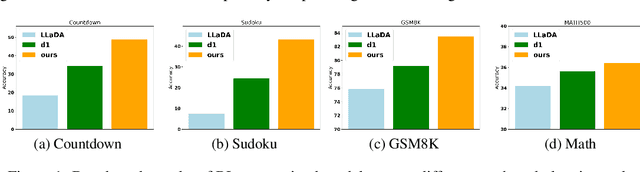

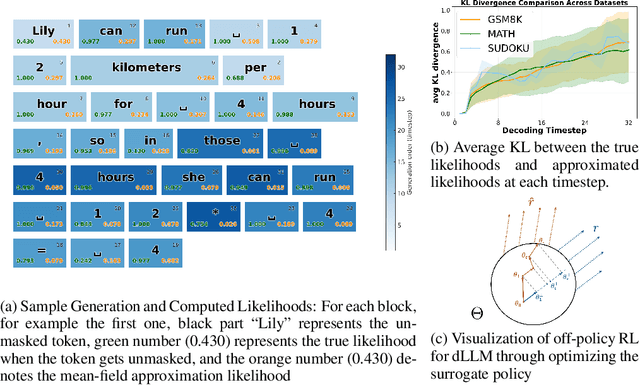

We propose DiFFPO, Diffusion Fast and Furious Policy Optimization, a unified framework for training masked diffusion large language models (dLLMs) to reason not only better (furious), but also faster via reinforcement learning (RL). We first unify the existing baseline approach such as d1 by proposing to train surrogate policies via off-policy RL, whose likelihood is much more tractable as an approximation to the true dLLM policy. This naturally motivates a more accurate and informative two-stage likelihood approximation combined with importance sampling correction, which leads to generalized RL algorithms with better sample efficiency and superior task performance. Second, we propose a new direction of joint training efficient samplers/controllers of dLLMs policy. Via RL, we incentivize dLLMs' natural multi-token prediction capabilities by letting the model learn to adaptively allocate an inference threshold for each prompt. By jointly training the sampler, we yield better accuracies with lower number of function evaluations (NFEs) compared to training the model only, obtaining the best performance in improving the Pareto frontier of the inference-time compute of dLLMs. We showcase the effectiveness of our pipeline by training open source large diffusion language models over benchmark math and planning tasks.
Mallows-DPO: Fine-Tune Your LLM with Preference Dispersions
May 23, 2024
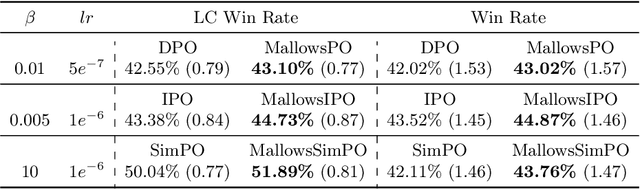
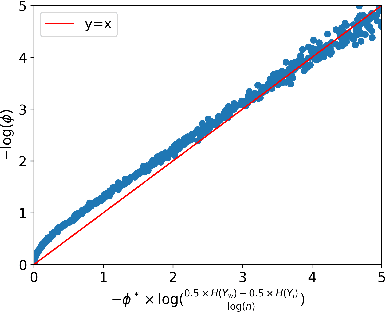
Direct Preference Optimization (DPO) has recently emerged as a popular approach to improve reinforcement learning with human feedback (RLHF), leading to better techniques to fine-tune large language models (LLM). A weakness of DPO, however, lies in its lack of capability to characterize the diversity of human preferences. Inspired by Mallows' theory of preference ranking, we develop in this paper a new approach, the Mallows-DPO. A distinct feature of this approach is a dispersion index, which reflects the dispersion of human preference to prompts. We show that existing DPO models can be reduced to special cases of this dispersion index, thus unified with Mallows-DPO. More importantly, we demonstrate (empirically) how to use this dispersion index to enhance the performance of DPO in a broad array of benchmark tasks, from synthetic bandit selection to controllable generations and dialogues, while maintaining great generalization capabilities.