 Add to Chrome
 Add to Firefox
 Add to Edge
A Continuous-Time Reinforcement Learning Framework for Fine-Tuning Discrete Diffusion Models
Jul 16, 2026
We formulate reinforcement learning (RL) in continuous time with discrete state spaces and possibly arbitrary action spaces via a stochastic control approach, where the state dynamics are modeled as a controlled continuous-time Markov chain (CTMC). We consider policy optimization problems and derive the corresponding policy gradient methods, leading to continuous-time variants of proximal policy optimization (PPO) and group relative policy optimization (GRPO). As a primary application, we develop a complete continuous-time RL framework for fine-tuning score-based discrete diffusion models. The proposed framework enables reward-driven optimization without requiring differentiability on the reward signals. In contrast to the existing GRPO-based approaches that only rely on terminal rewards, our formulation allows intermediate reward or advantage signals to be incorporated throughout the denoising trajectory. Importantly, when specialized to masked diffusion models (MDMs), our framework encompasses a rich class of policy parameterizations over the vocabulary simplex with analytically tractable probability ratios, providing a unified perspective on exploration and policy optimization in MDMs. For masked diffusion large language models (dLLMs), we further propose trajectory subsampling techniques to efficiently estimate computationally prohibitive trajectory likelihoods, reducing the computational cost of computing per-position probability ratios. We showcase the effectiveness of our methods on both low-dimensional entropy-regularized optimization problems and RL post-training of dLLMs on mathematical reasoning and coding tasks.

DG-CoLearn: An Efficient Collaborative Learning Framework for Dynamic Graphs
May 29, 2026Dynamic graph learning (DGL) is essential for modelling evolving graph data, but existing methods suffer from significant computational overhead due to repeated full-snapshot retraining and are not well-suited for collaborative settings with partitioned data. In realistic graph systems, cross-partition edges are unavoidable, but direct sharing of graph structure between clients may violate privacy constraints. We propose DG-CoLearn, a client-oblivious collaborative dynamic graph learning framework built on incremental graph snapshot processing, which focuses computation on graph regions affected by temporal updates while preserving historical information through temporal modelling. This incremental design is consistently applied across the entire graph processing pipeline, including a server-mediated embedding exchange mechanism to enable accurate multi-hop message passing without exposing raw cross-client structural information. Extensive experiments demonstrate that DG-CoLearn achieves up to 33.8$\times$ speedup in training time and 27.4$\times$ reduction in communication overhead, while consistently improving predictive performance on both node classification (up to 13.36% F1 improvement) and link prediction (up to 8.27% MAP improvement) tasks. These results highlight the effectiveness of DG-CoLearn in bridging efficiency, scalability, and client-to-client structural privacy in collaborative dynamic graph learning.
Tweedie's Formulae and Diffusion Generative Models Beyond Gaussian
May 19, 2026Diffusion models have achieved remarkable success in generating samples from unknown data distributions. Most popular stochastic differential equation-based diffusion models perturb the target distribution by adding Gaussian noise, transforming it into a simple prior, and then use denoising score matching, a consequence of Tweedie's formula, to learn the score function and generate clean samples from noise. However, non-Gaussian diffusion models with state-dependent diffusion coefficient have been largely underexplored, as have the corresponding Tweedie's formulae. In this work, we extend Tweedie's formula to important non-Gaussian processes, including geometric Brownian motion (GBM), squared Bessel (BESQ) processes, and Cox-Ingersoll-Ross (CIR) processes, thereby yielding the corresponding denoising score-matching objectives. We then apply the derived formulae to image and financial time series generation using GBM- and CIR-based diffusion models, and to empirical Bayes estimation under the BESQ setting. The reported experimental results demonstrate the potential of non-Gaussian models.
Convergence of Score-Based Discrete Diffusion Models: A Discrete-Time Analysis
Oct 03, 2024
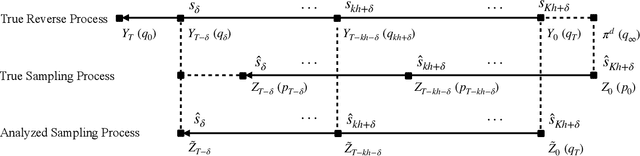
Diffusion models have achieved great success in generating high-dimensional samples across various applications. While the theoretical guarantees for continuous-state diffusion models have been extensively studied, the convergence analysis of the discrete-state counterparts remains under-explored. In this paper, we study the theoretical aspects of score-based discrete diffusion models under the Continuous Time Markov Chain (CTMC) framework. We introduce a discrete-time sampling algorithm in the general state space $[S]^d$ that utilizes score estimators at predefined time points. We derive convergence bounds for the Kullback-Leibler (KL) divergence and total variation (TV) distance between the generated sample distribution and the data distribution, considering both scenarios with and without early stopping under specific assumptions. Notably, our KL divergence bounds are nearly linear in dimension $d$, aligning with state-of-the-art results for diffusion models. Our convergence analysis employs a Girsanov-based method and establishes key properties of the discrete score function, which are essential for characterizing the discrete-time sampling process.