 Add to Chrome
 Add to Firefox
 Add to Edge
Weighted Sum Rate Maximization for ITS-Aided Arrays in Multi-User MIMO
Apr 09, 2026
This work explores the potential of integrating an Intelligent Transmissive Surface (ITS) into an antenna array to improve beamforming performance. We show that integrating a moderate number of passive refractive elements into a small antenna array can significantly improve the Weighted Sum Rate (WSR). We investigate the optimization of the WSR under two distinct operational constraints: a Radiated Power (RP) constraint and a Transmitted Power (TP) constraint. Our analysis reveals that the choice between these constraints significantly impacts the design parameters of the ITS-aided array. By contrasting these approaches, we explore critical design and material parameters, including the array geometry, surface loss, and illumination strategies.

QuarkMedBench: A Real-World Scenario Driven Benchmark for Evaluating Large Language Models
Mar 14, 2026While Large Language Models (LLMs) excel on standardized medical exams, high scores often fail to translate to high-quality responses for real-world medical queries. Current evaluations rely heavily on multiple-choice questions, failing to capture the unstructured, ambiguous, and long-tail complexities inherent in genuine user inquiries. To bridge this gap, we introduce QuarkMedBench, an ecologically valid benchmark tailored for real-world medical LLM assessment. We compiled a massive dataset spanning Clinical Care, Wellness Health, and Professional Inquiry, comprising 20,821 single-turn queries and 3,853 multi-turn sessions. To objectively evaluate open-ended answers, we propose an automated scoring framework that integrates multi-model consensus with evidence-based retrieval to dynamically generate 220,617 fine-grained scoring rubrics (~9.8 per query). During evaluation, hierarchical weighting and safety constraints structurally quantify medical accuracy, key-point coverage, and risk interception, effectively mitigating the high costs and subjectivity of human grading. Experimental results demonstrate that the generated rubrics achieve a 91.8% concordance rate with clinical expert blind audits, establishing highly dependable medical reliability. Crucially, baseline evaluations on this benchmark reveal significant performance disparities among state-of-the-art models when navigating real-world clinical nuances, highlighting the limitations of conventional exam-based metrics. Ultimately, QuarkMedBench establishes a rigorous, reproducible yardstick for measuring LLM performance on complex health issues, while its framework inherently supports dynamic knowledge updates to prevent benchmark obsolescence.
Hyperdimensional Computing Empowered Federated Foundation Model over Wireless Networks for Metaverse
Aug 26, 2024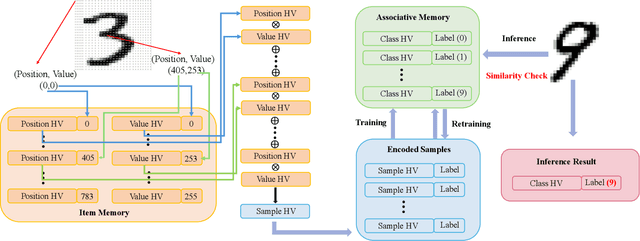

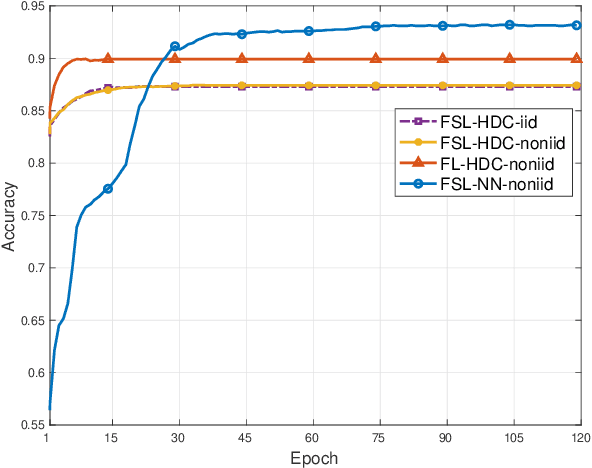

The Metaverse, a burgeoning collective virtual space merging augmented reality and persistent virtual worlds, necessitates advanced artificial intelligence (AI) and communication technologies to support immersive and interactive experiences. Federated learning (FL) has emerged as a promising technique for collaboratively training AI models while preserving data privacy. However, FL faces challenges such as high communication overhead and substantial computational demands, particularly for neural network (NN) models. To address these issues, we propose an integrated federated split learning and hyperdimensional computing (FSL-HDC) framework for emerging foundation models. This novel approach reduces communication costs, computation load, and privacy risks, making it particularly suitable for resource-constrained edge devices in the Metaverse, ensuring real-time responsive interactions. Additionally, we introduce an optimization algorithm that concurrently optimizes transmission power and bandwidth to minimize the maximum transmission time among all users to the server. The simulation results based on the MNIST dataset indicate that FSL-HDC achieves an accuracy rate of approximately 87.5%, which is slightly lower than that of FL-HDC. However, FSL-HDC exhibits a significantly faster convergence speed, approximately 3.733x that of FSL-NN, and demonstrates robustness to non-IID data distributions. Moreover, our proposed optimization algorithm can reduce the maximum transmission time by up to 64% compared with the baseline.