 Add to Chrome
 Add to Firefox
 Add to Edge
Gesture-Aware Indoor THz ISAC Systems for Adaptive Resource Allocation
May 28, 2026
This paper investigates a multi-user indoor integrated sensing and communication (ISAC) system operating in the terahertz (THz) band, designed for adaptive communication based on gesture recognition. Leveraging gesture tracking through an extended Kalman filter (EKF), the access point (AP) dynamically adjusts resource allocation in response to detected gesture variations, thereby improving sensing accuracy. Based on the gesture recognition results, the AP further updates the communication quality requirements of different users, enabling efficient resource allocation. To this end, an adaptive joint optimization algorithm for power allocation and beamforming is developed to maximize the overall sensing signal-to-interference-plus-noise ratio (SINR) while satisfying the gesture-dependent communication quality of service (QoS) constraints. Simulation results demonstrate that the proposed method effectively responds to gesture dynamics, achieving superior sensing accuracy and communication performance compared with conventional single-variable optimization baselines.

CRB-Guided Framework Design and Resource Allocation for Indoor mmWave ISCC Systems
May 28, 2026Integrated sensing, communication, and computation (ISCC) provides a promising framework for indoor human-centric applications. In these applications, short-term human pose prediction facilitates continuous human tracking and resource allocation in advance. In this paper, we propose a Cramer-Rao bound (CRB) guided resource allocation framework for indoor mmWave ISCC systems to minimize the human pose prediction error under communication, latency, and energy constraints. We characterize the impact of sensing power on range-estimation uncertainty and point-cloud perturbation based on the CRB. To capture the impact of computation resources on prediction performance, we adopt an adaptive-depth Mamba-based pose prediction model, where lightweight prediction heads are attached after every layer to enable inference with different model depths. With this unified sensing-computation modeling, we establish a quantitative relationship among sensing power, model depth, and prediction error. Furthermore, we formulate a joint resource allocation problem to minimize the pose prediction error. To solve this problem efficiently, we develop an alternating optimization (AO)-based algorithm, where closed-form solutions are derived for the sensing power and model depth update steps. Simulation results show that the proposed scheme significantly reduces pose prediction error compared with baseline methods, validating its effectiveness for resource-constrained indoor human-centric ISCC systems.
TOIB: Task-Oriented Orthogonalised Information Bottleneck for Distributed Semantic Communication
Apr 13, 2026Task-oriented semantic communication emerges as a crucial paradigm for next-generation wireless networks, aiming to efficiently transmit task-relevant information while reducing interference and redundancy across multiple users. Existing information bottleneck (IB)-based frameworks predominantly focus on single-user scenarios, neglecting cross-user semantic interference in distributed semantic communications. To overcome this limitation, we propose a task-oriented orthogonalised information bottleneck (TOIB) approach, explicitly designed for distributed semantic communication systems. By introducing task-conditioned latent variables, TOIB adaptively balances semantic sufficiency, semantic compression, and inter-user semantic orthogonality. Extensive simulations conducted on classification tasks demonstrate that TOIB consistently achieves superior classification accuracy across various signal-to-noise ratio (SNR) regimes compared to traditional IB and deep joint source-channel coding (JSCC) methods. Specifically, the proposed method significantly enhances robustness under harsh low-SNR conditions and effectively suppresses cross-user semantic interference, as validated by cross-decoding accuracy metrics.
Semantic Feature Multiple Access Empowered Integrated Learning and Communication Networks
Apr 10, 2026Integrated learning and communication (ILAC) unifies learned transceivers with radio resource management, where semantic feature multiple access (SFMA) enables paired users to superpose their learned representations over shared time-frequency resources. Unlike conventional multiple access schemes, SFMA interference arises in the learned feature space and depends jointly on the user pair, the transmit power, and the compression ratio. This coupling ties binary pairing decisions to continuous resource variables, yielding a mixed-integer non-convex optimization problem. To address this problem, we first propose similarity-conditioned SFMA (SC-SFMA), a Swin Transformer-based transceiver whose dual-conditioned similarity modulator (DC-SimM) gates cross-user feature fusion according to the inter-user semantic similarity. We then characterize the resulting pair-dependent interference by a bivariate logistic function parameterized by transmit power and compression ratio, thereby bridging the learned transceiver with network-level optimization. On this basis, we formulate a sum-rate maximization problem subject to per-user distortion, latency, energy, power, and bandwidth constraints. To solve this problem, we develop a three-block alternating optimization algorithm that integrates dual-decomposition-assisted compression ratio allocation, trust-region successive convex approximation (SCA) for joint power-bandwidth optimization, and dynamic feasible graph-based user pairing. Simulation results show that SC-SFMA achieves considerable peak signal-to-noise ratio (PSNR) and multi-scale structural similarity index measure (MS-SSIM) gains over deep joint source-channel coding (JSCC) and separation-based baselines. The proposed optimization framework attains significant sum rate improvements over conventional multiple access baselines.
Near-Field Integrated Sensing, Computing and Semantic Communication in Digital Twin-Assisted Vehicular Networks
Apr 07, 2026Digital twin (DT) technology offers transformative potential for vehicular networks, enabling high-fidelity virtual representations for enhanced safety and automation. However, seamless DT synchronization in dynamic environments faces challenges such as massive data transmission, precision sensing, and strict computational constraints. This paper proposes an integrated sensing, computing, and semantic communication (ISCSC) framework tailored for DT-assisted vehicular networks in the near-field (NF) regime. Leveraging a multi-user multiple-input multiple-output (MU-MIMO) configuration, each roadside unit (RSU) employs semantic communication to serve vehicles while simultaneously utilizing millimeter-wave (mmWave) radar for environmental mapping. We implement particle filtering at RSUs to achieve high-precision vehicle tracking. To optimize performance, we formulate a joint optimization problem balancing semantic communication rates and sensing accuracy under limited computational resources and power budget. Our solution includes a hybrid heuristic algorithm for vehicle-to-RSU assignment and an alternating optimization approach for determining semantic extraction ratios and beamforming matrices. Performance is extensively evaluated via the Cramér-Rao bound (CRB) for angle and distance estimation, semantic transmission rates, and resource utilization. Numerical results demonstrate that the proposed ISCSC framework achieves a 20% improvement in transmission rate while maintaining the sensing accuracy of existing integrated sensing and communication (ISAC) schemes under constrained resource conditions.
Hyperdimensional Computing Empowered Federated Foundation Model over Wireless Networks for Metaverse
Aug 26, 2024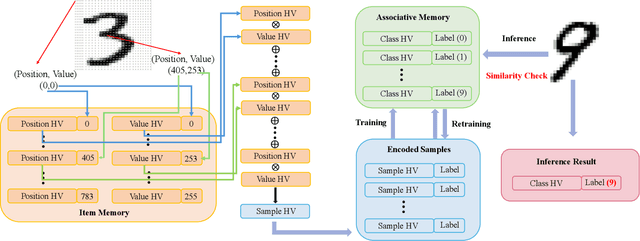

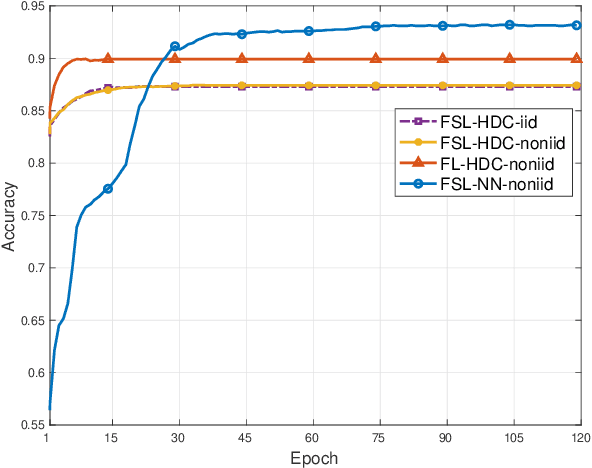

The Metaverse, a burgeoning collective virtual space merging augmented reality and persistent virtual worlds, necessitates advanced artificial intelligence (AI) and communication technologies to support immersive and interactive experiences. Federated learning (FL) has emerged as a promising technique for collaboratively training AI models while preserving data privacy. However, FL faces challenges such as high communication overhead and substantial computational demands, particularly for neural network (NN) models. To address these issues, we propose an integrated federated split learning and hyperdimensional computing (FSL-HDC) framework for emerging foundation models. This novel approach reduces communication costs, computation load, and privacy risks, making it particularly suitable for resource-constrained edge devices in the Metaverse, ensuring real-time responsive interactions. Additionally, we introduce an optimization algorithm that concurrently optimizes transmission power and bandwidth to minimize the maximum transmission time among all users to the server. The simulation results based on the MNIST dataset indicate that FSL-HDC achieves an accuracy rate of approximately 87.5%, which is slightly lower than that of FL-HDC. However, FSL-HDC exhibits a significantly faster convergence speed, approximately 3.733x that of FSL-NN, and demonstrates robustness to non-IID data distributions. Moreover, our proposed optimization algorithm can reduce the maximum transmission time by up to 64% compared with the baseline.
Distributed Machine Learning for UAV Swarms: Computing, Sensing, and Semantics
Jan 03, 2023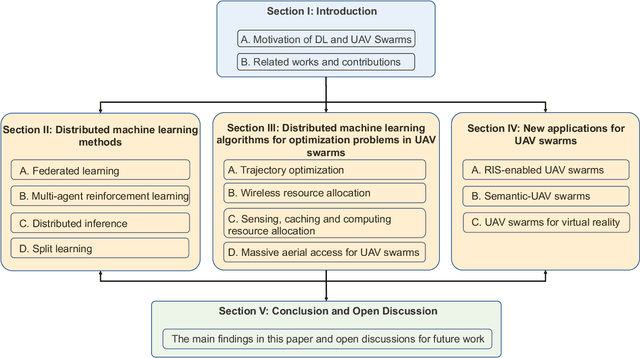
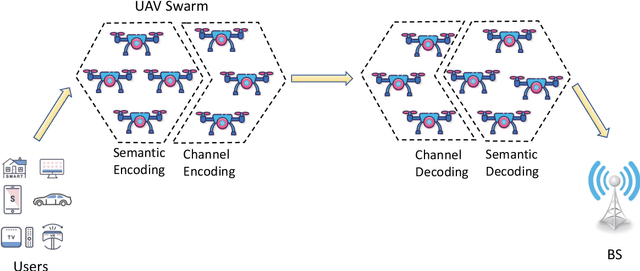
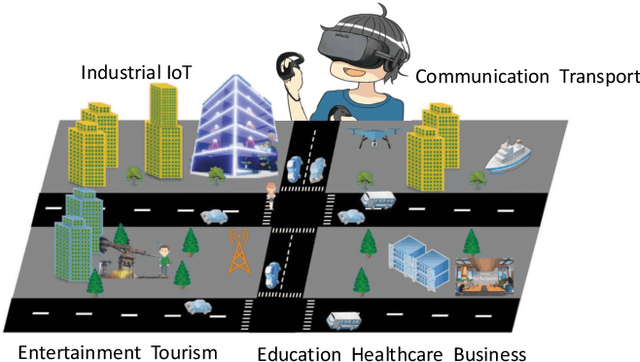
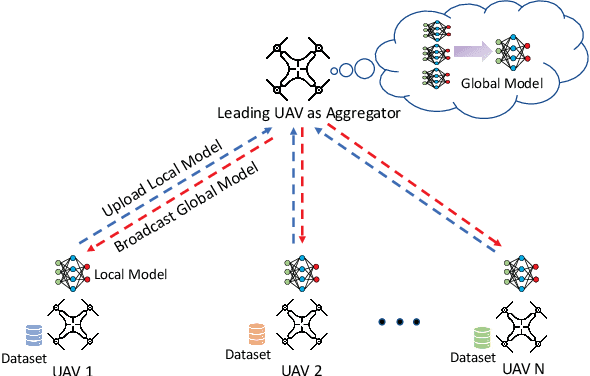
Unmanned aerial vehicle (UAV) swarms are considered as a promising technique for next-generation communication networks due to their flexibility, mobility, low cost, and the ability to collaboratively and autonomously provide services. Distributed learning (DL) enables UAV swarms to intelligently provide communication services, multi-directional remote surveillance, and target tracking. In this survey, we first introduce several popular DL algorithms such as federated learning (FL), multi-agent Reinforcement Learning (MARL), distributed inference, and split learning, and present a comprehensive overview of their applications for UAV swarms, such as trajectory design, power control, wireless resource allocation, user assignment, perception, and satellite communications. Then, we present several state-of-the-art applications of UAV swarms in wireless communication systems, such us reconfigurable intelligent surface (RIS), virtual reality (VR), semantic communications, and discuss the problems and challenges that DL-enabled UAV swarms can solve in these applications. Finally, we describe open problems of using DL in UAV swarms and future research directions of DL enabled UAV swarms. In summary, this survey provides a comprehensive survey of various DL applications for UAV swarms in extensive scenarios.