 Add to Chrome
 Add to Firefox
 Add to Edge
AlphaTransit: Learning to Design City-scale Transit Routes
May 27, 2026
Designing a transit network requires many sequential route extension decisions, but their quality is often visible only after the full network is assembled. This delayed-feedback challenge lies at the heart of the Transit Route Network Design Problem (TRNDP), where route interactions can be deceptive: an extension that appears useful locally can create transfer bottlenecks, produce redundant overlap, or reduce overall throughput. To guide route construction under delayed simulator feedback, we introduce AlphaTransit, a search-based planning framework for cityscale bus network design. AlphaTransit couples Monte Carlo Tree Search (MCTS) with a neural policy-value network: the policy proposes route extensions, the value estimates downstream design quality, and search uses these predictions to refine each decision. This provides decision-time lookahead during route construction without running simulator rollouts inside the search tree. We evaluate AlphaTransit on a new Bloomington TRNDP benchmark with realistic road topology and censusderived demand, under mixed and full transit demand settings. In the Bloomington network, AlphaTransit attains the highest service rate in both demand settings, reaching 54.6% and 82.1%, respectively. Relative to reinforcement learning without search, these correspond to 9.9% and 11.4% service rate gains; relative to MCTS without learned guidance, they correspond to 2.5% and 11.2% gains. These results suggest that coupling learned guidance with MCTS is more effective than using either approach alone for transit network design. Our code and data are publicly available in https://github.com/poudel-bibek/AlphaTransit.

DeCoR: Design and Control Co-Optimization for Urban Streets Using Reinforcement Learning
May 20, 2026Modern vision systems can detect, track, and forecast urban actors at scale, yet translating perception outputs to urban design remains limited. We introduce DeCoR, a two-stage reinforcement learning framework that leverages flow observations to co-optimize crosswalk layout and network-level signal control. The design stage encodes the pedestrian network as a graph and learns a generative policy that parameterizes a Gaussian mixture model over crosswalk location and width, from which new crosswalks are sampled. For each layout, a shared control policy learns adaptive signal timings to minimize joint pedestrian and vehicle delay. On a 750 m real-world urban corridor with demand sensed from video and Wi-Fi logs, DeCoR learns a layout that reduces pedestrian arrival time to their nearest crosswalk by 23% while using fewer crosswalks than existing configurations. On the control side, DeCoR reduces pedestrian and vehicle wait time by 79% and 65%, respectively, relative to fixed-time signalization. Further, the control policy generalizes to demands outside of training and is robust to layout changes without retraining.
Learning to Design City-scale Transit Routes
Dec 21, 2025Designing efficient transit route networks is an NP-hard problem with exponentially large solution spaces that traditionally relies on manual planning processes. We present an end-to-end reinforcement learning (RL) framework based on graph attention networks for sequential transit network construction. To address the long-horizon credit assignment challenge, we introduce a two-level reward structure combining incremental topological feedback with simulation-based terminal rewards. We evaluate our approach on a new real-world dataset from Bloomington, Indiana with topologically accurate road networks, census-derived demand, and existing transit routes. Our learned policies substantially outperform existing designs and traditional heuristics across two initialization schemes and two modal-split scenarios. Under high transit adoption with transit center initialization, our approach achieves 25.6% higher service rates, 30.9\% shorter wait times, and 21.0% better bus utilization compared to the real-world network. Under mixed-mode conditions with random initialization, it delivers 68.8% higher route efficiency than demand coverage heuristics and 5.9% lower travel times than shortest path construction. These results demonstrate that end-to-end RL can design transit networks that substantially outperform both human-designed systems and hand-crafted heuristics on realistic city-scale benchmarks.
Elevation Aware 2D/3D Co-simulation Framework for Large-scale Traffic Flow and High-fidelity Vehicle Dynamics
Dec 12, 2025Reliable testing of autonomous driving systems requires simulation environments that combine large-scale traffic modeling with realistic 3D perception and terrain. Existing tools rarely capture real-world elevation, limiting their usefulness in cities with complex topography. This paper presents an automated, elevation-aware co-simulation framework that integrates SUMO with CARLA using a pipeline that fuses OpenStreetMap road networks and USGS elevation data into physically consistent 3D environments. The system generates smooth elevation profiles, validates geometric accuracy, and enables synchronized 2D-3D simulation across platforms. Demonstrations on multiple regions of San Francisco show the framework's scalability and ability to reproduce steep and irregular terrain. The result is a practical foundation for high-fidelity autonomous vehicle testing in realistic, elevation-rich urban settings.
PulseRide: A Robotic Wheelchair for Personalized Exertion Control with Human-in-the-Loop Reinforcement Learning
Jun 05, 2025Maintaining an active lifestyle is vital for quality of life, yet challenging for wheelchair users. For instance, powered wheelchairs face increasing risks of obesity and deconditioning due to inactivity. Conversely, manual wheelchair users, who propel the wheelchair by pushing the wheelchair's handrims, often face upper extremity injuries from repetitive motions. These challenges underscore the need for a mobility system that promotes activity while minimizing injury risk. Maintaining optimal exertion during wheelchair use enhances health benefits and engagement, yet the variations in individual physiological responses complicate exertion optimization. To address this, we introduce PulseRide, a novel wheelchair system that provides personalized assistance based on each user's physiological responses, helping them maintain their physical exertion goals. Unlike conventional assistive systems focused on obstacle avoidance and navigation, PulseRide integrates real-time physiological data-such as heart rate and ECG-with wheelchair speed to deliver adaptive assistance. Using a human-in-the-loop reinforcement learning approach with Deep Q-Network algorithm (DQN), the system adjusts push assistance to keep users within a moderate activity range without under- or over-exertion. We conducted preliminary tests with 10 users on various terrains, including carpet and slate, to assess PulseRide's effectiveness. Our findings show that, for individual users, PulseRide maintains heart rates within the moderate activity zone as much as 71.7 percent longer than manual wheelchairs. Among all users, we observed an average reduction in muscle contractions of 41.86 percent, delaying fatigue onset and enhancing overall comfort and engagement. These results indicate that PulseRide offers a healthier, adaptive mobility solution, bridging the gap between passive and physically taxing mobility options.
Joint Pedestrian and Vehicle Traffic Optimization in Urban Environments using Reinforcement Learning
Apr 07, 2025Reinforcement learning (RL) holds significant promise for adaptive traffic signal control. While existing RL-based methods demonstrate effectiveness in reducing vehicular congestion, their predominant focus on vehicle-centric optimization leaves pedestrian mobility needs and safety challenges unaddressed. In this paper, we present a deep RL framework for adaptive control of eight traffic signals along a real-world urban corridor, jointly optimizing both pedestrian and vehicular efficiency. Our single-agent policy is trained using real-world pedestrian and vehicle demand data derived from Wi-Fi logs and video analysis. The results demonstrate significant performance improvements over traditional fixed-time signals, reducing average wait times per pedestrian and per vehicle by up to 67% and 52%, respectively, while simultaneously decreasing total accumulated wait times for both groups by up to 67% and 53%. Additionally, our results demonstrate generalization capabilities across varying traffic demands, including conditions entirely unseen during training, validating RL's potential for developing transportation systems that serve all road users.
MIAT: Maneuver-Intention-Aware Transformer for Spatio-Temporal Trajectory Prediction
Apr 07, 2025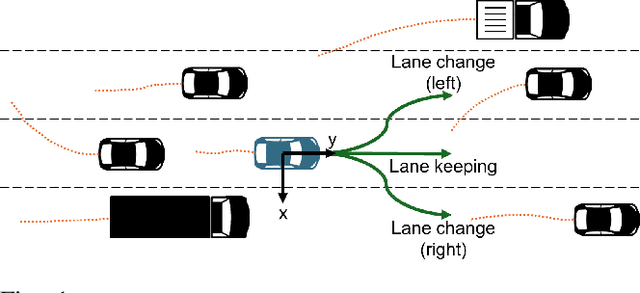
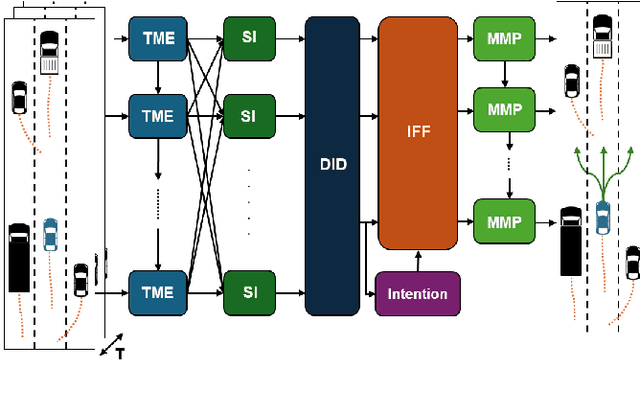
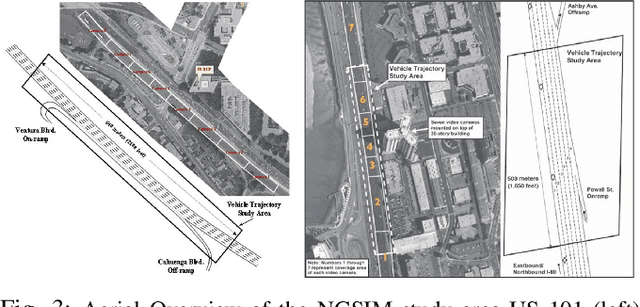
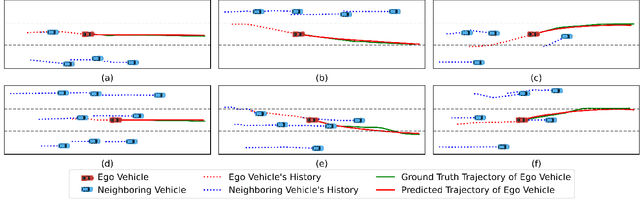
Accurate vehicle trajectory prediction is critical for safe and efficient autonomous driving, especially in mixed traffic environments with both human-driven and autonomous vehicles. However, uncertainties introduced by inherent driving behaviors -- such as acceleration, deceleration, and left and right maneuvers -- pose significant challenges for reliable trajectory prediction. We introduce a Maneuver-Intention-Aware Transformer (MIAT) architecture, which integrates a maneuver intention awareness mechanism with spatiotemporal interaction modeling to enhance long-horizon trajectory predictions. We systematically investigate the impact of varying awareness of maneuver intention on both short- and long-horizon trajectory predictions. Evaluated on the real-world NGSIM dataset and benchmarked against various transformer- and LSTM-based methods, our approach achieves an improvement of up to 4.7% in short-horizon predictions and a 1.6% in long-horizon predictions compared to other intention-aware benchmark methods. Moreover, by leveraging an intention awareness control mechanism, MIAT realizes an 11.1% performance boost in long-horizon predictions, with a modest drop in short-horizon performance.
Large-Scale Mixed-Traffic and Intersection Control using Multi-agent Reinforcement Learning
Apr 07, 2025Traffic congestion remains a significant challenge in modern urban networks. Autonomous driving technologies have emerged as a potential solution. Among traffic control methods, reinforcement learning has shown superior performance over traffic signals in various scenarios. However, prior research has largely focused on small-scale networks or isolated intersections, leaving large-scale mixed traffic control largely unexplored. This study presents the first attempt to use decentralized multi-agent reinforcement learning for large-scale mixed traffic control in which some intersections are managed by traffic signals and others by robot vehicles. Evaluating a real-world network in Colorado Springs, CO, USA with 14 intersections, we measure traffic efficiency via average waiting time of vehicles at intersections and the number of vehicles reaching their destinations within a time window (i.e., throughput). At 80% RV penetration rate, our method reduces waiting time from 6.17 s to 5.09 s and increases throughput from 454 vehicles per 500 seconds to 493 vehicles per 500 seconds, outperforming the baseline of fully signalized intersections. These findings suggest that integrating reinforcement learning-based control large-scale traffic can improve overall efficiency and may inform future urban planning strategies.
Mutual Adaptation in Human-Robot Co-Transportation with Human Preference Uncertainty
Mar 11, 2025Mutual adaptation can significantly enhance overall task performance in human-robot co-transportation by integrating both the robot's and human's understanding of the environment. While human modeling helps capture humans' subjective preferences, two challenges persist: (i) the uncertainty of human preference parameters and (ii) the need to balance adaptation strategies that benefit both humans and robots. In this paper, we propose a unified framework to address these challenges and improve task performance through mutual adaptation. First, instead of relying on fixed parameters, we model a probability distribution of human choices by incorporating a range of uncertain human parameters. Next, we introduce a time-varying stubbornness measure and a coordination mode transition model, which allows either the robot to lead the team's trajectory or, if a human's preferred path conflicts with the robot's plan and their stubbornness exceeds a threshold, the robot to transition to following the human. Finally, we introduce a pose optimization strategy to mitigate the uncertain human behaviors when they are leading. To validate the framework, we design and perform experiments with real human feedback. We then demonstrate, through simulations, the effectiveness of our models in enhancing task performance with mutual adaptation and pose optimization.
Analyzing Fundamental Diagrams of Mixed Traffic Control at Unsignalized Intersections
Dec 20, 2024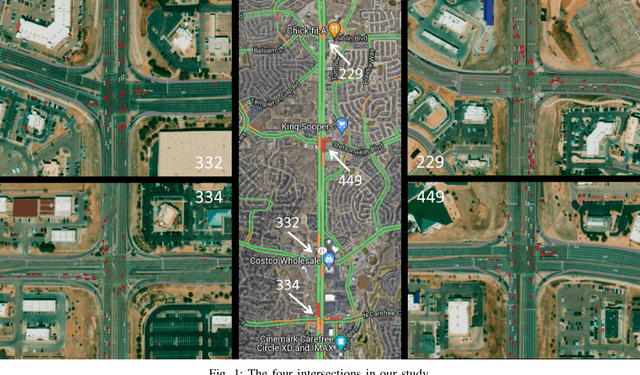
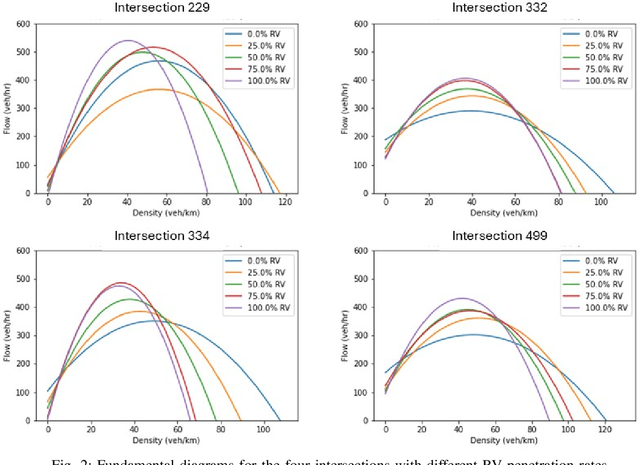
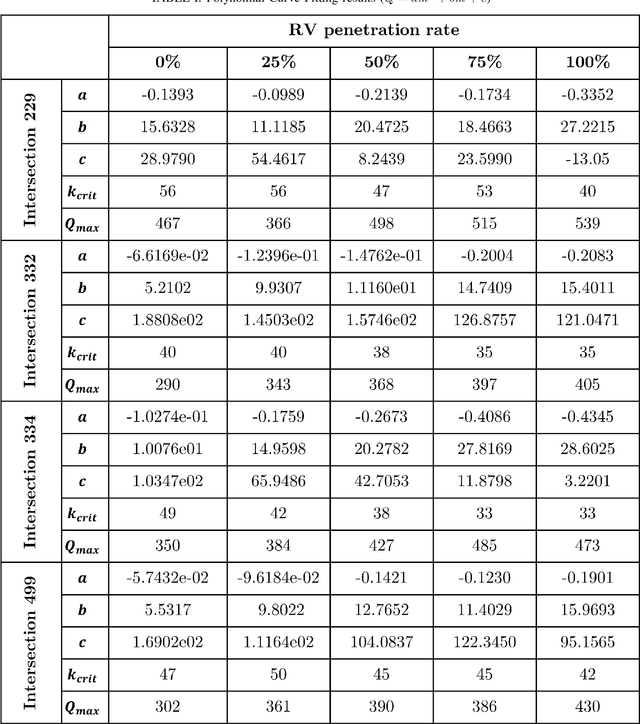
This report examines the effect of mixed traffic, specifically the variation in robot vehicle (RV) penetration rates, on the fundamental diagrams at unsignalized intersections. Through a series of simulations across four distinct intersections, the relationship between traffic flow characteristics were analyzed. The RV penetration rates were varied from 0% to 100% in increments of 25%. The study reveals that while the presence of RVs influences traffic dynamics, the impact on flow and speed is not uniform across different levels of RV penetration. The fundamental diagrams indicate that intersections may experience an increase in capacity with varying levels of RVs, but this trend does not consistently hold as RV penetration approaches 100%. The variability observed across intersections suggests that local factors possibly influence the traffic flow characteristics. These findings highlight the complexity of integrating RVs into the existing traffic system and underscore the need for intersection-specific traffic management strategies to accommodate the transition towards increased RV presence.