 Add to Chrome
 Add to Firefox
 Add to Edge
Geometry-Aligned LLM Fine-Tuning for Sequential Narrow-Opening Planning
Mar 17, 2026
We study rigid-body motion planning through multiple sequential narrow openings, which requires long-horizon geometric reasoning because the configuration used to traverse an early opening constrains the set of reachable configurations for subsequent ones. To achieve this, we propose a geometry-aligned large language model (LLM) fine-tuning framework that generates fixed-length, machine-readable waypoint sequences that are both geometrically feasible and coordinated across openings. Our approach uses a bi-level training pipeline. First, we perform failure-driven LoRA supervised fine-tuning (SFT) on human demonstrations, which incorporates structured failure feedback to teach the model common failure modes and enforce the output format. Second, we refine the same LoRA adapters using Group Relative Policy Optimization (GRPO) with geometric verification: each sampled waypoint sequence is densified by a model-based planner and scored with a deterministic geometry-derived reward to achieve continuous-motion feasibility. To validate the effectiveness of our proposed method, we provide both quantitative and qualitative results from simulations. Our method achieves the highest success rate in both in-distribution and out-of-distribution environments and qualitatively exhibits long-horizon geometric reasoning by selecting exit poses that facilitate entry into subsequent openings.

Mutual Adaptation in Human-Robot Co-Transportation with Human Preference Uncertainty
Mar 11, 2025Mutual adaptation can significantly enhance overall task performance in human-robot co-transportation by integrating both the robot's and human's understanding of the environment. While human modeling helps capture humans' subjective preferences, two challenges persist: (i) the uncertainty of human preference parameters and (ii) the need to balance adaptation strategies that benefit both humans and robots. In this paper, we propose a unified framework to address these challenges and improve task performance through mutual adaptation. First, instead of relying on fixed parameters, we model a probability distribution of human choices by incorporating a range of uncertain human parameters. Next, we introduce a time-varying stubbornness measure and a coordination mode transition model, which allows either the robot to lead the team's trajectory or, if a human's preferred path conflicts with the robot's plan and their stubbornness exceeds a threshold, the robot to transition to following the human. Finally, we introduce a pose optimization strategy to mitigate the uncertain human behaviors when they are leading. To validate the framework, we design and perform experiments with real human feedback. We then demonstrate, through simulations, the effectiveness of our models in enhancing task performance with mutual adaptation and pose optimization.
Human-Robot Co-Transportation with Human Uncertainty-Aware MPC and Pose Optimization
Mar 31, 2024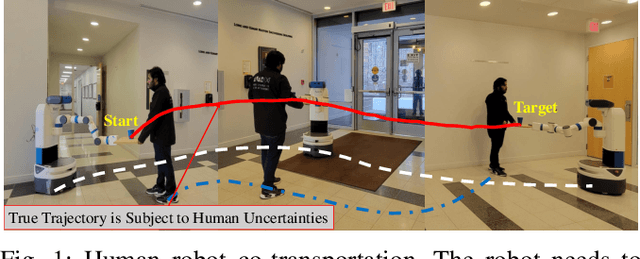
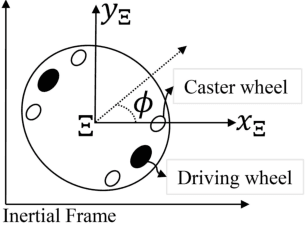
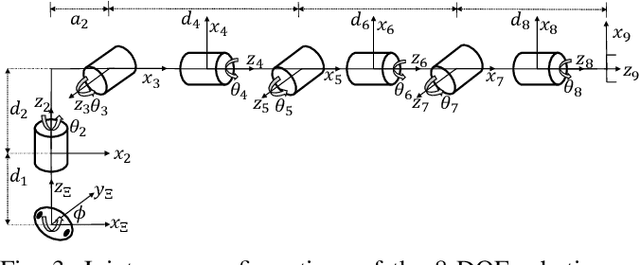
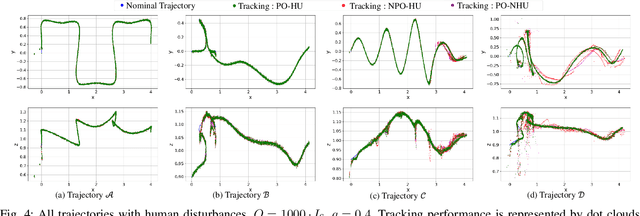
This paper proposes a new control algorithm for human-robot co-transportation based on a robot manipulator equipped with a mobile base and a robotic arm. The primary focus is to adapt to human uncertainties through the robot's whole-body dynamics and pose optimization. We introduce an augmented Model Predictive Control (MPC) formulation that explicitly models human uncertainties and contains extra variables than regular MPC to optimize the pose of the robotic arm. The core of our methodology involves a two-step iterative design: At each planning horizon, we select the best pose of the robotic arm (joint angle combination) from a candidate set, aiming to achieve the lowest estimated control cost. This selection is based on solving an uncertainty-aware Discrete Algebraic Ricatti Equation (DARE), which also informs the optimal control inputs for both the mobile base and the robotic arm. To validate the effectiveness of the proposed approach, we provide theoretical derivation for the uncertainty-aware DARE and perform simulated and proof-of-concept hardware experiments using a Fetch robot under varying conditions, including different nominal trajectories and noise levels. The results reveal that our proposed approach outperforms baseline algorithms, maintaining similar execution time with that do not consider human uncertainty or do not perform pose optimization.