 Add to Chrome
 Add to Firefox
 Add to Edge
HDRAgent: An Agentic Framework for Multi-Exposure HDR Imaging
Jun 08, 2026
Most existing multi-exposure HDR methods follow a fixed feed-forward reconstruction paradigm, making them prone to ghosting artifacts in complex dynamic scenes. To address this issue, we propose HDRAgent, the first agent-driven framework for HDR imaging, which adaptively selects reconstruction strategies according to the current scene conditions. Specifically, to provide scene-specific prior knowledge, we introduce a fine-grained contextual knowledge matching (FCM) module. This module leverages multimodal large language model (MLLM)-derived scene perception to retrieve relevant historical cases and tool knowledge, organizing them into structured evidence for MLLM-based adaptive tool scheduling. In addition, we propose a perception--distortion feedback mechanism that transforms post-execution quality assessment and artifact diagnosis into structured feedback, which is accumulated in historical memory to help subsequent contextual knowledge refinement and strategy selection. Furthermore, considering that extreme motion can invalidate alignment methods, we design an agent-guided generative alignment strategy that uses MLLM-based dynamic-region parsing to reconstruct unreliable contents in non-reference frames under reference-frame guidance. Experiments demonstrate that HDRAgent effectively reduces ghosting and local artifacts while achieving competitive or superior objective performance and visual quality.

GMODiff: One-Step Gain Map Refinement with Diffusion Priors for HDR Reconstruction
Dec 18, 2025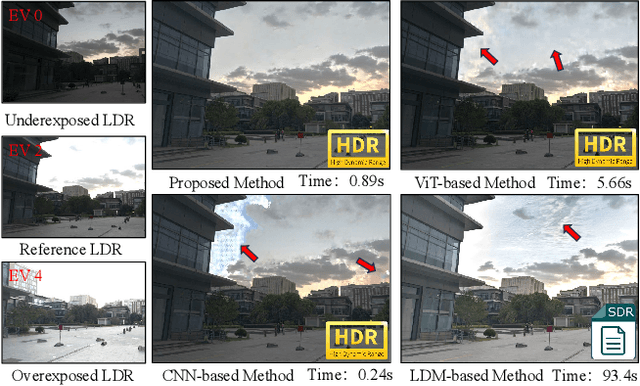
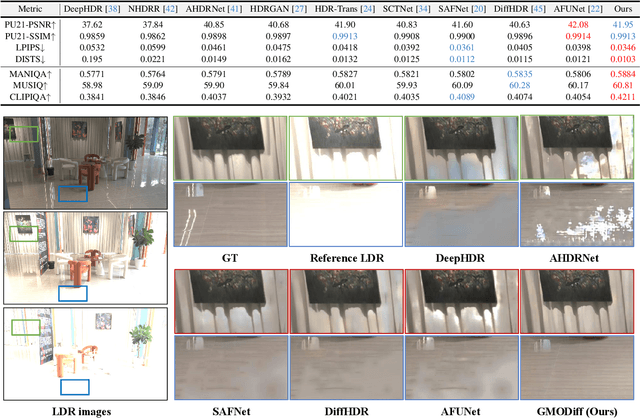
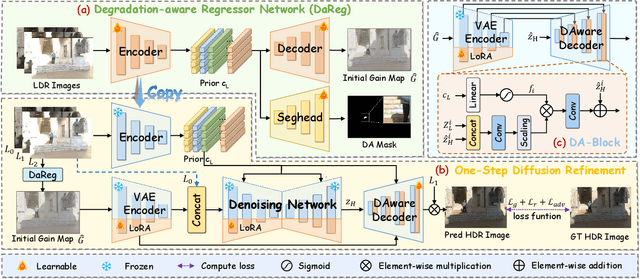
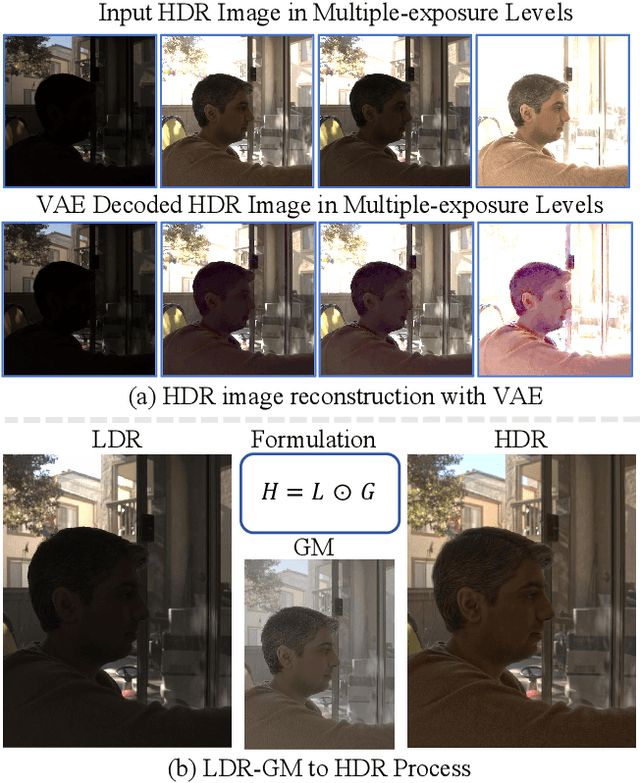
Pre-trained Latent Diffusion Models (LDMs) have recently shown strong perceptual priors for low-level vision tasks, making them a promising direction for multi-exposure High Dynamic Range (HDR) reconstruction. However, directly applying LDMs to HDR remains challenging due to: (1) limited dynamic-range representation caused by 8-bit latent compression, (2) high inference cost from multi-step denoising, and (3) content hallucination inherent to generative nature. To address these challenges, we introduce GMODiff, a gain map-driven one-step diffusion framework for multi-exposure HDR reconstruction. Instead of reconstructing full HDR content, we reformulate HDR reconstruction as a conditionally guided Gain Map (GM) estimation task, where the GM encodes the extended dynamic range while retaining the same bit depth as LDR images. We initialize the denoising process from an informative regression-based estimate rather than pure noise, enabling the model to generate high-quality GMs in a single denoising step. Furthermore, recognizing that regression-based models excel in content fidelity while LDMs favor perceptual quality, we leverage regression priors to guide both the denoising process and latent decoding of the LDM, suppressing hallucinations while preserving structural accuracy. Extensive experiments demonstrate that our GMODiff performs favorably against several state-of-the-art methods and is 100 faster than previous LDM-based methods.
NTIRE 2025 Challenge on Efficient Burst HDR and Restoration: Datasets, Methods, and Results
May 17, 2025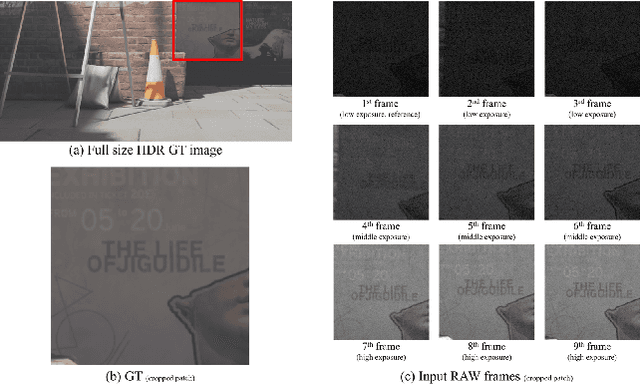
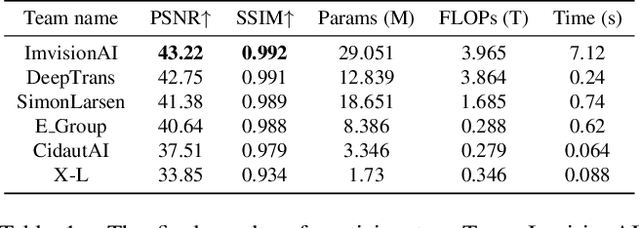
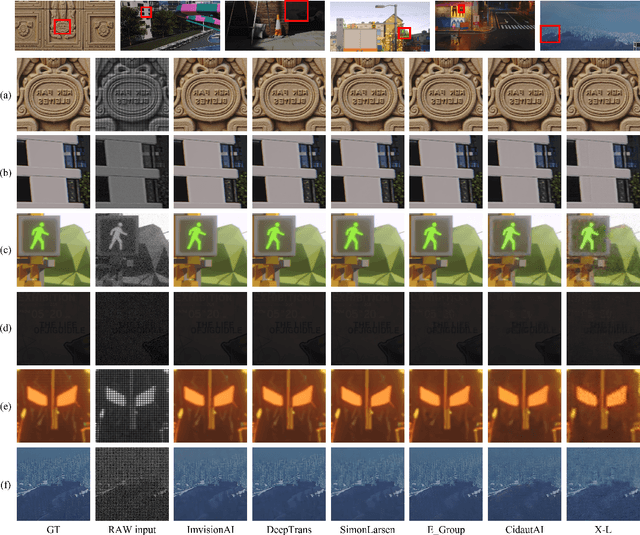
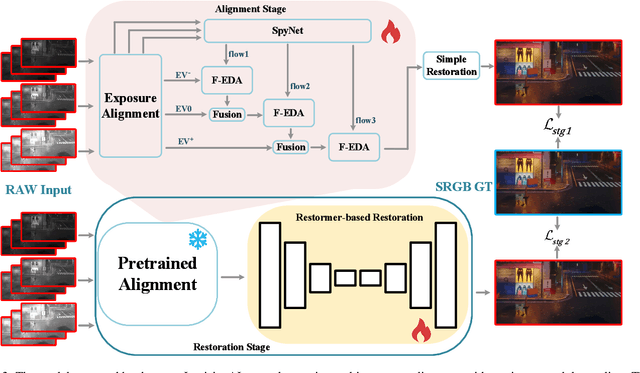
This paper reviews the NTIRE 2025 Efficient Burst HDR and Restoration Challenge, which aims to advance efficient multi-frame high dynamic range (HDR) and restoration techniques. The challenge is based on a novel RAW multi-frame fusion dataset, comprising nine noisy and misaligned RAW frames with various exposure levels per scene. Participants were tasked with developing solutions capable of effectively fusing these frames while adhering to strict efficiency constraints: fewer than 30 million model parameters and a computational budget under 4.0 trillion FLOPs. A total of 217 participants registered, with six teams finally submitting valid solutions. The top-performing approach achieved a PSNR of 43.22 dB, showcasing the potential of novel methods in this domain. This paper provides a comprehensive overview of the challenge, compares the proposed solutions, and serves as a valuable reference for researchers and practitioners in efficient burst HDR and restoration.