 Add to Chrome
 Add to Firefox
 Add to Edge
DVANet: Degradation-aware Visual-prior Alignment Network for Image Restoration
Jun 17, 2026
All-in-One image restoration aims to develop a unified restoration framework for handling diverse degradation types. Existing end-to-end methods usually regard the restoration process as a black-box mapping, lacking an explicit optimization interpretation. Although deep unfolding provides an interpretable iterative modeling paradigm for image restoration, existing methods mostly rely on fixed degradation assumptions or predefined degradation information, making them difficult to adapt to unified restoration requirements under complex degradations and locally damaged content. This limitation restricts their performance in degradation suppression and structural detail recovery. To address these issues, this paper proposes DVANet, a deep unfolding network inspired by the half-quadratic splitting optimization algorithm, which formulates unified image restoration under complex degradations as a collaborative unfolding process between degradation-aware observation consistency and visual-prior-guided reconstruction. Specifically, in the degradation-aware observation consistency branch, a degradation representation module is employed to extract global degradation attributes and local degradation cues, and degradation-conditioned mapping is used to enhance the model's adaptability to different degradation types. In the visual-prior-guided reconstruction branch, DINOv3 is introduced to provide structural and semantic information as hierarchical visual priors, thereby complementing the missing structural information in damaged regions and improving detail recovery. Extensive experiments demonstrate that DVANet achieves superior or competitive performance on multi-scenario degradation and cross-domain image restoration tasks, showing favorable degradation adaptability and generalization ability.

TPGDiff: Hierarchical Triple-Prior Guided Diffusion for Image Restoration
Jan 28, 2026All-in-one image restoration aims to address diverse degradation types using a single unified model. Existing methods typically rely on degradation priors to guide restoration, yet often struggle to reconstruct content in severely degraded regions. Although recent works leverage semantic information to facilitate content generation, integrating it into the shallow layers of diffusion models often disrupts spatial structures (\emph{e.g.}, blurring artifacts). To address this issue, we propose a Triple-Prior Guided Diffusion (TPGDiff) network for unified image restoration. TPGDiff incorporates degradation priors throughout the diffusion trajectory, while introducing structural priors into shallow layers and semantic priors into deep layers, enabling hierarchical and complementary prior guidance for image reconstruction. Specifically, we leverage multi-source structural cues as structural priors to capture fine-grained details and guide shallow layers representations. To complement this design, we further develop a distillation-driven semantic extractor that yields robust semantic priors, ensuring reliable high-level guidance at deep layers even under severe degradations. Furthermore, a degradation extractor is employed to learn degradation-aware priors, enabling stage-adaptive control of the diffusion process across all timesteps. Extensive experiments on both single- and multi-degradation benchmarks demonstrate that TPGDiff achieves superior performance and generalization across diverse restoration scenarios. Our project page is: https://leoyjtu.github.io/tpgdiff-project.
GMODiff: One-Step Gain Map Refinement with Diffusion Priors for HDR Reconstruction
Dec 18, 2025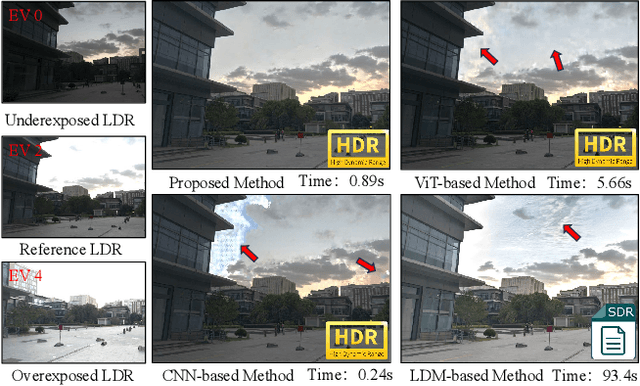
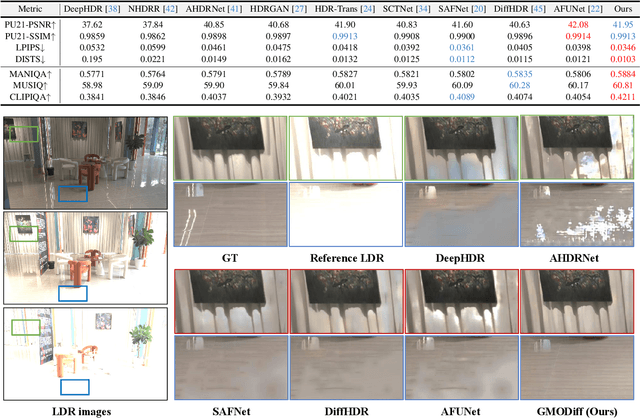
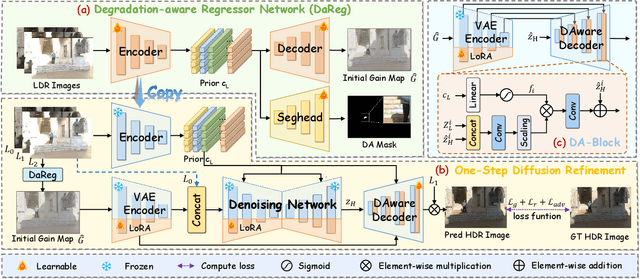
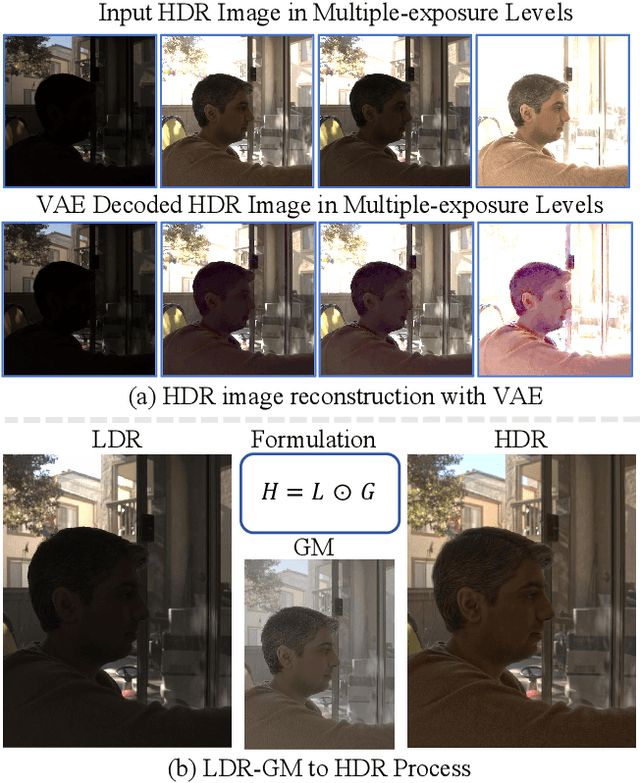
Pre-trained Latent Diffusion Models (LDMs) have recently shown strong perceptual priors for low-level vision tasks, making them a promising direction for multi-exposure High Dynamic Range (HDR) reconstruction. However, directly applying LDMs to HDR remains challenging due to: (1) limited dynamic-range representation caused by 8-bit latent compression, (2) high inference cost from multi-step denoising, and (3) content hallucination inherent to generative nature. To address these challenges, we introduce GMODiff, a gain map-driven one-step diffusion framework for multi-exposure HDR reconstruction. Instead of reconstructing full HDR content, we reformulate HDR reconstruction as a conditionally guided Gain Map (GM) estimation task, where the GM encodes the extended dynamic range while retaining the same bit depth as LDR images. We initialize the denoising process from an informative regression-based estimate rather than pure noise, enabling the model to generate high-quality GMs in a single denoising step. Furthermore, recognizing that regression-based models excel in content fidelity while LDMs favor perceptual quality, we leverage regression priors to guide both the denoising process and latent decoding of the LDM, suppressing hallucinations while preserving structural accuracy. Extensive experiments demonstrate that our GMODiff performs favorably against several state-of-the-art methods and is 100 faster than previous LDM-based methods.