 Add to Chrome
 Add to Firefox
 Add to Edge
ReCal3R: Reliability-Calibrated Learning Rates for Streaming 3D Reconstruction
Jul 06, 2026
Streaming 3D reconstruction relies on a compact recurrent scene state to process long image streams in linear time and bounded memory. However, repeated updates can gradually corrupt this state, causing reliable historical information to be overwritten by noisy or ambiguous observations. We introduce ReCal3R, a reliability-calibrated learning rate method for recurrent 3D reconstruction. Instead of directly applying a candidate learning rate, our method estimates state token reliability from the maintained scene state and uses it to calibrate a candidate learning rate derived from token alignment, state reconstruction residual, and recent update pressure. The resulting token-wise learning rate interpolates between a conservative base rate and the candidate rate, suppressing aggressive updates on unreliable tokens while preserving adaptation to informative frames. Applied to CUT3R as a training-free calibration rule, ReCal3R reaches strong performance on long sequences in pose, depth, and reconstruction quality, including a 3.7$\times$ reduction in ATE, with comparable runtime and memory. Code is available at: https://github.com/Powertony102/ReCal3R.

PEAM: Parametric Embodied Agent Memory through Contrastive Internalization of Experience in Minecraft
May 26, 2026We present PEAM, a Parametric Embodied Agent Memory framework in Minecraft that transforms agent memory from inference-time retrieval into parameter-resident skills internalized through experience. PEAM pairs a slow deliberative LLM for open-ended reasoning with a fast parametric module for reflexive execution of consolidated skills. The fast module is a multimodal Mixture-of-Experts LoRA architecture with per-category physically isolated adapters, enabling parameter-level continual learning without catastrophic forgetting. We treat failure as a first-class training signal: failure--correction trajectory pairs are internalized through a joint behavioral-cloning and contrastive objective, so the agent learns not only what succeeds but also how corrected actions differ from failed ones. To govern consolidation, PEAM introduces a parameterization-worthiness score for deciding which experience should be internalized, and a scale-free self-triggered consolidation mechanism for deciding when to internalize without task-specific hand-tuned thresholds, making the agent self-evolving as the trigger transfers across task distributions without re-tuning. Experiments in Minecraft show that PEAM improves long-horizon task performance, mitigates forgetting on previously consolidated skills, and improves parametric-versus-retrieval efficiency over retrieval-based embodied agents and parametric memory variants.
Can Segmentation Models Understand the World? Towards Proactive Affordance Reasoning via Visual Chain-of-Thought
May 26, 2026Recent segmentation models couple large language models (LLMs) with mask decoders to ground complex language expressions into masks, yet their instructions remain target-referential: they describe, constrain, or imply the region to be segmented. However, in real-world embodied interaction, human instructions are often at the intent-level, which includes the desired outcome without naming the region that enables it. To bridge this gap, we introduce SegWorld, where the model reasons about the scene through a multi-level visual chain-of-thought (CoT) before committing to a mask. Before receiving any instructions, it proactively observes the scene, describing visible objects and inferring plausible events they may support. Given an instruction, it continues the chain: from the object relevant to the intent, through the action that satisfies it, to the physical interaction site, the object part that affords the action. We formalize SegWorld as probabilistic inference, in which proactive observation supplies a linguistic scene context that improves mask prediction when instructions are given at the level of intent. We construct an intent-to-part benchmark for evaluating affordance-bearing part segmentation from high-level goals. Experiments show SegWorld matches instruction-driven baselines on target-referential instructions and improves substantially on intent-level ones.
Adding Thermal Awareness to Visual Systems in Real-Time via Distilled Diffusion Models
May 07, 2026Purely RGB-based vision models often fail to provide reliable cues in challenging scenarios such as nighttime and fog, leading to degraded performance and safety risks. Infrared imaging captures heat-emitting sources and provides critical complementary information, but existing high-fidelity fusion methods suffer from prohibitive latency, rendering them impractical for real-time edge deployment. To address this, we propose FusionProxy, a real-time image fusion module designed as a fully independent, plug-and-play component with diffusion level quality. FusionProxy exploits two complementary statistics of a teacher sample ensemble: per-pixel variance in raw image space, used to weight pixel-level supervision, and per-pixel variance inside frozen foundation backbones, used to route feature-level alignment spatially. Once trained, FusionProxy can be directly integrated into any visual perception system without joint optimization. Extensive experiments demonstrate that our method achieves superior performance on static recognition tasks and significantly enhances robustness in dynamic tasks, including closed-loop autonomous driving. Crucially, FusionProxy achieves real-time inference speeds on diverse platforms, from high-end GPUs to commodity hardware, providing a flexible and generalizable solution for all-day perception.
QuadBox: Accelerating 3D Gaussian Splatting with Geometry-Aware Boxes
May 06, 20263D Gaussian Splatting (3DGS) has emerged as an advanced technique for real-time novel view synthesis by representing scene geometry and appearance using differentiable Gaussian primitives. However, efficiently computing precise Gaussian-tile intersections remains a critical task in the rasterization pipeline. To this end, we propose QuadBox, a method that leverages four axis-aligned bounding boxes to tightly encapsulate projected Gaussians in a discrete manner. First, we derive a geometry-aware stretching factor that enables the construction of a tile-aligned QuadBox, which covers the elliptical projection and largely excludes irrelevant tiles. Second, we introduce QPass, a single-pass tile traversal algorithm that exhaustively exploits the discrete nature of QuadBox, ensuring that the tile intersection check is performed with simple interval tests. Experiments on public datasets show that our method accelerates the rendering speed of 3DGS by 1.85$\times$. Code is available at \href{https://github.com/Powertony102/QuadBox}{https://github.com/Powertony102/QuadBox}.
LumiVideo: An Intelligent Agentic System for Video Color Grading
Apr 02, 2026Video color grading is a critical post-production process that transforms flat, log-encoded raw footage into emotionally resonant cinematic visuals. Existing automated methods act as static, black-box executors that directly output edited pixels, lacking both interpretability and the iterative control required by professionals. We introduce LumiVideo, an agentic system that mimics the cognitive workflow of professional colorists through four stages: Perception, Reasoning, Execution, and Reflection. Given only raw log video, LumiVideo autonomously produces a cinematic base grade by analyzing the scene's physical lighting and semantic content. Its Reasoning engine synergizes an LLM's internalized cinematic knowledge with a Retrieval-Augmented Generation (RAG) framework via a Tree of Thoughts (ToT) search to navigate the non-linear color parameter space. Rather than generating pixels, the system compiles the deduced parameters into industry-standard ASC-CDL configurations and a globally consistent 3D LUT, analytically guaranteeing temporal consistency. An optional Reflection loop then allows creators to refine the result via natural language feedback. We further introduce LumiGrade, the first log-encoded video benchmark for evaluating automated grading. Experiments show that LumiVideo approaches human expert quality in fully automatic mode while enabling precise iterative control when directed.
S-VGGT: Structure-Aware Subscene Decomposition for Scalable 3D Foundation Models
Mar 18, 2026Feed-forward 3D foundation models face a key challenge: the quadratic computational cost introduced by global attention, which severely limits scalability as input length increases. Concurrent acceleration methods, such as token merging, operate at the token level. While they offer local savings, the required nearest-neighbor searches introduce undesirable overhead. Consequently, these techniques fail to tackle the fundamental issue of structural redundancy dominant in dense capture data. In this work, we introduce \textbf{S-VGGT}, a novel approach that addresses redundancy at the structural frame level, drastically shifting the optimization focus. We first leverage the initial features to build a dense scene graph, which characterizes structural scene redundancy and guides the subsequent scene partitioning. Using this graph, we softly assign frames to a small number of subscenes, guaranteeing balanced groups and smooth geometric transitions. The core innovation lies in designing the subscenes to share a common reference frame, establishing a parallel geometric bridge that enables independent and highly efficient processing without explicit geometric alignment. This structural reorganization provides strong intrinsic acceleration by cutting the global attention cost at its source. Crucially, S-VGGT is entirely orthogonal to token-level acceleration methods, allowing the two to be seamlessly combined for compounded speedups without compromising reconstruction fidelity. Code is available at https://github.com/Powertony102/S-VGGT.
Break the Tie: Learning Cluster-Customized Category Relationships for Categorical Data Clustering
Nov 12, 2025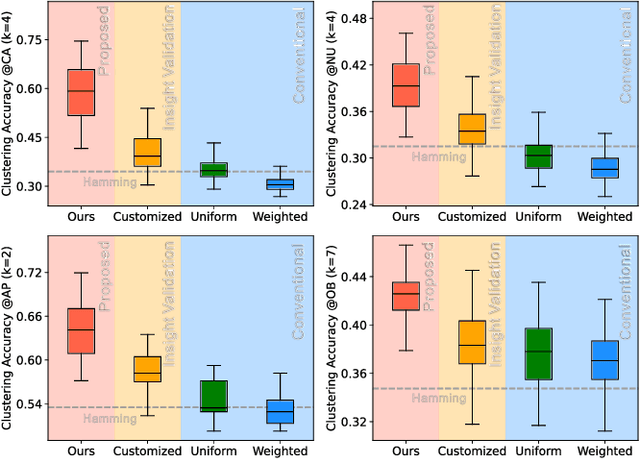
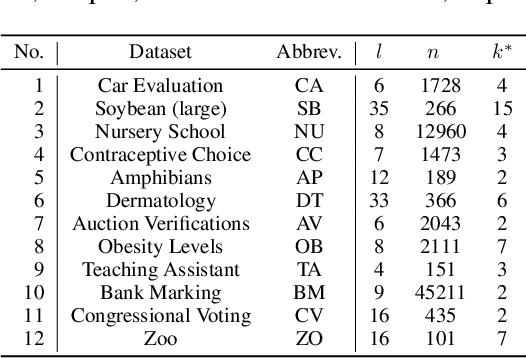
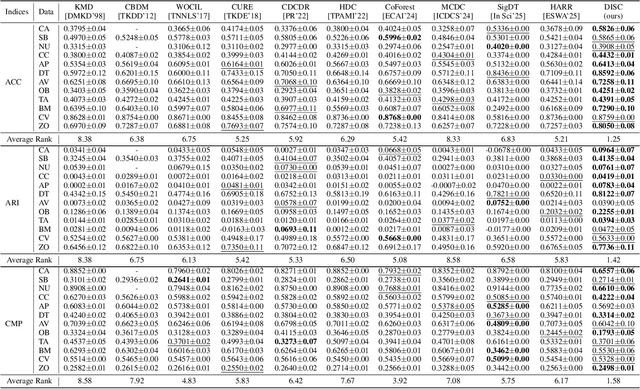
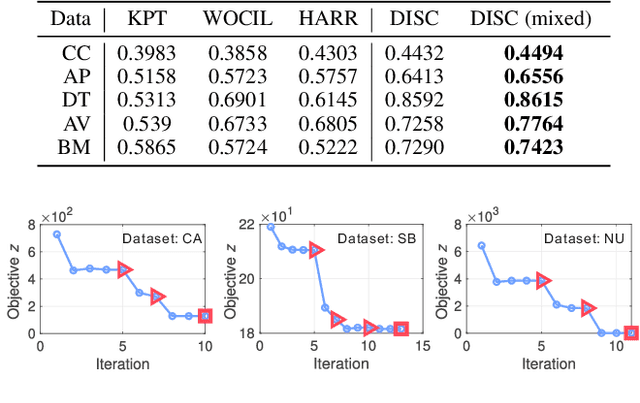
Categorical attributes with qualitative values are ubiquitous in cluster analysis of real datasets. Unlike the Euclidean distance of numerical attributes, the categorical attributes lack well-defined relationships of their possible values (also called categories interchangeably), which hampers the exploration of compact categorical data clusters. Although most attempts are made for developing appropriate distance metrics, they typically assume a fixed topological relationship between categories when learning distance metrics, which limits their adaptability to varying cluster structures and often leads to suboptimal clustering performance. This paper, therefore, breaks the intrinsic relationship tie of attribute categories and learns customized distance metrics suitable for flexibly and accurately revealing various cluster distributions. As a result, the fitting ability of the clustering algorithm is significantly enhanced, benefiting from the learnable category relationships. Moreover, the learned category relationships are proved to be Euclidean distance metric-compatible, enabling a seamless extension to mixed datasets that include both numerical and categorical attributes. Comparative experiments on 12 real benchmark datasets with significance tests show the superior clustering accuracy of the proposed method with an average ranking of 1.25, which is significantly higher than the 5.21 ranking of the current best-performing method.
DDO-IN: Dual Domains Optimization for Implicit Neural Network to Eliminate Motion Artifact in Magnetic Resonance Imaging
Mar 11, 2025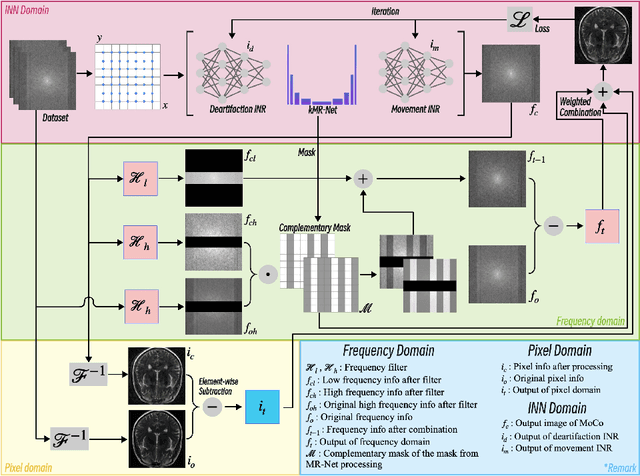
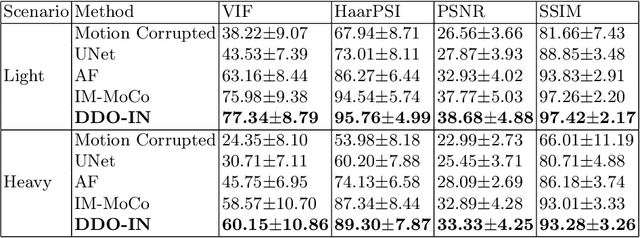
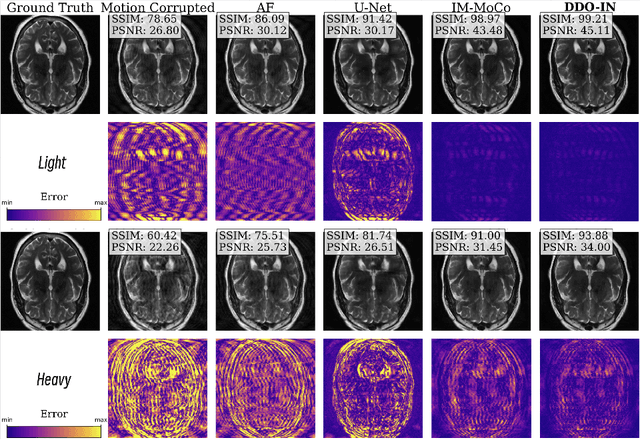
Magnetic resonance imaging (MRI) motion artifacts can seriously affect clinical diagnostics, making it challenging to interpret images accurately. Existing methods for eliminating motion artifacts struggle to retain fine structural details and simultaneously lack the necessary vividness and sharpness. In this study, we present a novel dual-domain optimization (DDO) approach that integrates information from the pixel and frequency domains guiding the recovery of clean magnetic resonance images through implicit neural representations(INRs). Specifically, our approach leverages the low-frequency components in the k-space as a reference to capture accurate tissue textures, while high-frequency and pixel information contribute to recover details. Furthermore, we design complementary masks and dynamic loss weighting transitioning from global to local attention that effectively suppress artifacts while retaining useful details for reconstruction. Experimental results on the NYU fastMRI dataset demonstrate that our method outperforms existing approaches in multiple evaluation metrics. Our code is available at https://anonymous.4open.science/r/DDO-IN-A73B.
Leveraging CORAL-Correlation Consistency Network for Semi-Supervised Left Atrium MRI Segmentation
Oct 21, 2024
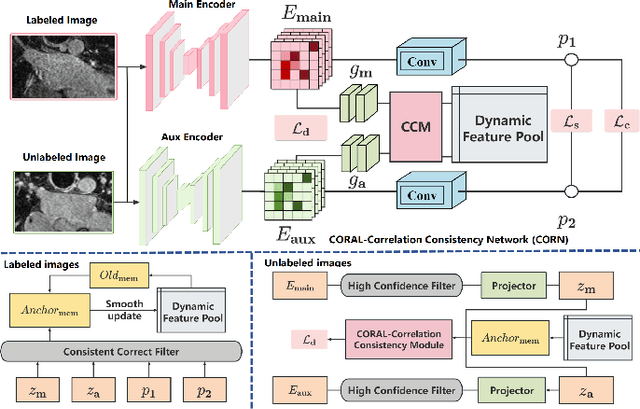
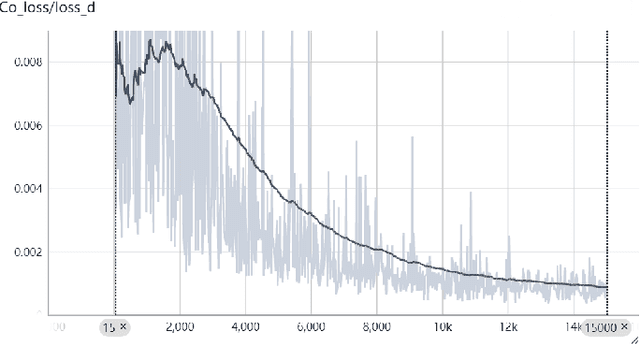
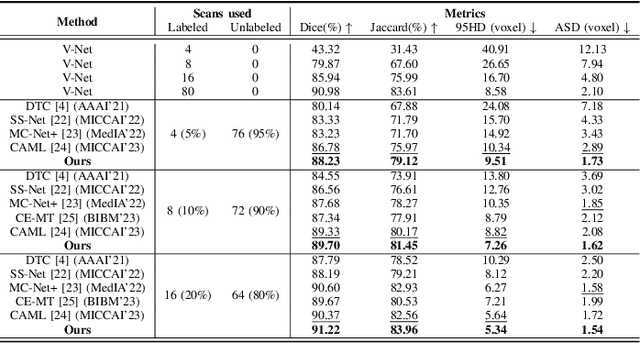
Semi-supervised learning (SSL) has been widely used to learn from both a few labeled images and many unlabeled images to overcome the scarcity of labeled samples in medical image segmentation. Most current SSL-based segmentation methods use pixel values directly to identify similar features in labeled and unlabeled data. They usually fail to accurately capture the intricate attachment structures in the left atrium, such as the areas of inconsistent density or exhibit outward curvatures, adding to the complexity of the task. In this paper, we delve into this issue and introduce an effective solution, CORAL(Correlation-Aligned)-Correlation Consistency Network (CORN), to capture the global structure shape and local details of Left Atrium. Diverging from previous methods focused on each local pixel value, the CORAL-Correlation Consistency Module (CCM) in the CORN leverages second-order statistical information to capture global structural features by minimizing the distribution discrepancy between labeled and unlabeled samples in feature space. Yet, direct construction of features from unlabeled data frequently results in ``Sample Selection Bias'', leading to flawed supervision. We thus further propose the Dynamic Feature Pool (DFP) for the CCM, which utilizes a confidence-based filtering strategy to remove incorrectly selected features and regularize both teacher and student models by constraining the similarity matrix to be consistent. Extensive experiments on the Left Atrium dataset have shown that the proposed CORN outperforms previous state-of-the-art semi-supervised learning methods.