 Add to Chrome
 Add to Firefox
 Add to Edge
FlashPDE: A Drop-in Fused Triton Operator Library for Neural PDE Solvers
Jul 20, 2026
Physics-Informed Neural Networks (PINNs) solve PDEs by incorporating physical constraints into neural-network training, but large-scale problems are limited by automatic-differentiation memory overhead and inefficient execution of grid-based PDE operators. We present FlashPDE, a drop-in fused operator library for grid-based scientific machine learning. FlashPDE replaces fragmented PyTorch finite-difference execution with differentiable Triton kernels. Each operator integrates fused stencil evaluation, an analytic discrete-adjoint backward pass, and boundary-gradient correction within a unified torch.autograd.Function interface. The library provides 14 differentiable PDE operators covering 17 configurations across 1D--3D elliptic, parabolic, and Navier--Stokes systems, while remaining independent of neural architectures and training strategies. Experiments on an NVIDIA A100 GPU show that FlashPDE reduces peak memory usage by up to 37.0x compared with coordinate-based automatic differentiation and reduces CUDA kernel launches by up to 3.5x compared with eager PyTorch finite-difference implementations. Across six representative PDE benchmarks, FlashPDE achieves up to 2.30x end-to-end time-to-solution speedup and up to 19.2x kernel-level acceleration while maintaining numerical agreement with PyTorch finite-difference references. FlashPDE provides a hardware-efficient execution layer that bridges differentiable PDE solvers and GPU-optimized numerical computation within the PyTorch ecosystem.

Vocabulary In-Context Learning in Transformers: Benefits of Positional Encoding
Nov 09, 2025Numerous studies have demonstrated that the Transformer architecture possesses the capability for in-context learning (ICL). In scenarios involving function approximation, context can serve as a control parameter for the model, endowing it with the universal approximation property (UAP). In practice, context is represented by tokens from a finite set, referred to as a vocabulary, which is the case considered in this paper, \emph{i.e.}, vocabulary in-context learning (VICL). We demonstrate that VICL in single-layer Transformers, without positional encoding, does not possess the UAP; however, it is possible to achieve the UAP when positional encoding is included. Several sufficient conditions for the positional encoding are provided. Our findings reveal the benefits of positional encoding from an approximation theory perspective in the context of ICL.
DAE-Fuse: An Adaptive Discriminative Autoencoder for Multi-Modality Image Fusion
Sep 16, 2024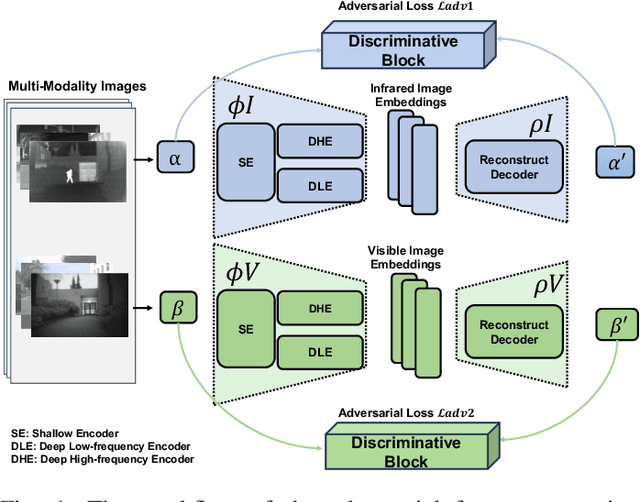
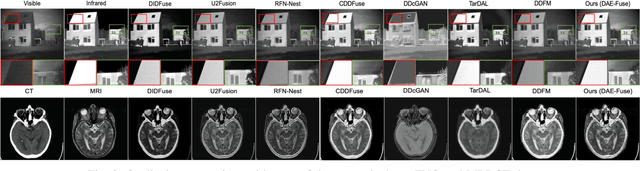
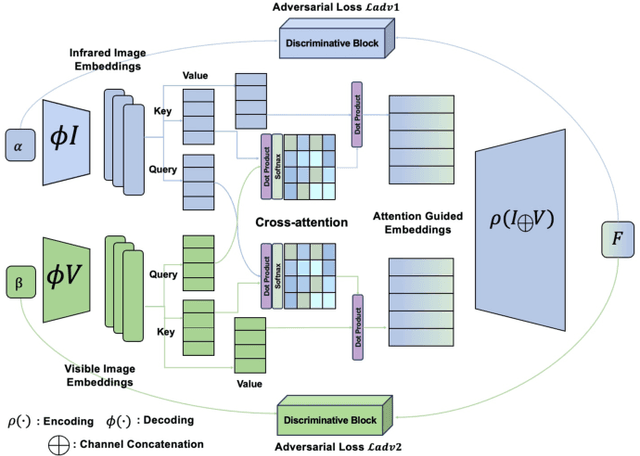
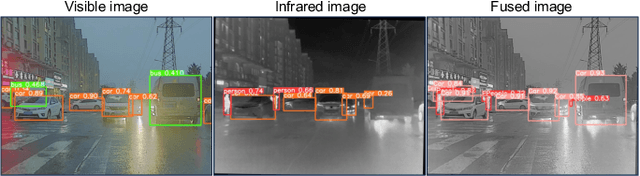
Multi-modality image fusion aims to integrate complementary data information from different imaging modalities into a single image. Existing methods often generate either blurry fused images that lose fine-grained semantic information or unnatural fused images that appear perceptually cropped from the inputs. In this work, we propose a novel two-phase discriminative autoencoder framework, termed DAE-Fuse, that generates sharp and natural fused images. In the adversarial feature extraction phase, we introduce two discriminative blocks into the encoder-decoder architecture, providing an additional adversarial loss to better guide feature extraction by reconstructing the source images. While the two discriminative blocks are adapted in the attention-guided cross-modality fusion phase to distinguish the structural differences between the fused output and the source inputs, injecting more naturalness into the results. Extensive experiments on public infrared-visible, medical image fusion, and downstream object detection datasets demonstrate our method's superiority and generalizability in both quantitative and qualitative evaluations.