 Add to Chrome
 Add to Firefox
 Add to Edge
Real-Time State Estimation in Smart Grids over 5G Networks: Experimental Validation Using Raspberry Pis and Typhoon HIL
Jun 26, 2026
Reliable, low-latency communication is critical for real-time monitoring and control in modern Smart Grids (SGs). The emergence of 5G networks, with enhanced reliability, significantly lower latency, and native support for massive machine-type communication, offers strong potential to enable advanced grid applications such as state estimation (SE) and fault detection. While existing studies investigate 5G for SG use cases, most rely on simulations or analytical models; experimental validation using real hardware and SG data remains limited. This paper fills this gap by presenting a fully experimental validation of real-time SE over a commercial 5G network using a 5G-based multi-node testbed built with Raspberry Pi (RPi)-based SG nodes and a Typhoon Hardware-in-the-Loop (HIL) real-time simulator. We first characterize 5G communication performance using simulated SG data under varying reporting rates and deployment environments by evaluating Key Performance Indicators (KPIs) such as end-to-end delay, jitter, and frame loss. Experimental results show that the worst-case mean delay observed for the 5G is approximately 6.5x lower than that of our previous LTE cat-M study at the corresponding reporting rate. We then stream real-time voltage, current, and phase-angle measurements-generated by an IEEE 4-node feeder model in Typhoon HIL simulator-to a remote Phasor Data Concentrator (PDC) for SE and fault detection. Results demonstrate that 5G-enabled measurements support accurate SE under both steady-state and dynamic load variations. Furthermore, fault-detection experiments confirm reliable and prompt fault detection, with detection delays as low as 0.80 s.

Threshold Optimization and Dynamic Adaptation of Distributed Optimal Power Flow in 5G Networks
Jun 25, 2026In this paper, we present an experimental evaluation study of the Alternating Direction Method of Multipliers (ADMM), which is a widely used technique in the distributed optimization of power distribution networks. The focus of this study is on how real 5G communication performance affects ADMM in a fully experimental platform that features commercial 5G connectivity and real-time control. The ADMM-based Distributed Optimal Power Flow (DOPF) problem is solved using the IEEE 123-bus unbalanced distribution feeder subdivided into five areas, each managed by a local controller implemented on a Raspberry Pi. To mitigate the impact of the communication network variability, we propose a delay threshold-based mechanism that yields a 7.75% reduction in convergence time compared to a no-threshold baseline. We also devised a policy to dynamically update the threshold value based on communication and computation conditions, achieving a 26.42% reduction in the convergence time compared with the static optimal threshold. These results demonstrate the potential of adaptive, communication-aware control strategies for real-world Smart Grid (SG) deployments.
Synergies Between Federated Learning and O-RAN: Towards an Elastic Virtualized Architecture for Multiple Distributed Machine Learning Services
Apr 14, 2023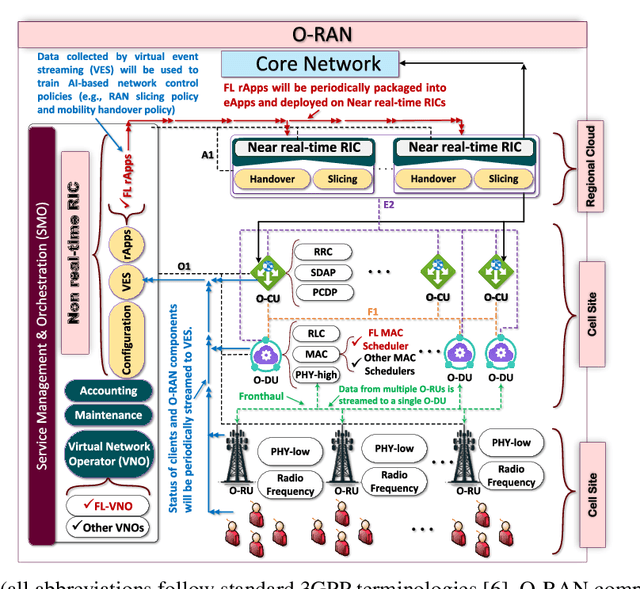
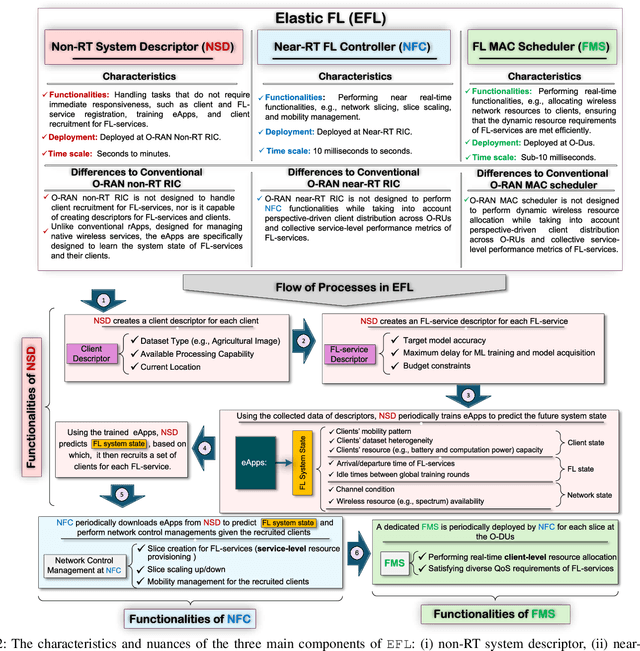
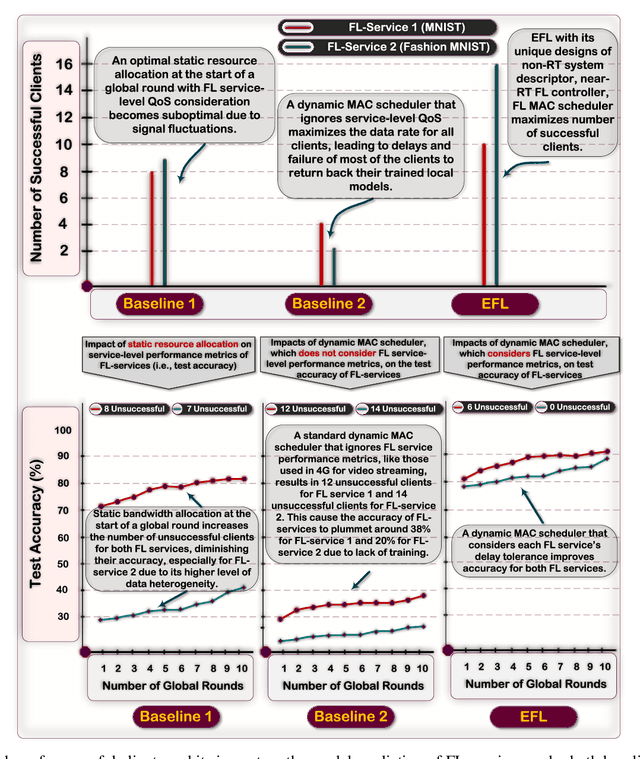
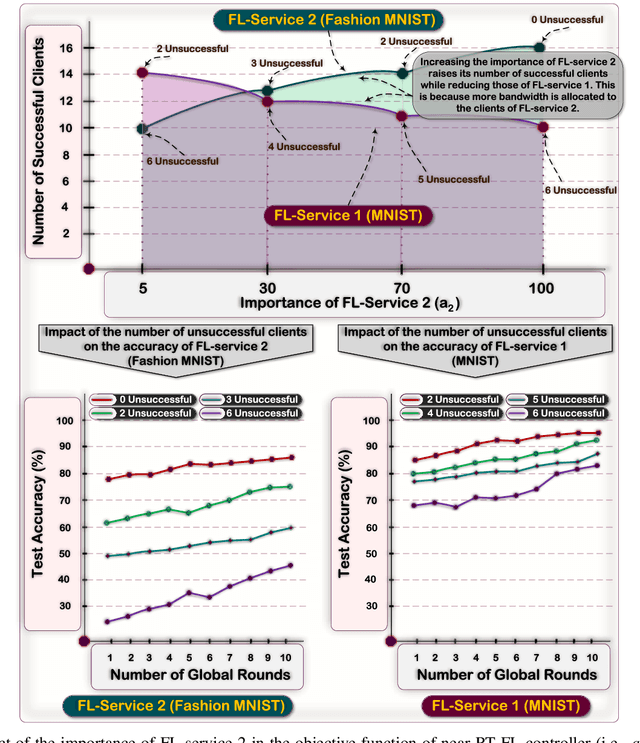
Federated learning (FL) is the most popular distributed machine learning technique. However, implementation of FL over modern wireless networks faces key challenges caused by (i) dynamics of the network conditions, (ii) coexistence of multiple FL services/tasks in the system, and (iii) concurrent execution of FL services with other network services, which are not jointly considered in prior works. Motivated by these challenges, we introduce a generic FL paradigm over next-generation (NextG) networks, called dynamic multi-service FL (DMS-FL). We identify three unexplored design considerations in DMS-FL: (i) FL service operator accumulation, (ii) wireless resource fragmentation, and (iii) signal strength fluctuations. We take the first steps towards addressing these design considerations through proposing a novel distributed ML architecture called elastic virtualized FL (EV-FL). EV-FL unleashes the full potential of Open RAN (O-RAN) systems and introduces an elastic resource provisioning methodology to execute FL services. It further constitutes a multi-time-scale FL management system that introduces three dimensions into existing FL architectures: (i) virtualization, (ii) scalability, and (iii) elasticity. Through investigating EV-FL, we reveal a series of open research directions for future work. We finally simulate EV-FL to demonstrate its potential to save wireless resources and increase fairness among FL services.
Experimental End-To-End Delay Analysis of LTE cat-M With High-Rate Synchrophasor Communications
Jul 11, 2022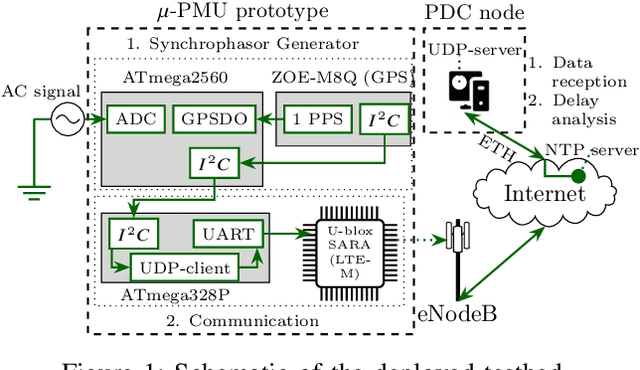
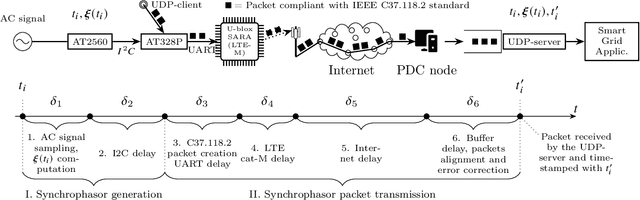
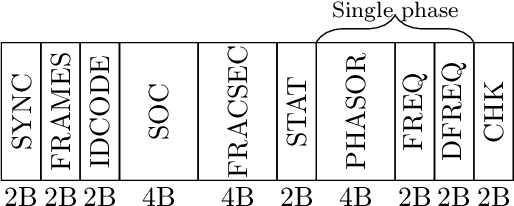
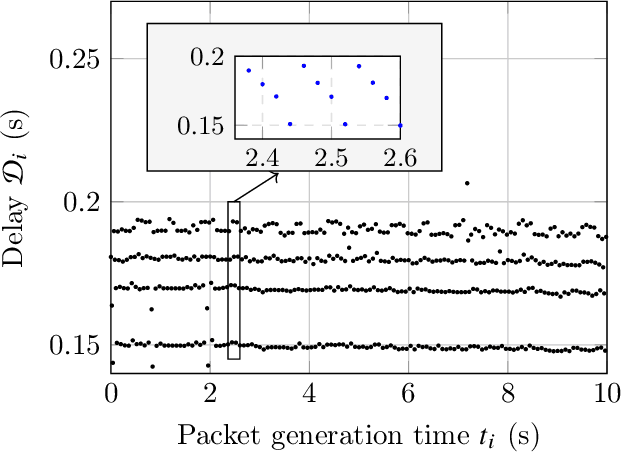
Micro-Phasor Measurement Units (u-PMUs) are devices that permit monitoring voltage and current in the distribution grid with high accuracy, thus enabling a wide range of smart grid applications, such as state estimation, protection and control. These devices need to transmit the synchronous measurements of voltage and current, also known as synchrophasors, to the power utility control center at high rate. The use of wireless networks, such as LTE, to transmit synchrophasor data is becoming increasingly popular. However, synchrophasors are included in small frames and it would be more efficient to use low power cellular solutions, such as LTE cat-M. In this work, we present experimental research on the deployment of a u-PMU with the ability to connect over a commercial LTE cat-M network. The deployed u-PMU is built with off-the-shelf hardware, such as Arduino microcontrollers, and is used to transmit data-compliant with the IEEE C37.118.2 standard at a variable rate from 1 frame/s to 80 frames/s. A detailed network performance analysis is carried out to show the suitability of LTE cat-M to support u-PMU communications. Experimental results on performance indicators, such as delay and jitter, are reported. The effect of the LTE cat-M access mechanism on the time distribution of frame arrivals is also thoroughly analyzed.
A Machine Learning framework for Sleeping Cell Detection in a Smart-city IoT Telecommunications Infrastructure
Oct 02, 2019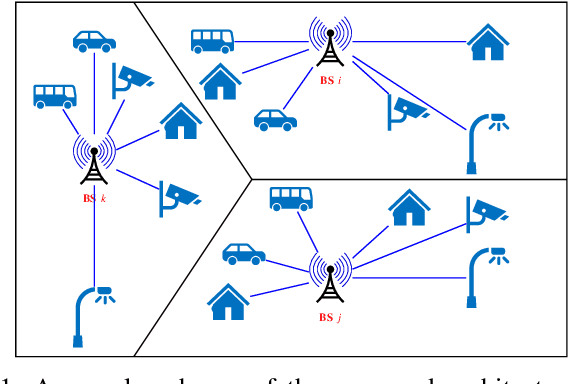
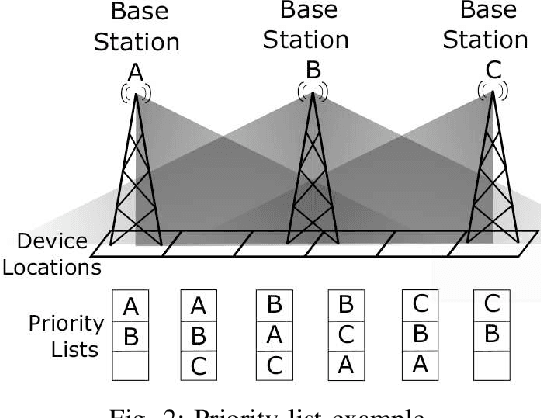
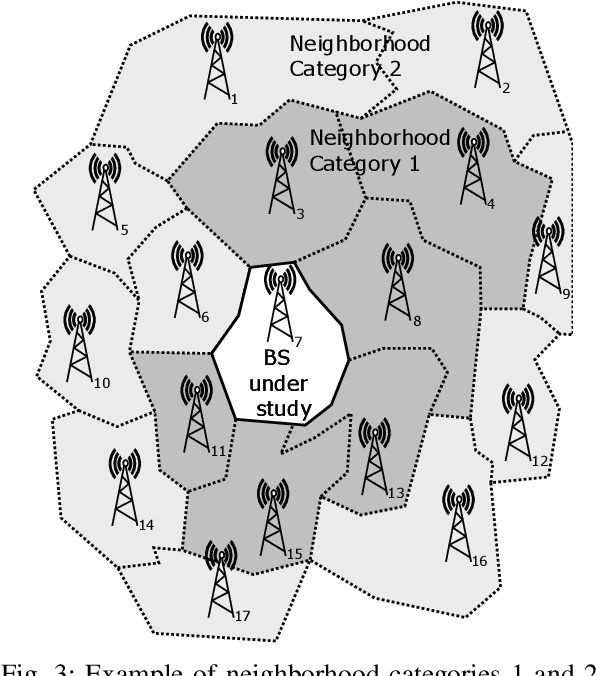
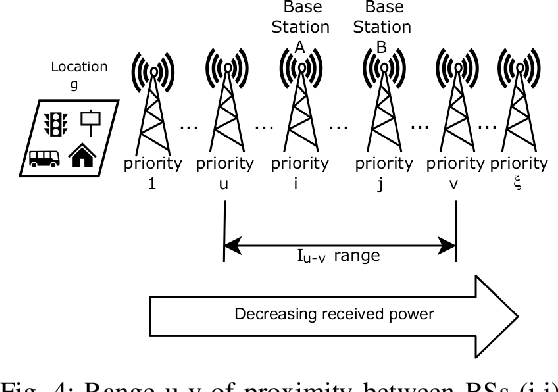
The smooth operation of largely deployed Internet of Things {IoT} applications will depend, among other things, on effective infrastructure failure detection. Access failures in wireless networks Base Stations (BSs) produce a phenomenon called "Sleeping Cells", which can render a cell catatonic without triggering any alarms or provoking immediate effects on the cell's performance, making it difficult to discover. To detect this kind of failures, we propose a Machine Learning framework, based on the use of Key Performance Indicator (KPI) statistics from the BS under study, as well as those of the neighboring BS with propensity to have their performance affected by the failure. A simple way to classify neighbors is to use Voronoi diagrams. In this paper we propose a much more realistic approach based on the nature of the radio-propagation and the way the devices choose the BS to which they send access requests. We gather data from large-scale simulators that use real location data for BSs and IoT devices, and pose the detection problem as a supervised binary classification problem. We measure the effects caused on the detection performance, by the size of time aggregations of the data, the level of traffic and the parameters of the neighborhood definition. Extra Trees and Naive Bayes classifiers achieved Receiver Operating Characteristic (ROC) area under the curve scores of 0.996 and 0.993 respectively with False Positive Rates (FPRs) under 5 %. The proposed framework holds potential for other pattern recognition tasks in smart-cities wireless infrastructures, that would enable the monitoring, prediction and improvement of the Quality of Service (QoS) experienced by IoT applications.