 Add to Chrome
 Add to Firefox
 Add to Edge
ABot-N1: Toward a General Visual Language Navigation Foundation Model
Jul 14, 2026
Visual Language Navigation foundation models aim to unify deep reasoning for grounded spatial decisions with broad versatility for diverse embodied tasks. Current approaches typically achieve this integration via monolithic policies that map observations directly to actions, yet they often suffer from coordinate drift and poor handling of long-tail semantics. Furthermore, these black-box mappings lack interpretability, hindering the simultaneous achievement of generality, robustness, and transparency. We present ABot-N1, a step toward a general Visual Language Navigation foundation model, that addresses these challenges by decoupling cognition from control via a slow-fast architecture guided by dual visual-language signals. More specifically, a slow vision-language reasoner performs explicit Chain-of-Thought reasoning while producing a pixel goal. This compact set of image-space anchor points serves as a universal interface for diverse tasks, including point-goal, object-goal, poi-goal, instruction-following, and person-following. Subsequently, a fast action expert leverages both the textual cues and the pixel guidance to generate continuous waypoints at the native control frequency. By bridging high-level intents and low-level control through pixel-grounded anchors paired with explicit linguistic traces, our approach ensures robust, generalizable, and interpretable navigation across simulation and real-world benchmarks. ABot-N1 establishes new state-of-the-art records, delivering massive gains specifically in urban-scale navigation: boosting POI arrival by 35.0% (to 77.3%) and achieving 95.4%/92.9% SR in complex indoor and outdoor scenes. It also maintains superior robustness across object-reaching, person-following, and instruction-following tasks. New Point-Goal/POI-Goal benchmarks are released as open source to advance the field of urban-scale navigation.

ABot-M0.5: Unified Mobility-and-Manipulation World Action Model
Jul 01, 2026Mobile manipulation is a key capability for general-purpose robots, yet remains challenging for current embodied learning methods. VLA policies are typically reactive and lack explicit world modeling, while existing World Action Models (WAMs) are still poorly aligned with the structure of mobile manipulation: they operate on coarse video chunks, model entangled navigation-manipulation actions, and train inverse dynamics under supervision that does not match autoregressive inference. As a result, they often miss fine-grained contact dynamics, suffer from action-distribution conflicts, and accumulate errors over long-horizon rollouts. We propose ABot-M0.5, a new WAM built on the insight that mobile manipulation requires alignment at three levels: temporal granularity, action space, and train-test consistency. To align temporal granularity, we introduce intermediate latent actions that capture local visual state transitions and serve as an bridging action space between video latents and embodiment-specific controls. To align action space, we design a dual-level Mixture-of-Transformers architecture that disentangles both modality representations and heterogeneous action subspaces such as base movement and arm manipulation. To align inference conditions, we propose the dream-forcing training strategy that progressively trains inverse dynamics on model-predicted videos, improving train-test alignment and robustness during autoregressive prediction. Experiments on challenging mobile and fine-grained manipulation benchmarks demonstrate that ABot-M0.5 achieves state-of-the-art performance in both long-horizon task success and finegrained control accuracy. These results highlight the critical importance of granularity-aligned, action-disentangled, and inference-consistent world-action modeling.
Estimation & Recognition under Perspective of Random-Fuzzy Dual Interpretation of Unknown Quantity: with Demonstration of IMM Filter
Nov 02, 2021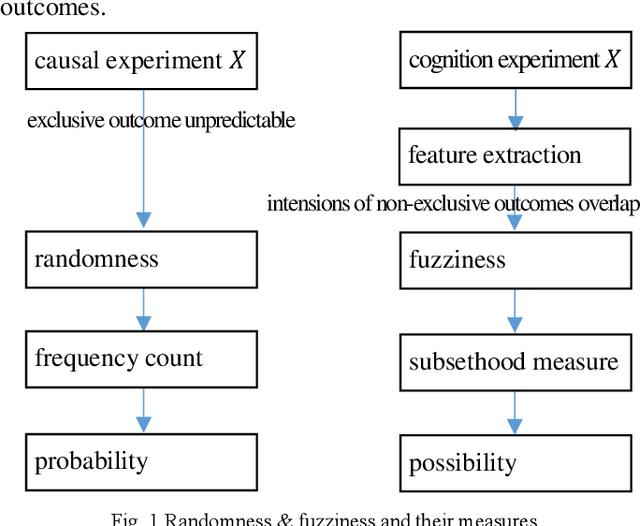
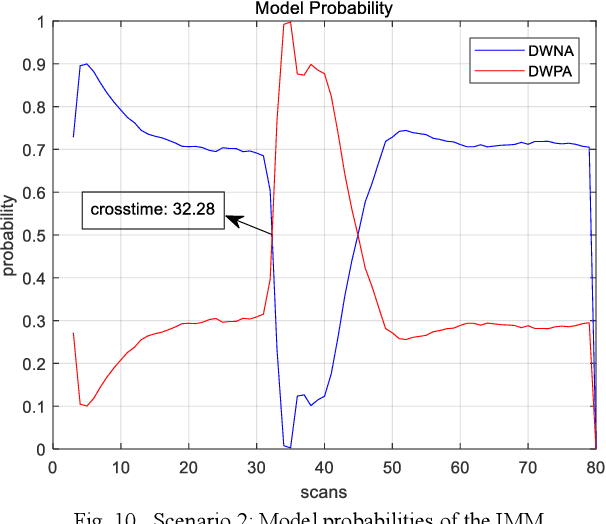
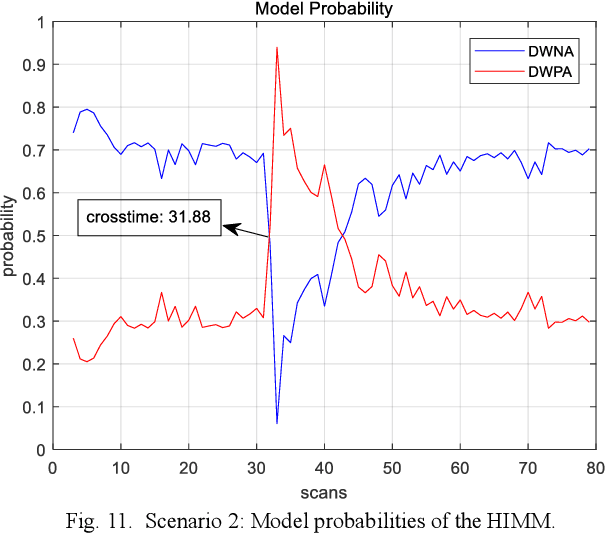
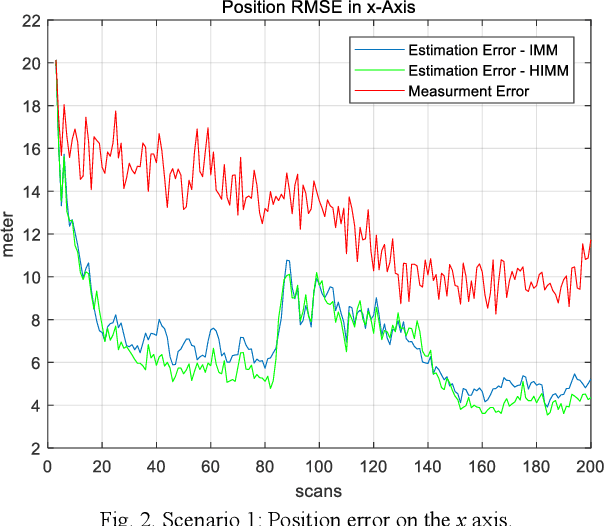
This paper is to consider the problems of estimation and recognition from the perspective of sigma-max inference (probability-possibility inference), with a focus on discovering whether some of the unknown quantities involved could be more faithfully modeled as fuzzy uncertainty. Two related key issues are addressed: 1) the random-fuzzy dual interpretation of unknown quantity being estimated; 2) the principle of selecting sigma-max operator for practical problems, such as estimation and recognition. Our perspective, conceived from definitions of randomness and fuzziness, is that continuous unknown quantity involved in estimation with inaccurate prior should be more appropriately modeled as randomness and handled by sigma inference; whereas discrete unknown quantity involved in recognition with insufficient (and inaccurate) prior could be better modeled as fuzziness and handled by max inference. The philosophy was demonstrated by an updated version of the well-known interacting multiple model (IMM) filter, for which the jump Markovian System is reformulated as a hybrid uncertainty system, with continuous state evolution modeled as usual as model-conditioned stochastic system and discrete mode transitions modeled as fuzzy system by a possibility (instead of probability) transition matrix, and hypotheses mixing is conducted by using the operation of "max" instead of "sigma". For our example of maneuvering target tracking using simulated data from both a short-range fire control radar and a long-range surveillance radar, the updated IMM filter shows significant improvement over the classic IMM filter, due to its peculiarity of hard decision of system model and a faster response to the transition of discrete mode.
The Sigma-Max System Induced from Randomness and Fuzziness
Oct 12, 2021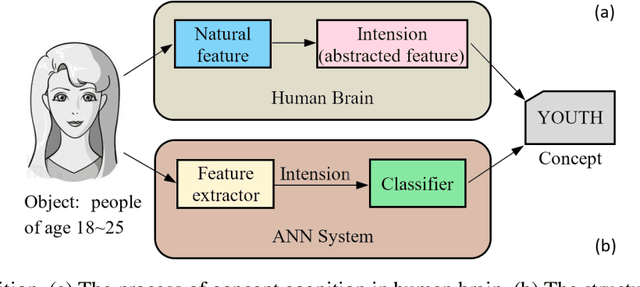
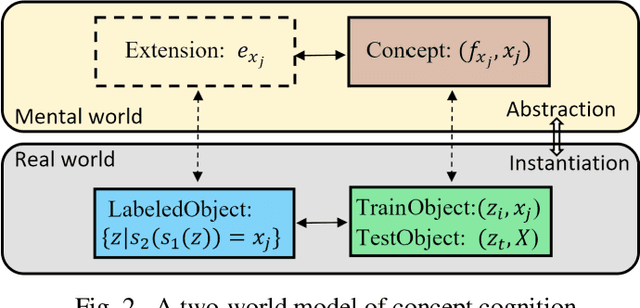
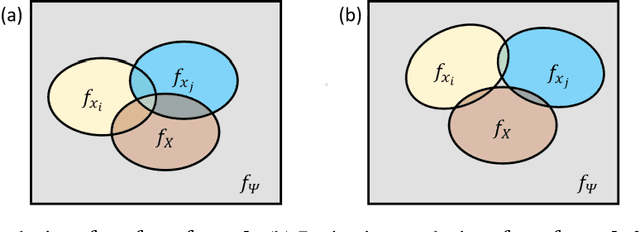
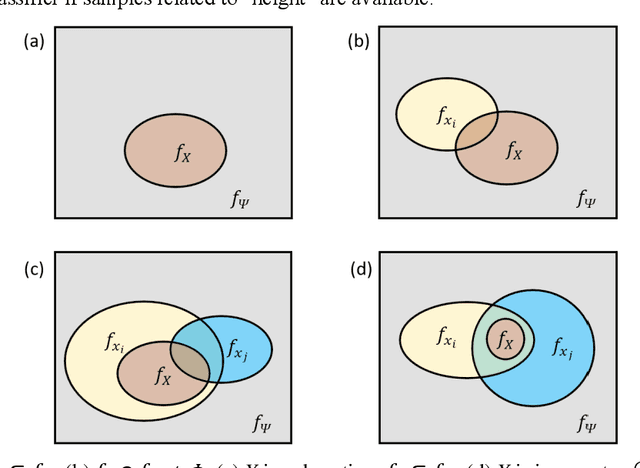
This paper managed to induce probability theory (sigma system) and possibility theory (max system) respectively from randomness and fuzziness, through which the premature theory of possibility is expected to be well founded. Such an objective is achieved by addressing three open key issues: a) the lack of clear mathematical definitions of randomness and fuzziness; b) the lack of intuitive mathematical definition of possibility; c) the lack of abstraction procedure of the axiomatic definitions of probability/possibility from their intuitive definitions. Especially, the last issue involves the question why the key axiom of "maxitivity" is adopted for possibility measure. By taking advantage of properties of the well-defined randomness and fuzziness, we derived the important conclusion that "max" is the only but un-strict disjunctive operator that is applicable across the fuzzy event space, and is an exact operator for fuzzy feature extraction that assures the max inference is an exact mechanism. It is fair to claim that the long-standing problem of lack of consensus to the foundation of possibility theory is well resolved, which would facilitate wider adoption of possibility theory in practice and promote cross prosperity of the two uncertainty theories of probability and possibility.