 Add to Chrome
 Add to Firefox
 Add to Edge
CliniCARE-Bench: Clinical Calibrated Audit of Medical Reasoning in EHR
Aug 07, 2026
Large language models perform strongly on medical knowledge benchmarks, but reliable clinical deployment requires agents to conduct defensible investigations over heterogeneous, longitudinal records: determining what evidence is needed, retrieving and reconciling structured and free-text data, grounding conclusions in verifiable evidence, and deferring cases that cannot be resolved reliably. We introduce CliniCARE-Bench (Clinical Calibrated Audit of Medical Reasoning in EHR), a benchmark for retrospective clinical audit: 25 clinician-validated scenarios instantiated as 750 patient-specific cases over real-patient-derived MIMIC-IV data. Systems investigate each case through a governed, logged tool environment for record retrieval, computation, and policy access, and return one of four verdicts---Yes, No, Indeterminate: Lack of Data, or Indeterminate: Medically Ambiguous---the last two separating missing evidence from residual medical ambiguity. Beyond verdict accuracy, we score patient-evidence and policy grounding, process adherence, calibrated abstention, reliability, and efficiency against case-level reference verdicts produced by independent multi-model adjudication and calibrated against Clinical Board review. Every retrieval, computation, and report is replayable, so the investigation trace is inspectable and scorable. To our knowledge, CliniCARE-Bench is the first deployment-oriented clinical-agent benchmark to jointly evaluate real longitudinal EHR investigation, claim-level evidence grounding, governing-policy use, process adherence, and calibrated abstention within a common patient-level adjudication framework. Across 16 agentic systems, four-way accuracy spans 65.3-76.1%, but raw accuracy overstates investigation quality. Defect-free accuracy, which credits a verdict only when correct and free of prohibited shortcuts, is 4.8-14.8 points lower and reorders the leaderboard.

PSEBench: A Controllable and Verifiable Benchmark for Evaluating LLMs in Patient Safety Event Triage
Jun 03, 2026Patient safety event triage, determining whether a clinical event is reportable under jurisdiction-specific policy, is a high-stakes task typically performed manually by patient safety experts. Although LLMs may support this workflow, reliable evaluation is limited by the lack of benchmarks to capture evidence-grounded policy reasoning, proactive information seeking for incomplete reports, and principled abstention in irreducibly ambiguous cases. We address this gap with a policy-grounded construction methodology centered on the clause card, a structured representation that factorizes regulatory text into auditable decision specifications. Combining clause cards with anchor-driven instantiation and closed-loop verification, our scalable pipeline produces narratives with by-construction ground truth and naturally supports generating missing information and uncertain variants. We instantiate this method on Minnesota's 29 Reportable Adverse Health Events, producing PSEBench, a 5,074-case benchmark with an agentic evaluation environment. Evaluation on 15 representative LLMs reveals consistent capability trends, demonstrates the benchmark's utility, and identifies actionable gaps toward reliable LLM-based patient safety event triage.
EHRBench: An Automated and Reliable EHR-based Benchmark for Clinical Decision Making with LLMs
May 28, 2026Clinical decision-making (CDM) is central to real-world clinical workflows, where clinicians infer diagnoses, select treatments, or anticipate future health outcomes under incomplete evidence. LLMs are increasingly used to support these decisions due to strong language capabilities, broad biomedical knowledge, and efficiency, yet the reliability of LLMs on real-world clinical decision tasks remains insufficiently understood. To evaluate CDM models, especially LLM-based models, an ideal and practical medical decision benchmark should be constructed via an automated yet reliable pipeline to ensure both scale and quality. Moreover, the grounding of a CDM benchmark in real patient EHRs can better support evaluation on practical CDM tasks that require substantive biomedical knowledge and clinical inference. To fill the gaps, we introduce EHRBench, an automated and reliable EHR-grounded benchmark for evaluating LLM-based clinical decision-making at scale. To ensure scalability and reliability, EHRBench is constructed through an EHR-LLM-KB(knowledge-base) interaction pipeline. For efficiency, we use a specialized LLM to automatically convert encounter-level EHR trajectories into structured templates and deterministically instantiate the templates into QA items. In parallel, we apply systematic KB-based verification and enrichment to filter hallucinated or ambiguous relations and to improve reliability. Using this pipeline, we construct nearly 1M (960,067) QA items spanning three core inference-required clinical decision tasks: diagnosis, treatment, and prognosis. We benchmark more than 30 representative LLMs on EHRBench and provide detailed analyses of performance and robustness. The results show consistent capability trends across settings, further validating the reliability of EHRBench and highlighting actionable gaps toward clinically reliable LLM systems.
Towards a Virtual Neuroscientist: Autonomous Neuroimaging Analysis via Multi-Agent Collaboration
May 10, 2026Transforming neuroimaging data into clinically actionable biomarkers is a knowledge-intensive and labor-intensive process. Standardized workflows such as fMRIPrep have improved robustness and efficiency, but they are statically configured and cannot reason about downstream objectives, deliberate over alternative strategies, or close the loop between intermediate evidence and subsequent decisions in the way a human researcher would. This lack of closed-loop adaptation often leaves domain experts trapped in a cycle of manual trial-and-error to tune parameters and remediate pipeline failures, severely constraining the scalability of clinical biomarker development. To bridge this gap, we introduce NIAgent, a multi-agent system for autonomous end-to-end neuroimaging analysis. Unlike conventional flat tool-calling agents, NIAgent adopts a code-centric execution paradigm where specialist agents collaboratively synthesize and optimize executable programs over composable domain-specific primitives. This design enables robust, long-horizon workflow construction that adapts dynamically to runtime observations. Furthermore, we propose a hierarchical verification framework for autonomous quality control, integrating cohort-level metric screening with agentic visual inspection to drive evidence-grounded workflow remediation. Experiments on ADHD-200 and ADNI demonstrate that NIAgent outperforms standard workflow-based baselines in predictive performance while exhibiting sophisticated agentic behaviors, including strategy exploration and adaptive refinement.
End-to-End Deep Learning for Structural Brain Imaging: A Unified Framework
Feb 23, 2025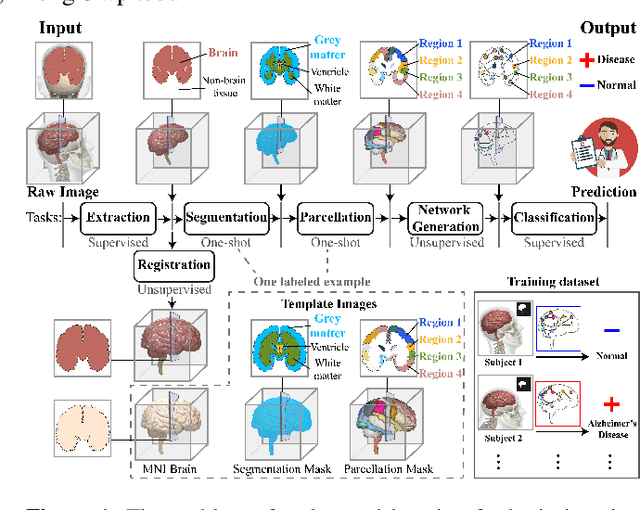
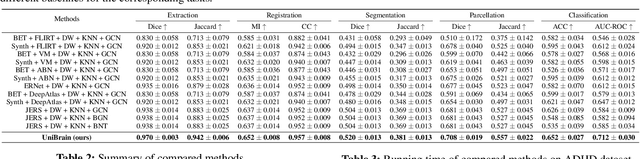
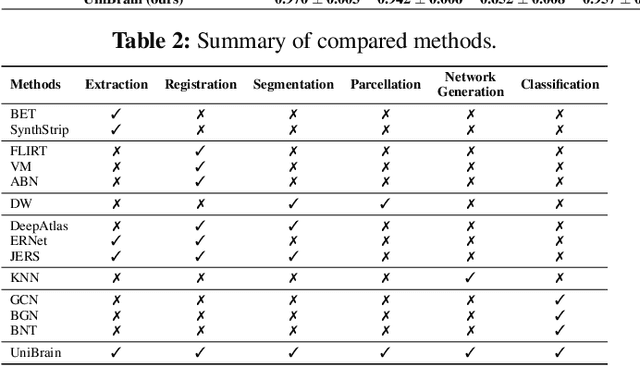
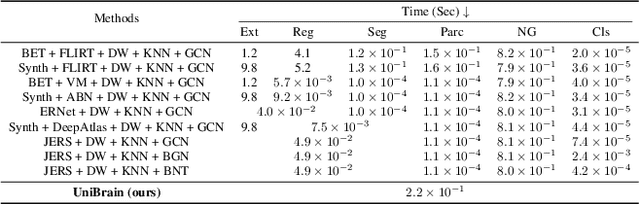
Brain imaging analysis is fundamental in neuroscience, providing valuable insights into brain structure and function. Traditional workflows follow a sequential pipeline-brain extraction, registration, segmentation, parcellation, network generation, and classification-treating each step as an independent task. These methods rely heavily on task-specific training data and expert intervention to correct intermediate errors, making them particularly burdensome for high-dimensional neuroimaging data, where annotations and quality control are costly and time-consuming. We introduce UniBrain, a unified end-to-end framework that integrates all processing steps into a single optimization process, allowing tasks to interact and refine each other. Unlike traditional approaches that require extensive task-specific annotations, UniBrain operates with minimal supervision, leveraging only low-cost labels (i.e., classification and extraction) and a single labeled atlas. By jointly optimizing extraction, registration, segmentation, parcellation, network generation, and classification, UniBrain enhances both accuracy and computational efficiency while significantly reducing annotation effort. Experimental results demonstrate its superiority over existing methods across multiple tasks, offering a more scalable and reliable solution for neuroimaging analysis. Our code and data can be found at https://github.com/Anonymous7852/UniBrain
Rethinking Functional Brain Connectome Analysis: Do Graph Deep Learning Models Help?
Jan 28, 2025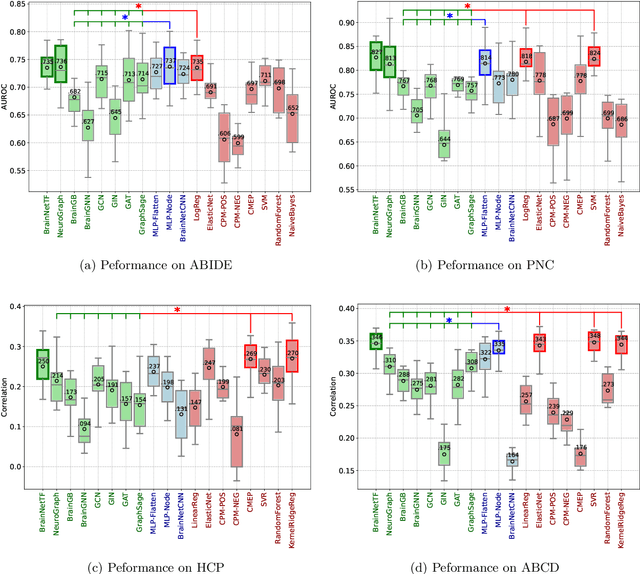
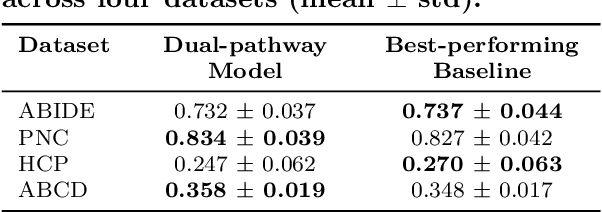
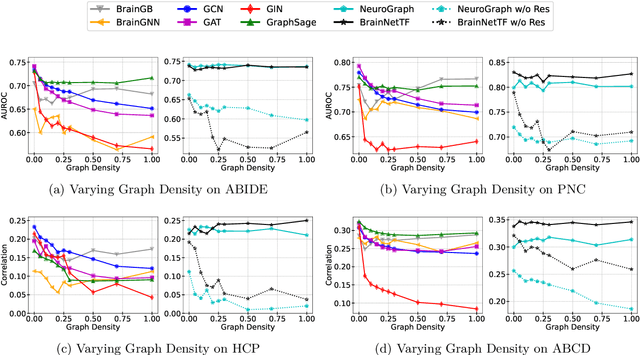
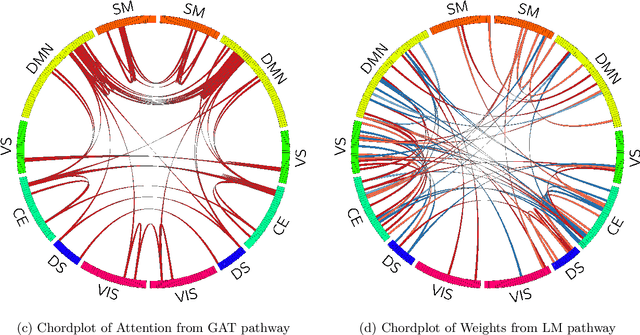
Functional brain connectome is crucial for deciphering the neural mechanisms underlying cognitive functions and neurological disorders. Graph deep learning models have recently gained tremendous popularity in this field. However, their actual effectiveness in modeling the brain connectome remains unclear. In this study, we re-examine graph deep learning models based on four large-scale neuroimaging studies encompassing diverse cognitive and clinical outcomes. Surprisingly, we find that the message aggregation mechanism, a hallmark of graph deep learning models, does not help with predictive performance as typically assumed, but rather consistently degrades it. To address this issue, we propose a hybrid model combining a linear model with a graph attention network through dual pathways, achieving robust predictions and enhanced interpretability by revealing both localized and global neural connectivity patterns. Our findings urge caution in adopting complex deep learning models for functional brain connectome analysis, emphasizing the need for rigorous experimental designs to establish tangible performance gains and perhaps more importantly, to pursue improvements in model interpretability.