 Add to Chrome
 Add to Firefox
 Add to Edge
FurNav: Development and Preliminary Study of a Robot Direction Giver
Sep 25, 2023
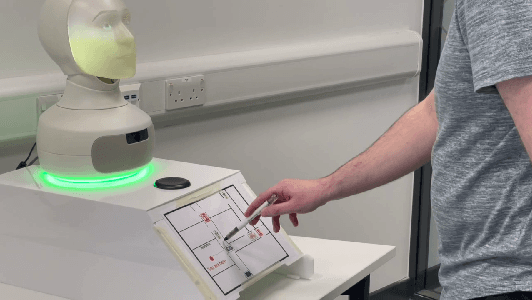
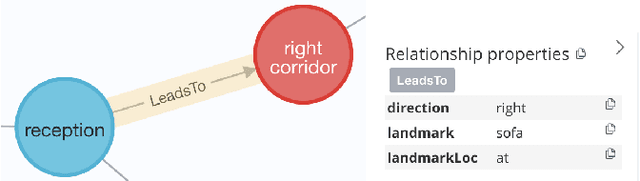

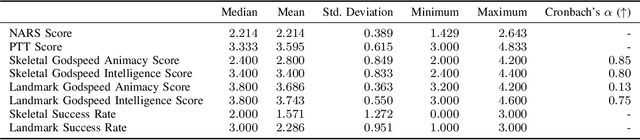
When giving directions to a lost-looking tourist, would you first reference the street-names, cardinal directions, landmarks, or simply tell them to walk five hundred metres in one direction then turn left? Depending on the circumstances, one could reasonably make use of any of these direction giving styles. However, research on direction giving with a robot does not often look at how these different direction styles impact perceptions of the robots intelligence, nor does it take into account how users prior dispositions may impact ratings. In this work, we look at generating natural language for two navigation styles using a created system for a Furhat robot, before measuring perceived intelligence and animacy alongside users prior dispositions to robots in a small preliminary study (N=7). Our results confirm findings by previous work that prior negative attitudes towards robots correlates negatively with propensity to trust robots, and also suggests avenues for future research. For example, more data is needed to explore the link between perceived intelligence and direction style. We end by discussing our plan to run a larger scale experiment, and how to improve our existing study design.

FurChat: An Embodied Conversational Agent using LLMs, Combining Open and Closed-Domain Dialogue with Facial Expressions
Aug 30, 2023We demonstrate an embodied conversational agent that can function as a receptionist and generate a mixture of open and closed-domain dialogue along with facial expressions, by using a large language model (LLM) to develop an engaging conversation. We deployed the system onto a Furhat robot, which is highly expressive and capable of using both verbal and nonverbal cues during interaction. The system was designed specifically for the National Robotarium to interact with visitors through natural conversations, providing them with information about the facilities, research, news, upcoming events, etc. The system utilises the state-of-the-art GPT-3.5 model to generate such information along with domain-general conversations and facial expressions based on prompt engineering.
Understanding Counterspeech for Online Harm Mitigation
Jul 01, 2023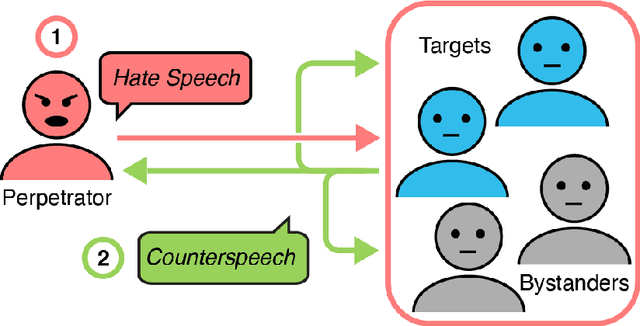
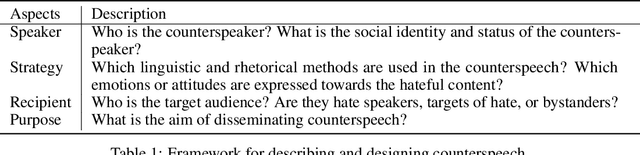
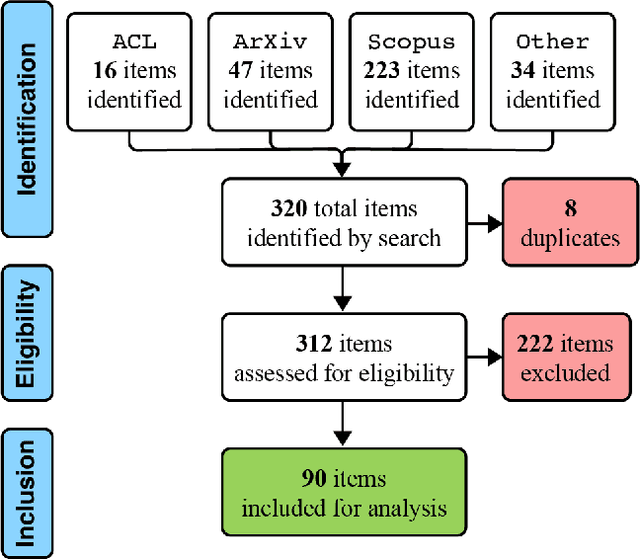
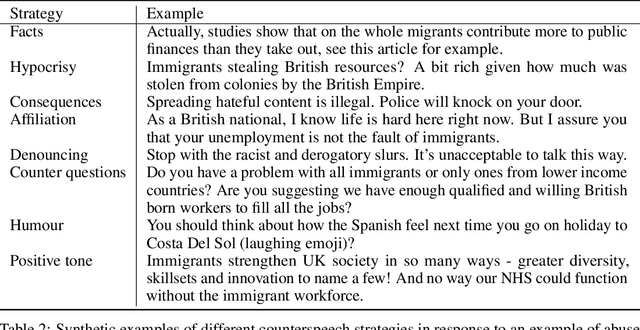
Counterspeech offers direct rebuttals to hateful speech by challenging perpetrators of hate and showing support to targets of abuse. It provides a promising alternative to more contentious measures, such as content moderation and deplatforming, by contributing a greater amount of positive online speech rather than attempting to mitigate harmful content through removal. Advances in the development of large language models mean that the process of producing counterspeech could be made more efficient by automating its generation, which would enable large-scale online campaigns. However, we currently lack a systematic understanding of several important factors relating to the efficacy of counterspeech for hate mitigation, such as which types of counterspeech are most effective, what are the optimal conditions for implementation, and which specific effects of hate it can best ameliorate. This paper aims to fill this gap by systematically reviewing counterspeech research in the social sciences and comparing methodologies and findings with computer science efforts in automatic counterspeech generation. By taking this multi-disciplinary view, we identify promising future directions in both fields.
The Dangers of trusting Stochastic Parrots: Faithfulness and Trust in Open-domain Conversational Question Answering
May 25, 2023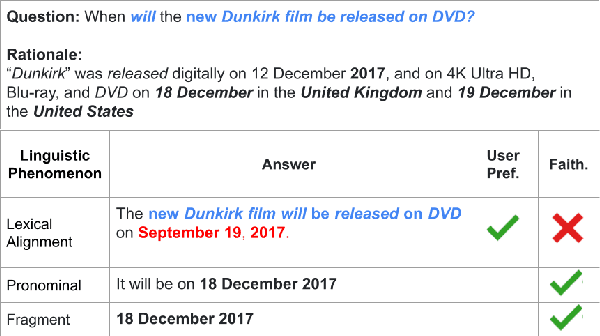
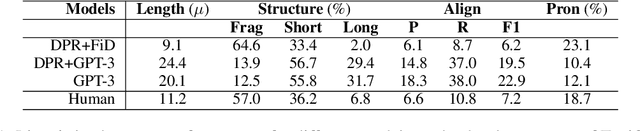

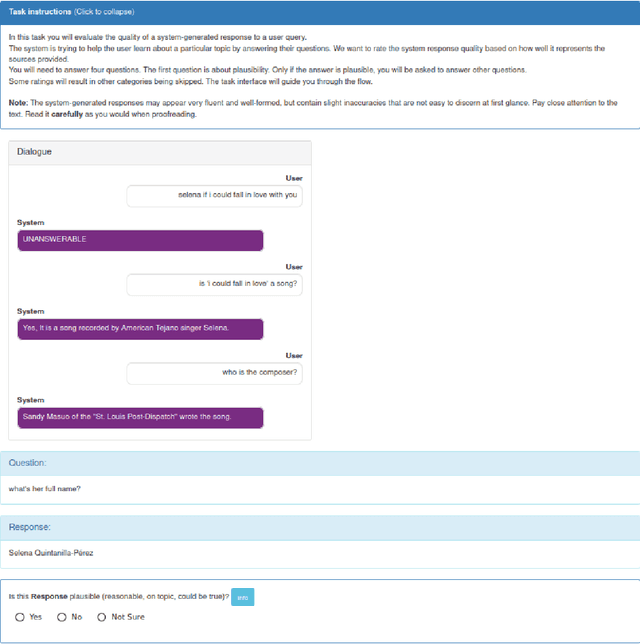
Large language models are known to produce output which sounds fluent and convincing, but is also often wrong, e.g. "unfaithful" with respect to a rationale as retrieved from a knowledge base. In this paper, we show that task-based systems which exhibit certain advanced linguistic dialog behaviors, such as lexical alignment (repeating what the user said), are in fact preferred and trusted more, whereas other phenomena, such as pronouns and ellipsis are dis-preferred. We use open-domain question answering systems as our test-bed for task based dialog generation and compare several open- and closed-book models. Our results highlight the danger of systems that appear to be trustworthy by parroting user input while providing an unfaithful response.
iLab at SemEval-2023 Task 11 Le-Wi-Di: Modelling Disagreement or Modelling Perspectives?
May 10, 2023


There are two competing approaches for modelling annotator disagreement: distributional soft-labelling approaches (which aim to capture the level of disagreement) or modelling perspectives of individual annotators or groups thereof. We adapt a multi-task architecture -- which has previously shown success in modelling perspectives -- to evaluate its performance on the SEMEVAL Task 11. We do so by combining both approaches, i.e. predicting individual annotator perspectives as an interim step towards predicting annotator disagreement. Despite its previous success, we found that a multi-task approach performed poorly on datasets which contained distinct annotator opinions, suggesting that this approach may not always be suitable when modelling perspectives. Furthermore, our results explain that while strongly perspectivist approaches might not achieve state-of-the-art performance according to evaluation metrics used by distributional approaches, our approach allows for a more nuanced understanding of individual perspectives present in the data. We argue that perspectivist approaches are preferable because they enable decision makers to amplify minority views, and that it is important to re-evaluate metrics to reflect this goal.
ANTONIO: Towards a Systematic Method of Generating NLP Benchmarks for Verification
May 06, 2023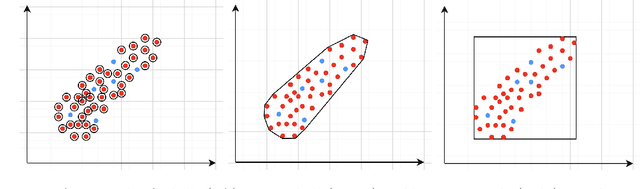
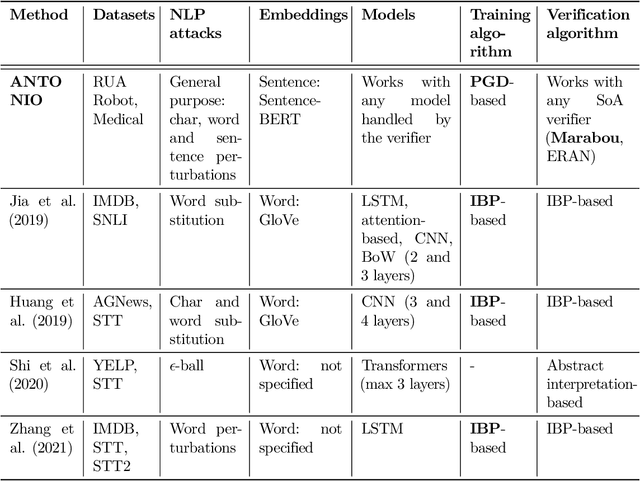
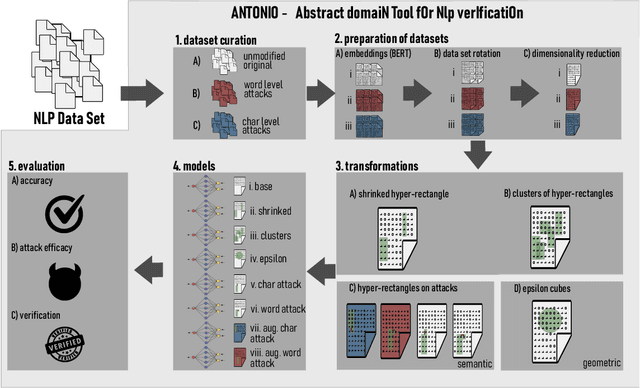
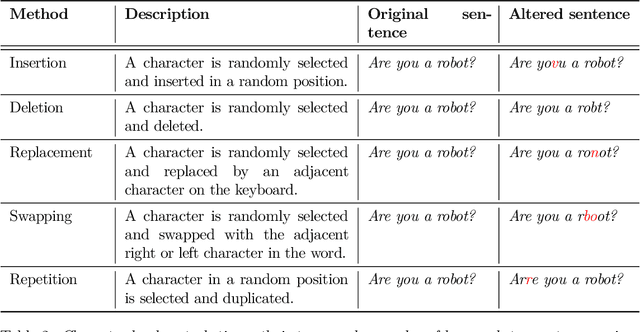
Verification of machine learning models used in Natural Language Processing (NLP) is known to be a hard problem. In particular, many known neural network verification methods that work for computer vision and other numeric datasets do not work for NLP. Here, we study technical reasons that underlie this problem. Based on this analysis, we propose practical methods and heuristics for preparing NLP datasets and models in a way that renders them amenable to known verification methods based on abstract interpretation. We implement these methods as a Python library called ANTONIO that links to the neural network verifiers ERAN and Marabou. We perform evaluation of the tool using an NLP dataset R-U-A-Robot suggested as a benchmark for verifying legally critical NLP applications. We hope that, thanks to its general applicability, this work will open novel possibilities for including NLP verification problems into neural network verification competitions, and will popularise NLP problems within this community.
Missing Information, Unresponsive Authors, Experimental Flaws: The Impossibility of Assessing the Reproducibility of Previous Human Evaluations in NLP
May 02, 2023


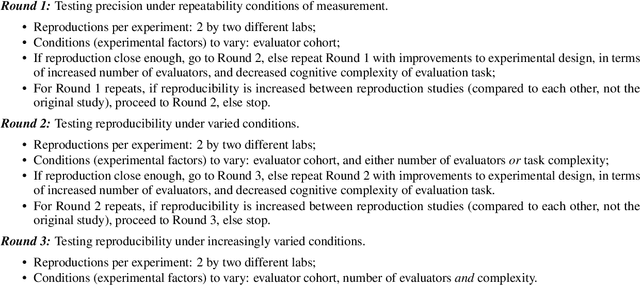
We report our efforts in identifying a set of previous human evaluations in NLP that would be suitable for a coordinated study examining what makes human evaluations in NLP more/less reproducible. We present our results and findings, which include that just 13\% of papers had (i) sufficiently low barriers to reproduction, and (ii) enough obtainable information, to be considered for reproduction, and that all but one of the experiments we selected for reproduction was discovered to have flaws that made the meaningfulness of conducting a reproduction questionable. As a result, we had to change our coordinated study design from a reproduce approach to a standardise-then-reproduce-twice approach. Our overall (negative) finding that the great majority of human evaluations in NLP is not repeatable and/or not reproducible and/or too flawed to justify reproduction, paints a dire picture, but presents an opportunity for a rethink about how to design and report human evaluations in NLP.
Quality-agnostic Image Captioning to Safely Assist People with Vision Impairment
May 01, 2023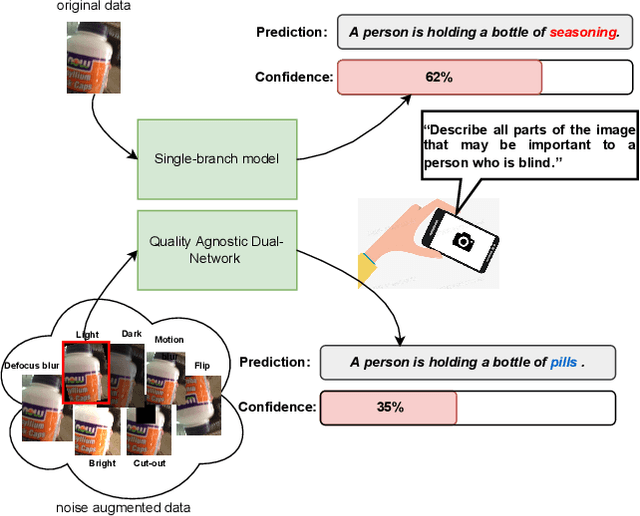

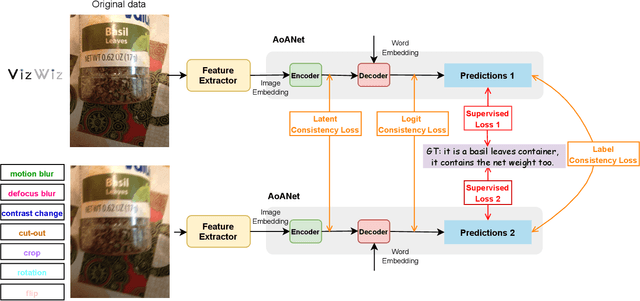
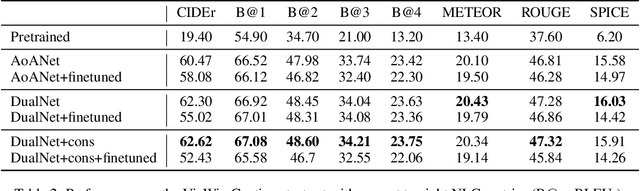
Automated image captioning has the potential to be a useful tool for people with vision impairments. Images taken by this user group are often noisy, which leads to incorrect and even unsafe model predictions. In this paper, we propose a quality-agnostic framework to improve the performance and robustness of image captioning models for visually impaired people. We address this problem from three angles: data, model, and evaluation. First, we show how data augmentation techniques for generating synthetic noise can address data sparsity in this domain. Second, we enhance the robustness of the model by expanding a state-of-the-art model to a dual network architecture, using the augmented data and leveraging different consistency losses. Our results demonstrate increased performance, e.g. an absolute improvement of 2.15 on CIDEr, compared to state-of-the-art image captioning networks, as well as increased robustness to noise with up to 3 points improvement on CIDEr in more noisy settings. Finally, we evaluate the prediction reliability using confidence calibration on images with different difficulty/noise levels, showing that our models perform more reliably in safety-critical situations. The improved model is part of an assisted living application, which we develop in partnership with the Royal National Institute of Blind People.
SemEval-2023 Task 11: Learning With Disagreements (LeWiDi)
Apr 28, 2023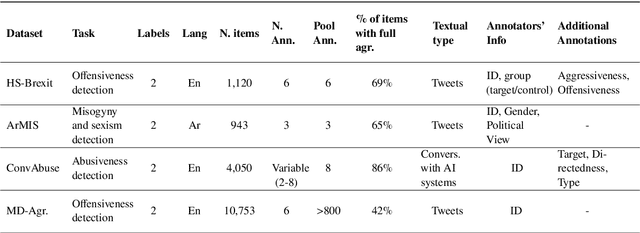
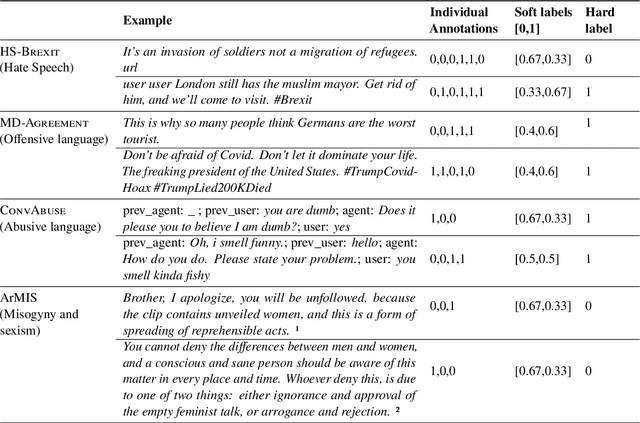
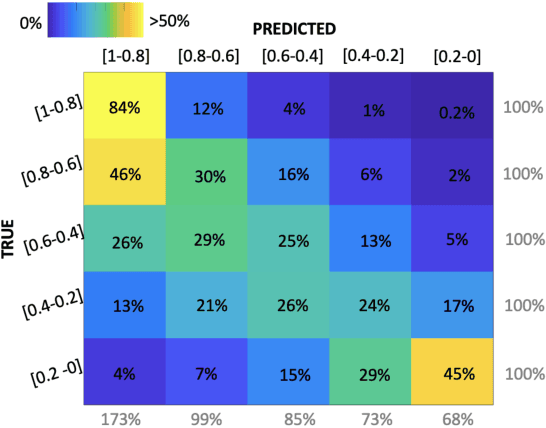
NLP datasets annotated with human judgments are rife with disagreements between the judges. This is especially true for tasks depending on subjective judgments such as sentiment analysis or offensive language detection. Particularly in these latter cases, the NLP community has come to realize that the approach of 'reconciling' these different subjective interpretations is inappropriate. Many NLP researchers have therefore concluded that rather than eliminating disagreements from annotated corpora, we should preserve them-indeed, some argue that corpora should aim to preserve all annotator judgments. But this approach to corpus creation for NLP has not yet been widely accepted. The objective of the LeWiDi series of shared tasks is to promote this approach to developing NLP models by providing a unified framework for training and evaluating with such datasets. We report on the second LeWiDi shared task, which differs from the first edition in three crucial respects: (i) it focuses entirely on NLP, instead of both NLP and computer vision tasks in its first edition; (ii) it focuses on subjective tasks, instead of covering different types of disagreements-as training with aggregated labels for subjective NLP tasks is a particularly obvious misrepresentation of the data; and (iii) for the evaluation, we concentrate on soft approaches to evaluation. This second edition of LeWiDi attracted a wide array of participants resulting in 13 shared task submission papers.
Consistency is Key: Disentangling Label Variation in Natural Language Processing with Intra-Annotator Agreement
Jan 25, 2023We commonly use agreement measures to assess the utility of judgements made by human annotators in Natural Language Processing (NLP) tasks. While inter-annotator agreement is frequently used as an indication of label reliability by measuring consistency between annotators, we argue for the additional use of intra-annotator agreement to measure label stability over time. However, in a systematic review, we find that the latter is rarely reported in this field. Calculating these measures can act as important quality control and provide insights into why annotators disagree. We propose exploratory annotation experiments to investigate the relationships between these measures and perceptions of subjectivity and ambiguity in text items.