 Add to Chrome
 Add to Firefox
 Add to Edge
Learning Reusable Hybrid Motion Priors for Humanoid Locomotion from Motion Imitation
Jul 27, 2026
Reinforcement learning can produce robust humanoid controllers, but each new task is typically trained as a separate policy with its own reward design and training process. Motion imitation provides an alternative source of motor competence by training policies to track retargeted human motions, yet the resulting controllers remain reference trackers and are not directly usable as task policies. We propose a three-stage pipeline that turns motion-imitation skills into a reusable hybrid motion prior (HMP) for humanoid locomotion. First, an expert policy is trained to imitate retargeted human motion-capture clips. Second, the expert is distilled into a frozen architecture composed of a proprioceptive encoder, a residual vector-quantized (RVQ) codebook, and an action decoder. Third, task-level policies are trained to solve locomotion tasks by selecting discrete codebook entries while the HMP remains frozen. We evaluate the method on velocity tracking, point-goal navigation, and fall-recovery velocity tracking in simulation, and deploy the velocity-tracking policy on a real Unitree G1 robot. The distillation process preserves the tracking behavior of the expert, while the resulting HMP can be reused without retraining as the action interface for different downstream locomotion policies. The learned HMP reveals an interpretable codebook structure in which the number of active RVQ stages modulates the available gait patterns. We further show that training the codebook with the rotation trick improves latent organization and reduces downstream falls compared with a standard straight-through estimator.

Characterizing Optimizer-Dependent Training Dynamics Through Hessian Eigenvector Displacement and Localization
Jun 29, 2026Hessian spectral properties are a standard tool in analysing neural-network training, with eigenvalues linked to sharpness, generalization, and optimization dynamics. Eigenvalues quantify curvature magnitude, while eigenvectors identify which parameters generate that curvature. In this work, we study how the leading Hessian eigenvectors evolve during training and how they affect the learning trajectories. We track the training dynamics of multilayer perceptrons on a classification problem and measure eigenvector dynamics through two complementary statistics: (i) displacement over time, inspired by analyses of glassy systems, and (ii) localization via the inverse participation ratio. The metrics are compared against a random null model of the Hessian induced by the architecture. Our results reveal clear optimizer-dependent behaviour. SGD leads to progressively more stable leading curvature directions, while Adam exhibits substantially stronger reorganization of eigenvectors throughout training. We also observe a localization phenomenon under Adam, where a small subset of parameters contributes disproportionately to the leading curvature directions. These results suggest that Hessian eigenvector dynamics capture key differences in optimizer behaviour and the resulting training trajectories.
Stable Transformer-Actor-Critic Model Predictive Control: A Contraction Analysis Approach
Jun 18, 2026Actor-Critic Model Predictive Control (MPC) effectively addresses complex, non-convex control problems, but guaranteeing the closed-loop stability of sequence-based learning models within these pipelines remains challenging. This paper introduces a novel Transformer-Actor-Critic MPC architecture with formal robustness guarantees. First, we prove that Transformer networks can satisfy global incremental Input-to-State Stability ($δ$ISS). We then leverage Riemannian contraction theory to analyze the interconnected dynamics between the physical plant and the predictive neural network. Finally, we integrate these theoretical bounds as a training regularizer to yield a certifiably robust policy. The framework is validated on a nonlinear 3D drone model executing target-reaching and obstacle-avoidance maneuvers.
A Progress-Aware Leader-Follower Midair Docking System for Dual-Drone Aerial Manipulation
May 28, 2026Reliable midair docking between small unmanned aerial vehicles (UAVs) is essential for modular aerial cooperation and manipulation, but it requires precise relative-pose control and repeatable platform under tight thrust and payload constraints. We present a dual-drone docking platform where two quadrotors operate in a leader-follower formation and dock using a lightweight modular frame with passive magnetic latching. A progress-aware mission supervisor manages phase transitions: approach, alignment, capture, and settle. This platform integrates a complete hardware-software stack (ROS 2 with Crazyflie/PX4 interfaces) and synchronized logging for benchmark evaluation. We evaluate the platform in simulation and real-world experiments using quantitative metrics such as formation error, baseline and yaw consistency, docking success rate, time-to-dock, and failure-mode statistics. The platform enables statistically grounded comparison of docking supervision and synchronization strategies and provides a practical testbed for modular aerial cooperation and repeatable midair aerial manipulation.
Feedback-MPPI: Fast Sampling-Based MPC via Rollout Differentiation -- Adios low-level controllers
Jun 17, 2025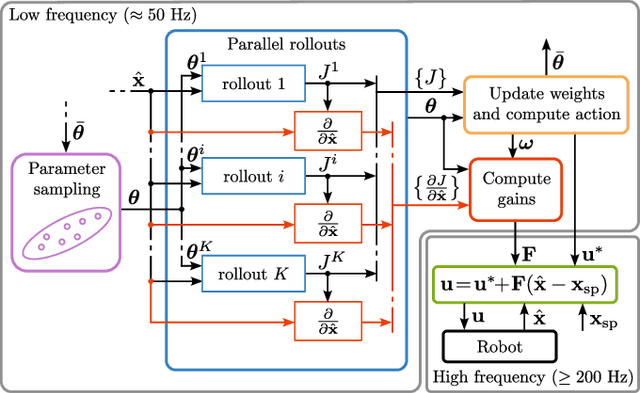
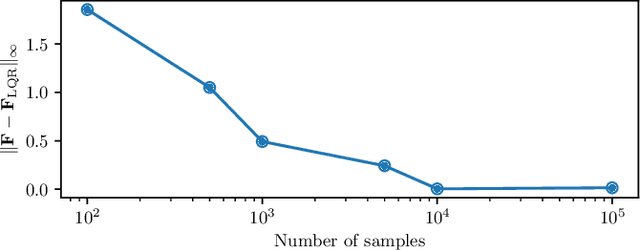
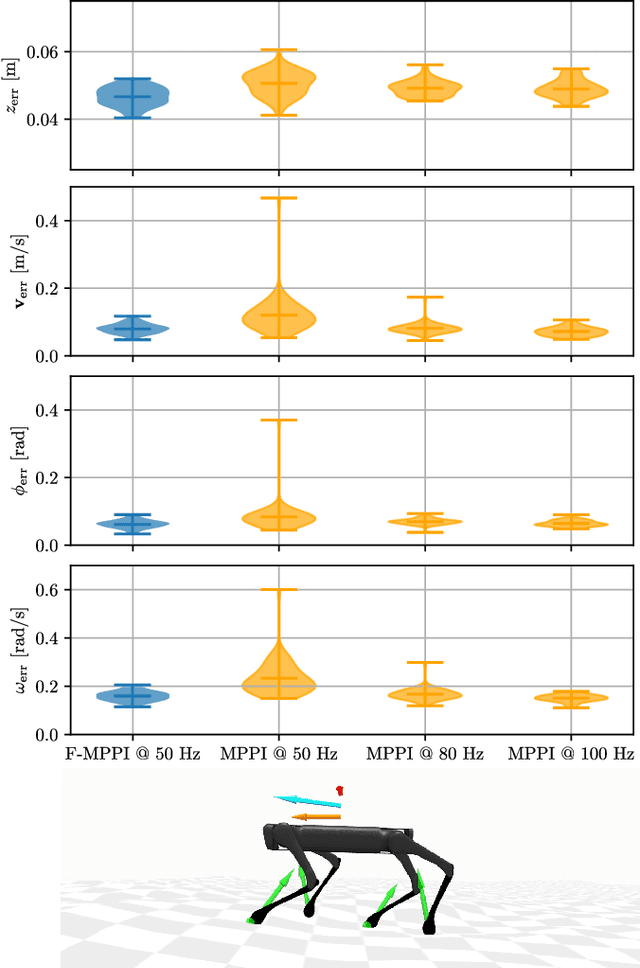
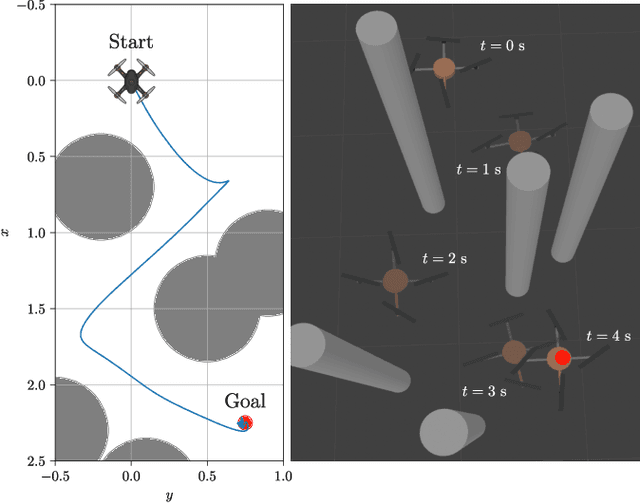
Model Predictive Path Integral control is a powerful sampling-based approach suitable for complex robotic tasks due to its flexibility in handling nonlinear dynamics and non-convex costs. However, its applicability in real-time, highfrequency robotic control scenarios is limited by computational demands. This paper introduces Feedback-MPPI (F-MPPI), a novel framework that augments standard MPPI by computing local linear feedback gains derived from sensitivity analysis inspired by Riccati-based feedback used in gradient-based MPC. These gains allow for rapid closed-loop corrections around the current state without requiring full re-optimization at each timestep. We demonstrate the effectiveness of F-MPPI through simulations and real-world experiments on two robotic platforms: a quadrupedal robot performing dynamic locomotion on uneven terrain and a quadrotor executing aggressive maneuvers with onboard computation. Results illustrate that incorporating local feedback significantly improves control performance and stability, enabling robust, high-frequency operation suitable for complex robotic systems.
Immersive Teleoperation Framework for Locomanipulation Tasks
Apr 21, 2025Recent advancements in robotic loco-manipulation have leveraged Virtual Reality (VR) to enhance the precision and immersiveness of teleoperation systems, significantly outperforming traditional methods reliant on 2D camera feeds and joystick controls. Despite these advancements, challenges remain, particularly concerning user experience across different setups. This paper introduces a novel VR-based teleoperation framework designed for a robotic manipulator integrated onto a mobile platform. Central to our approach is the application of Gaussian splatting, a technique that abstracts the manipulable scene into a VR environment, thereby enabling more intuitive and immersive interactions. Users can navigate and manipulate within the virtual scene as if interacting with a real robot, enhancing both the engagement and efficacy of teleoperation tasks. An extensive user study validates our approach, demonstrating significant usability and efficiency improvements. Two-thirds (66%) of participants completed tasks faster, achieving an average time reduction of 43%. Additionally, 93% preferred the Gaussian Splat interface overall, with unanimous (100%) recommendations for future use, highlighting improvements in precision, responsiveness, and situational awareness. Finally, we demonstrate the effectiveness of our framework through real-world experiments in two distinct application scenarios, showcasing the practical capabilities and versatility of the Splat-based VR interface.
On-Line Learning for Planning and Control of Underactuated Robots with Uncertain Dynamics
Jan 30, 2025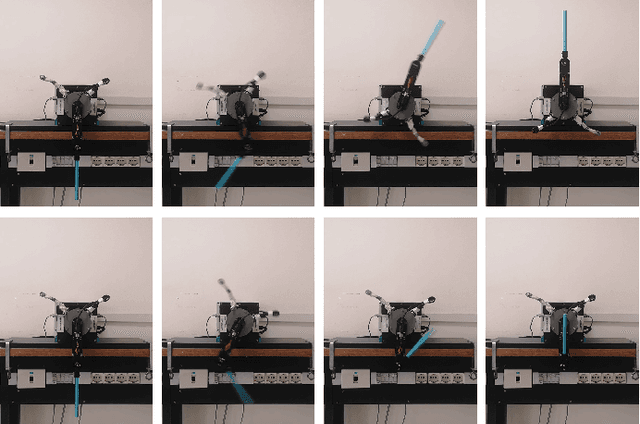
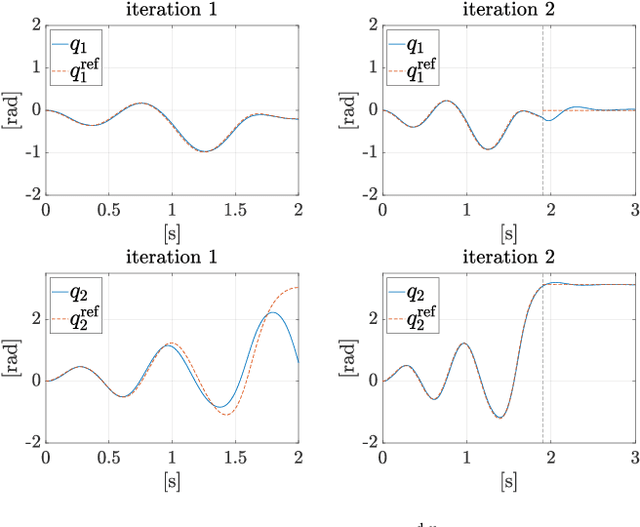
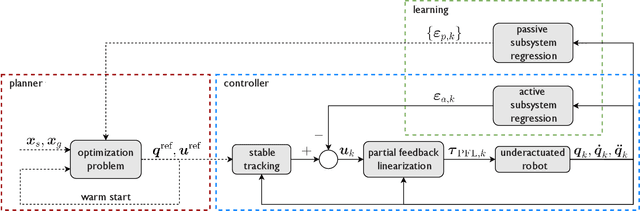
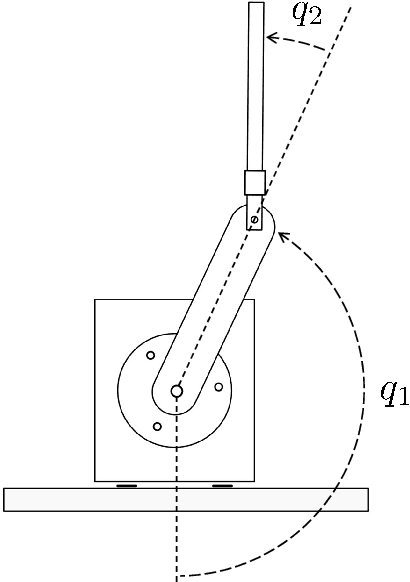
We present an iterative approach for planning and controlling motions of underactuated robots with uncertain dynamics. At its core, there is a learning process which estimates the perturbations induced by the model uncertainty on the active and passive degrees of freedom. The generic iteration of the algorithm makes use of the learned data in both the planning phase, which is based on optimization, and the control phase, where partial feedback linearization of the active dofs is performed on the model updated on-line. The performance of the proposed approach is shown by comparative simulations and experiments on a Pendubot executing various types of swing-up maneuvers. Very few iterations are typically needed to generate dynamically feasible trajectories and the tracking control that guarantees their accurate execution, even in the presence of large model uncertainties.
On the Benefits of GPU Sample-Based Stochastic Predictive Controllers for Legged Locomotion
Mar 18, 2024Quadrupedal robots excel in mobility, navigating complex terrains with agility. However, their complex control systems present challenges that are still far from being fully addressed. In this paper, we introduce the use of Sample-Based Stochastic control strategies for quadrupedal robots, as an alternative to traditional optimal control laws. We show that Sample-Based Stochastic methods, supported by GPU acceleration, can be effectively applied to real quadruped robots. In particular, in this work, we focus on achieving gait frequency adaptation, a notable challenge in quadrupedal locomotion for gradient-based methods. To validate the effectiveness of Sample-Based Stochastic controllers we test two distinct approaches for quadrupedal robots and compare them against a conventional gradient-based Model Predictive Control system. Our findings, validated both in simulation and on a real 21Kg Aliengo quadruped, demonstrate that our method is on par with a traditional Model Predictive Control strategy when the robot is subject to zero or moderate disturbance, while it surpasses gradient-based methods in handling sustained external disturbances, thanks to the straightforward gait adaptation strategy that is possible to achieve within their formulation.
DVN-SLAM: Dynamic Visual Neural SLAM Based on Local-Global Encoding
Mar 18, 2024Recent research on Simultaneous Localization and Mapping (SLAM) based on implicit representation has shown promising results in indoor environments. However, there are still some challenges: the limited scene representation capability of implicit encodings, the uncertainty in the rendering process from implicit representations, and the disruption of consistency by dynamic objects. To address these challenges, we propose a real-time dynamic visual SLAM system based on local-global fusion neural implicit representation, named DVN-SLAM. To improve the scene representation capability, we introduce a local-global fusion neural implicit representation that enables the construction of an implicit map while considering both global structure and local details. To tackle uncertainties arising from the rendering process, we design an information concentration loss for optimization, aiming to concentrate scene information on object surfaces. The proposed DVN-SLAM achieves competitive performance in localization and mapping across multiple datasets. More importantly, DVN-SLAM demonstrates robustness in dynamic scenes, a trait that sets it apart from other NeRF-based methods.
ViT-A*: Legged Robot Path Planning using Vision Transformer A*
Oct 11, 2023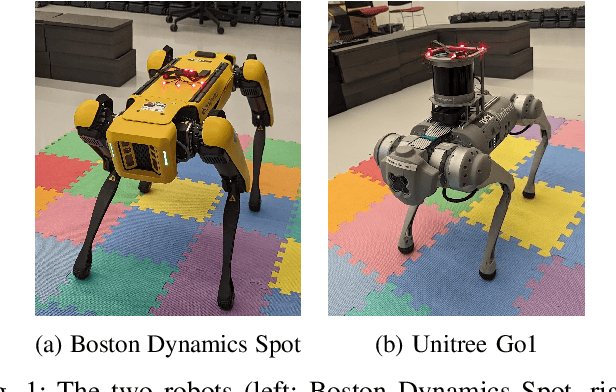
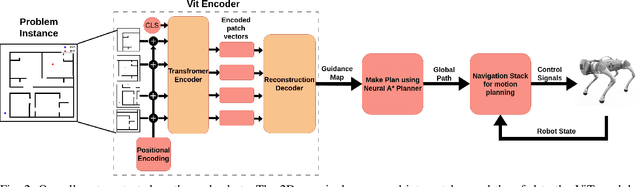
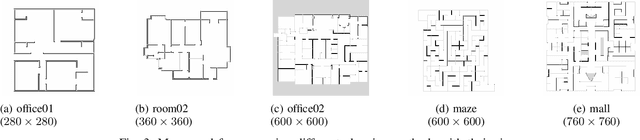
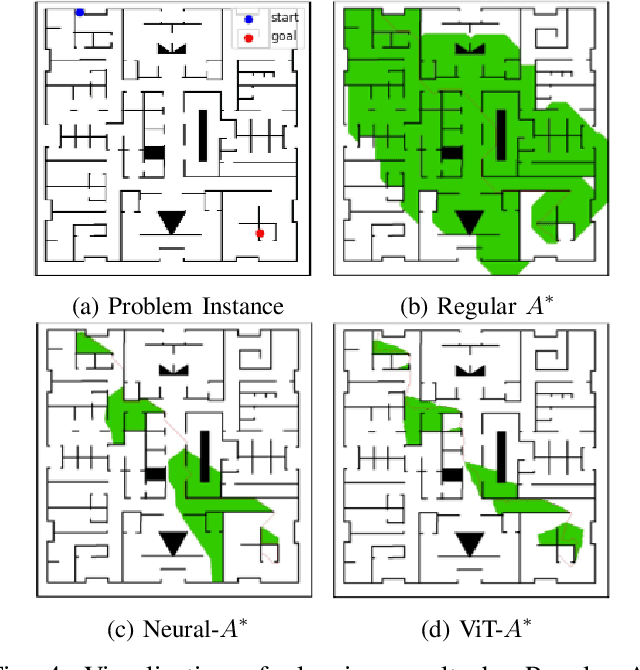
Legged robots, particularly quadrupeds, offer promising navigation capabilities, especially in scenarios requiring traversal over diverse terrains and obstacle avoidance. This paper addresses the challenge of enabling legged robots to navigate complex environments effectively through the integration of data-driven path-planning methods. We propose an approach that utilizes differentiable planners, allowing the learning of end-to-end global plans via a neural network for commanding quadruped robots. The approach leverages 2D maps and obstacle specifications as inputs to generate a global path. To enhance the functionality of the developed neural network-based path planner, we use Vision Transformers (ViT) for map pre-processing, to enable the effective handling of larger maps. Experimental evaluations on two real robotic quadrupeds (Boston Dynamics Spot and Unitree Go1) demonstrate the effectiveness and versatility of the proposed approach in generating reliable path plans.
* 6 pages, 6 figures, conference