 Add to Chrome
 Add to Firefox
 Add to Edge
Quadruped Parkour Learning: Sparsely Gated Mixture of Experts with Visual Input
Apr 21, 2026
Robotic parkour provides a compelling benchmark for advancing locomotion over highly challenging terrain, including large discontinuities such as elevated steps. Recent approaches have demonstrated impressive capabilities, including dynamic climbing and jumping, but typically rely on sequential multilayer perceptron (MLP) architectures with densely activated layers. In contrast, sparsely gated mixture-of-experts (MoE) architectures have emerged in the large language model domain as an effective paradigm for improving scalability and performance by activating only a subset of parameters at inference time. In this work, we investigate the application of sparsely gated MoE architectures to vision-based robotic parkour. We compare control policies based on standard MLPs and MoE architectures under a controlled setting where the number of active parameters at inference time is matched. Experimental results on a real Unitree Go2 quadruped robot demonstrate clear performance gains, with the MoE policy achieving double the number of successful trials in traversing large obstacles compared to a standard MLP baseline. We further show that achieving comparable performance with a standard MLP requires scaling its parameter count to match that of the total MoE model, resulting in a 14.3\% increase in computation time. These results highlight that sparsely gated MoE architectures provide a favorable trade-off between performance and computational efficiency, enabling improved scaling of control policies for vision-based robotic parkour. An anonymized link to the codebase is https://osf.io/v2kqj/files/github?view_only=7977dee10c0a44769184498eaba72e44.

Feedback-MPPI: Fast Sampling-Based MPC via Rollout Differentiation -- Adios low-level controllers
Jun 17, 2025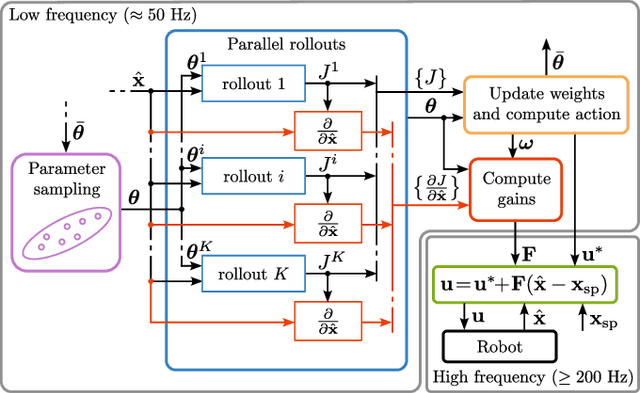
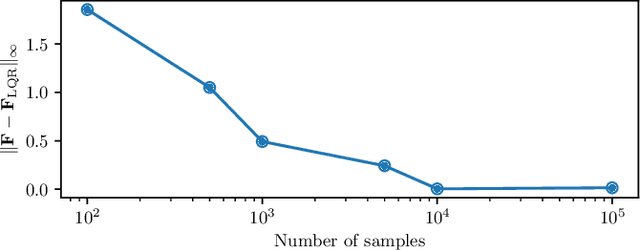
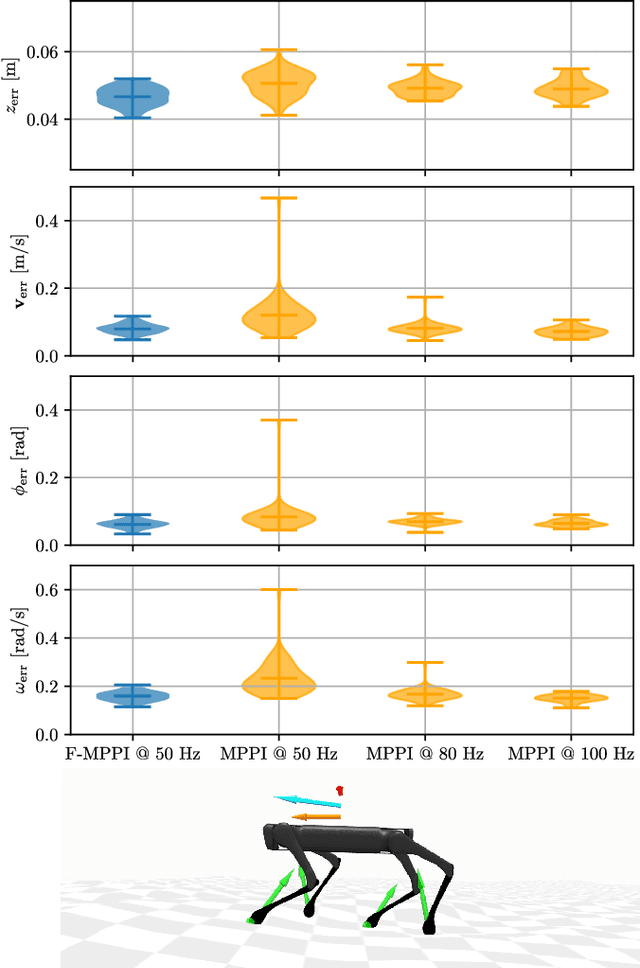
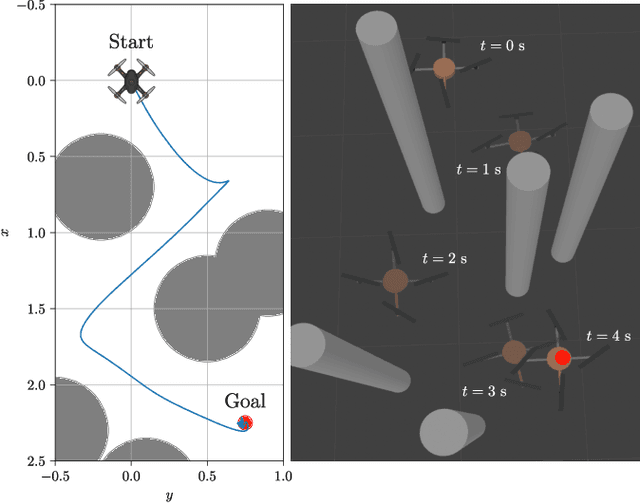
Model Predictive Path Integral control is a powerful sampling-based approach suitable for complex robotic tasks due to its flexibility in handling nonlinear dynamics and non-convex costs. However, its applicability in real-time, highfrequency robotic control scenarios is limited by computational demands. This paper introduces Feedback-MPPI (F-MPPI), a novel framework that augments standard MPPI by computing local linear feedback gains derived from sensitivity analysis inspired by Riccati-based feedback used in gradient-based MPC. These gains allow for rapid closed-loop corrections around the current state without requiring full re-optimization at each timestep. We demonstrate the effectiveness of F-MPPI through simulations and real-world experiments on two robotic platforms: a quadrupedal robot performing dynamic locomotion on uneven terrain and a quadrotor executing aggressive maneuvers with onboard computation. Results illustrate that incorporating local feedback significantly improves control performance and stability, enabling robust, high-frequency operation suitable for complex robotic systems.