 Add to Chrome
 Add to Firefox
 Add to Edge
Domain-specific Hardware Acceleration for Model Predictive Path Integral Control
Jan 17, 2026
Accurately controlling a robotic system in real time is a challenging problem. To address this, the robotics community has adopted various algorithms, such as Model Predictive Control (MPC) and Model Predictive Path Integral (MPPI) control. The first is difficult to implement on non-linear systems such as unmanned aerial vehicles, whilst the second requires a heavy computational load. GPUs have been successfully used to accelerate MPPI implementations; however, their power consumption is often excessive for autonomous or unmanned targets, especially when battery-powered. On the other hand, custom designs, often implemented on FPGAs, have been proposed to accelerate robotic algorithms while consuming considerably less energy than their GPU (or CPU) implementation. However, no MPPI custom accelerator has been proposed so far. In this work, we present a hardware accelerator for MPPI control and simulate its execution. Results show that the MPPI custom accelerator allows more accurate trajectories than GPU-based MPPI implementations.

Feedback-MPPI: Fast Sampling-Based MPC via Rollout Differentiation -- Adios low-level controllers
Jun 17, 2025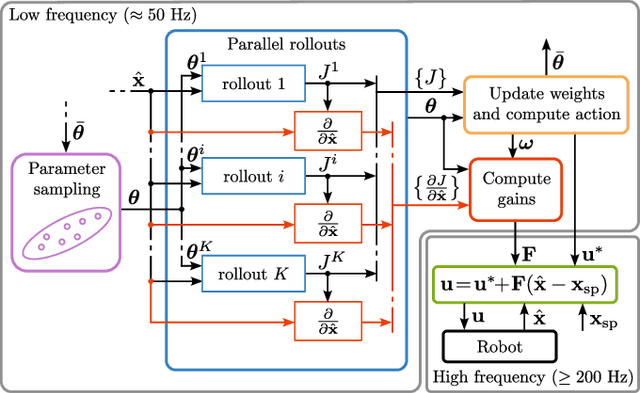
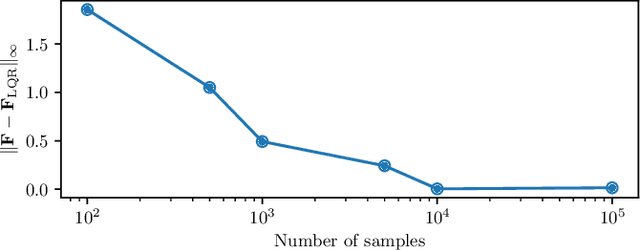
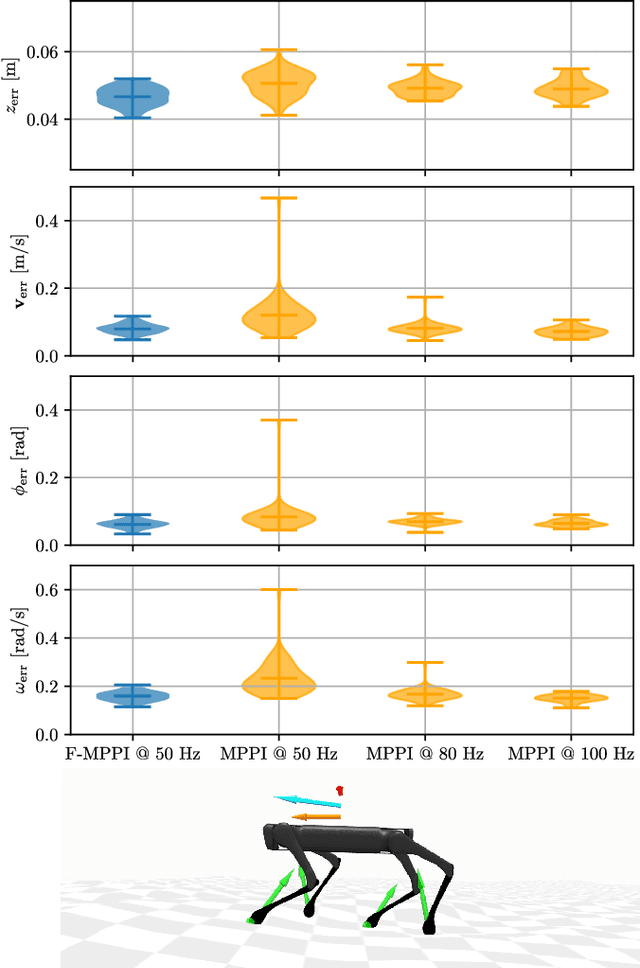
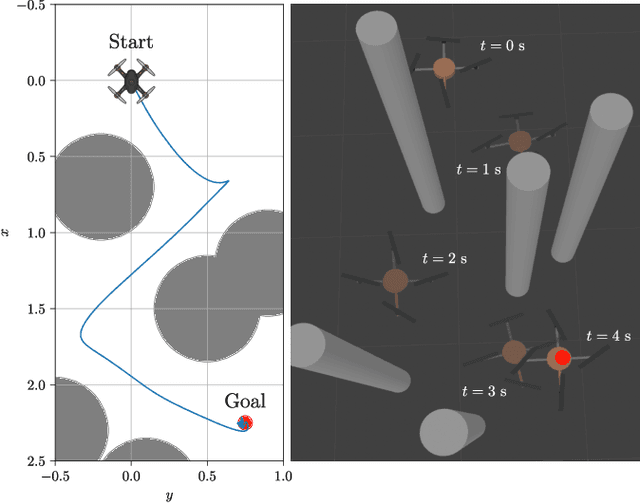
Model Predictive Path Integral control is a powerful sampling-based approach suitable for complex robotic tasks due to its flexibility in handling nonlinear dynamics and non-convex costs. However, its applicability in real-time, highfrequency robotic control scenarios is limited by computational demands. This paper introduces Feedback-MPPI (F-MPPI), a novel framework that augments standard MPPI by computing local linear feedback gains derived from sensitivity analysis inspired by Riccati-based feedback used in gradient-based MPC. These gains allow for rapid closed-loop corrections around the current state without requiring full re-optimization at each timestep. We demonstrate the effectiveness of F-MPPI through simulations and real-world experiments on two robotic platforms: a quadrupedal robot performing dynamic locomotion on uneven terrain and a quadrotor executing aggressive maneuvers with onboard computation. Results illustrate that incorporating local feedback significantly improves control performance and stability, enabling robust, high-frequency operation suitable for complex robotic systems.