 Add to Chrome
 Add to Firefox
 Add to Edge
Learning Reusable Hybrid Motion Priors for Humanoid Locomotion from Motion Imitation
Jul 27, 2026
Reinforcement learning can produce robust humanoid controllers, but each new task is typically trained as a separate policy with its own reward design and training process. Motion imitation provides an alternative source of motor competence by training policies to track retargeted human motions, yet the resulting controllers remain reference trackers and are not directly usable as task policies. We propose a three-stage pipeline that turns motion-imitation skills into a reusable hybrid motion prior (HMP) for humanoid locomotion. First, an expert policy is trained to imitate retargeted human motion-capture clips. Second, the expert is distilled into a frozen architecture composed of a proprioceptive encoder, a residual vector-quantized (RVQ) codebook, and an action decoder. Third, task-level policies are trained to solve locomotion tasks by selecting discrete codebook entries while the HMP remains frozen. We evaluate the method on velocity tracking, point-goal navigation, and fall-recovery velocity tracking in simulation, and deploy the velocity-tracking policy on a real Unitree G1 robot. The distillation process preserves the tracking behavior of the expert, while the resulting HMP can be reused without retraining as the action interface for different downstream locomotion policies. The learned HMP reveals an interpretable codebook structure in which the number of active RVQ stages modulates the available gait patterns. We further show that training the codebook with the rotation trick improves latent organization and reduces downstream falls compared with a standard straight-through estimator.

Synthetic Data Generation for Anomaly Detection on Table Grapes
Dec 17, 2024

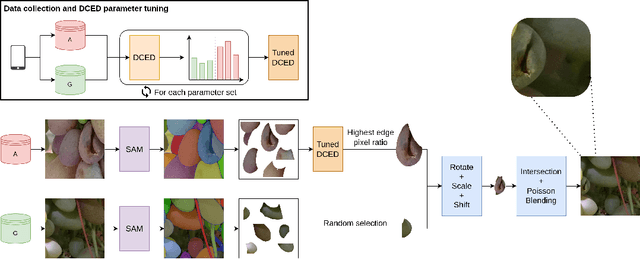
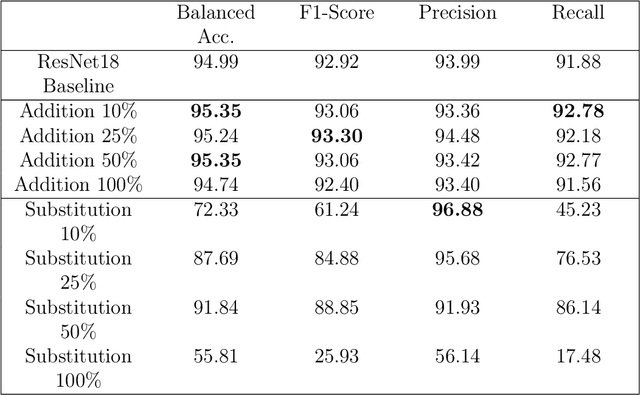
Early detection of illnesses and pest infestations in fruit cultivation is critical for maintaining yield quality and plant health. Computer vision and robotics are increasingly employed for the automatic detection of such issues, particularly using data-driven solutions. However, the rarity of these problems makes acquiring and processing the necessary data to train such algorithms a significant obstacle. One solution to this scarcity is the generation of synthetic high-quality anomalous samples. While numerous methods exist for this task, most require highly trained individuals for setup. This work addresses the challenge of generating synthetic anomalies in an automatic fashion that requires only an initial collection of normal and anomalous samples from the user - a task that is straightforward for farmers. We demonstrate the approach in the context of table grape cultivation. Specifically, based on the observation that normal berries present relatively smooth surfaces, while defects result in more complex textures, we introduce a Dual-Canny Edge Detection (DCED) filter. This filter emphasizes the additional texture indicative of diseases, pest infestations, or other defects. Using segmentation masks provided by the Segment Anything Model, we then select and seamlessly blend anomalous berries onto normal ones. We show that the proposed dataset augmentation technique improves the accuracy of an anomaly classifier for table grapes and that the approach can be generalized to other fruit types.