 Add to Chrome
 Add to Firefox
 Add to Edge
Closing the Lab-to-Store Gap: A Data-Efficient Post-Training and Experience-Driven Learning VLA Framework for Retail Humanoids
Jul 22, 2026
Closing the gap between benchmark performance and reliable real-world operation remains a central challenge for Vision-Language-Action (VLA) humanoid robots, which must handle execution errors, distribution shifts, and environmental variability. This paper presents DEED (Data-Efficient Post-Training and Experience-Driven Learning), a systems-level approach evaluated on a supermarket chip-restocking task using a Unitree G1-Edu humanoid robot and the GR00T N1.6 foundation model. DEED comprises three key components: (1) a data-efficient post-training pipeline with control-frequency alignment, data curation, task-relevant visual highlighting, and reduced VLA dependence; (2) a real-world study of experience-driven refinement, adapted from RECAP via a text-based advantage prefix and a vision-language value function; and (3) a latent-space analysis tool for studying in- and out-of-distribution behavior. Our results suggest that bridging the lab-to-store gap is primarily a systems integration challenge rather than an architectural one: careful data design and targeted post-training can transform a policy that fails under naive fine-tuning into a competent real-world system using only a single GPU.

G$^3$VLA: Geometric inductive bias for Vision-Language-Action Models
Jun 23, 2026Vision-language-action (VLA) models have made rapid progress in generalist robot manipulation by harnessing semantic knowledge from pretrained vision-language backbones, but their visual tokens remain grounded in 2D image coordinates rather than the calibrated geometry of the robot's cameras -- a mismatch especially pronounced in multi-camera setups, where views are coupled by known intrinsics and extrinsics yet processed as independent images. We propose G$^3$VLA, a camera-aware geometric module that injects calibrated structure into the visual-token stream of a pretrained VLA without altering its action space or imitation objective, combining intrinsic-conditioned ray embeddings, projective positional encoding (PRoPE), and bidirectional cross-view fusion. Geometric supervision is provided either from ground-truth point maps when available, or from confidence-gated $π^3$X teacher predictions, requiring no depth sensors or manual annotations. Instantiated on $π_0$, G$^3$VLA yields consistent gains across the LIBERO suites, RoboCasa24, RoboTwin2.0, and real-robot settings, with the largest improvements on spatially and object-sensitive tasks. We further validate on $π_{0.5}$ and GR00T 1.5, with results suggesting that geometric transfer is most effective when geometry-aware tokens have direct access to the action generation pathway. Our project page is at https://sites.google.com/view/g3vla
Finetuning Vision-Language-Action Models Requires Fewer Layers Than You Think
Jun 18, 2026Vision-Language-Action (VLA) models pre-trained on massive video-robot datasets have revolutionized robotic manipulation, yet their multi-billion parameter architectures impose prohibitive computational burdens during downstream fine-tuning and real-time inference. In this work, we reveal a highly non-trivial architectural characteristic of these continuous control foundation policies (e.g., pi_0, GR00T-N1.5): despite being trained on diverse physical trajectories, they exhibit severe layer-wise representational redundancy. To exploit this, we introduce a structural compression pipeline that is entirely training-free, bypassing the need of existing methods to load full-scale models to learn optimized token reductions or dynamic layer selectors. Instead, using only a single forward pass via Centered Kernel Alignment to identify redundant layer features, we remove twin layers to permanently compress the model depth by up to 50% across both the VLM backbone and the continuous control policy head. Downstream fine-tuning of this streamlined architecture yields a dual acceleration benefit: a 40-50% reduction in training time and up to 30% faster real-time inference, while matching or exceeding full-scale base model performance. We comprehensively validate our method across three simulation benchmarks (LIBERO, RoboCasa, SimplerEnv) and 10 diverse real-world manipulation tasks across 4 unique robotic embodiments. These results prove that advanced VLAs require significantly fewer layers than previously assumed, offering a highly compute-efficient paradigm for scalable robot learning.
FOCA: Future-Oriented Conditioning for Data-Efficient Vision-Language-Action Adaptation
Jun 18, 2026Vision-Language-Action (VLA) models enable general-purpose robotic control via large-scale multimodal pretraining, yet their effectiveness under few-shot imitation learning remains limited. We conduct a systematic stress test of state-of-the-art VLA models and show that performance degrades sharply as demonstrations are reduced, revealing a key weakness of existing adaptation strategies. To address this, we introduce FOCA, a future-oriented conditioning framework for data-efficient VLA adaptation. FOCA combines explicit prediction of task-grounded future interaction embeddings with implicit alignment to future goal observations, enabling long-horizon reasoning in latent space without pixel-level prediction. This formulation naturally supports action-free co-training with synthetic videos from video world models and can be interpreted as learning a future-conditioned value-like representation. Extensive experiments demonstrate FOCA achieves 95.7% success with 20 demonstrations on LIBERO, improves 7-12% on RoboCasa, and delivers up to 26% absolute gains on real robots, establishing a new state of the art in few-shot VLA adaptation.
Adversarial Sensor Errors for Safe and Robust Wind Turbine Fleet Control
Apr 09, 2026Plant-level control is an emerging wind energy technology that presents opportunities and challenges. By controlling turbines in a coordinated manner via a central controller, it is possible to achieve greater wind power plant efficiency. However, there is a risk that measurement errors will confound the process, or even that hackers will alter the telemetry signals received by the central controller. This paper presents a framework for developing a safe plant controller by training it with an adversarial agent designed to confound it. This necessitates training the adversary to confound the controller, creating a sort of circular logic or "Arms Race." This paper examines three broad training approaches for co-training the protagonist and adversary, finding that an Arms Race approach yields the best results. These initial results indicate that the Arms Race adversarial training reduced worst-case performance degradation from 39% power loss to 7.9% power gain relative to a baseline operational strategy.
Interactive Identification of Granular Materials using Force Measurements
Mar 26, 2024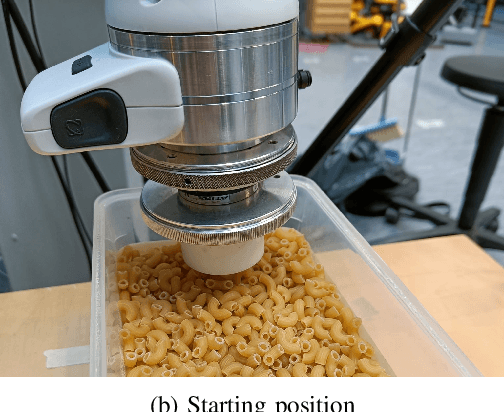
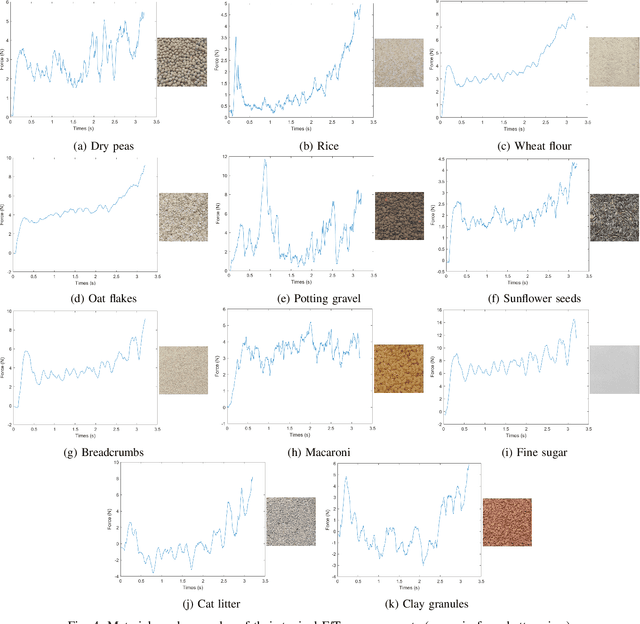
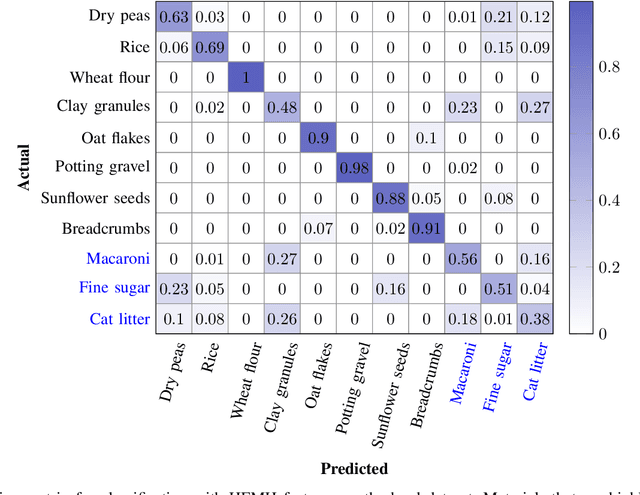
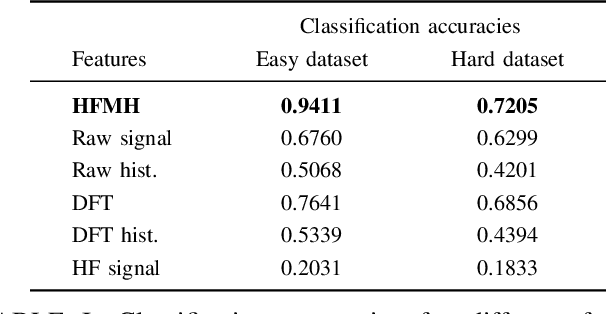
The ability to identify granular materials facilitates the emergence of various new applications in robotics, ranging from cooking at home to truck loading at mining sites. However, granular material identification remains a challenging and underexplored area. In this work, we present a novel interactive material identification framework that enables robots to identify a wide range of granular materials using only a force-torque sensor for perception. Our framework, comprising interactive exploration, feature extraction, and classification stages, prioritizes simplicity and transparency for seamless integration into various manipulation pipelines. We evaluate the proposed approach through extensive experiments with a real-world dataset comprising 11 granular materials, which we also make publicly available. Additionally, we conducted a comprehensive qualitative analysis of the dataset to offer deeper insights into its nature, aiding future development. Our results show that the proposed method is capable of accurately identifying a wide range of granular materials solely relying on force measurements obtained from direct interaction with the materials. Code and dataset are available at: https://irobotics.aalto.fi/indentify_granular/.
Dynamic Manipulation of Deformable Objects using Imitation Learning with Adaptation to Hardware Constraints
Mar 19, 2024Imitation Learning (IL) is a promising paradigm for learning dynamic manipulation of deformable objects since it does not depend on difficult-to-create accurate simulations of such objects. However, the translation of motions demonstrated by a human to a robot is a challenge for IL, due to differences in the embodiments and the robot's physical limits. These limits are especially relevant in dynamic manipulation where high velocities and accelerations are typical. To address this problem, we propose a framework that first maps a dynamic demonstration into a motion that respects the robot's constraints using a constrained Dynamic Movement Primitive. Second, the resulting object state is further optimized by quasi-static refinement motions to optimize task performance metrics. This allows both efficiently altering the object state by dynamic motions and stable small-scale refinements. We evaluate the framework in the challenging task of bag opening, designing the system BILBO: Bimanual dynamic manipulation using Imitation Learning for Bag Opening. Our results show that BILBO can successfully open a wide range of crumpled bags, using a demonstration with a single bag. See supplementary material at https://sites.google.com/view/bilbo-bag.
Online Learning of Human Constraints from Feedback in Shared Autonomy
Mar 05, 2024Real-time collaboration with humans poses challenges due to the different behavior patterns of humans resulting from diverse physical constraints. Existing works typically focus on learning safety constraints for collaboration, or how to divide and distribute the subtasks between the participating agents to carry out the main task. In contrast, we propose to learn a human constraints model that, in addition, considers the diverse behaviors of different human operators. We consider a type of collaboration in a shared-autonomy fashion, where both a human operator and an assistive robot act simultaneously in the same task space that affects each other's actions. The task of the assistive agent is to augment the skill of humans to perform a shared task by supporting humans as much as possible, both in terms of reducing the workload and minimizing the discomfort for the human operator. Therefore, we propose an augmentative assistant agent capable of learning and adapting to human physical constraints, aligning its actions with the ergonomic preferences and limitations of the human operator.
SPONGE: Sequence Planning with Deformable-ON-Rigid Contact Prediction from Geometric Features
Mar 24, 2023Planning robotic manipulation tasks, especially those that involve interaction between deformable and rigid objects, is challenging due to the complexity in predicting such interactions. We introduce SPONGE, a sequence planning pipeline powered by a deep learning-based contact prediction model for contacts between deformable and rigid bodies under interactions. The contact prediction model is trained on synthetic data generated by a developed simulation environment to learn the mapping from point-cloud observation of a rigid target object and the pose of a deformable tool, to 3D representation of the contact points between the two bodies. We experimentally evaluated the proposed approach for a dish cleaning task both in simulation and on a real \panda with real-world objects. The experimental results demonstrate that in both scenarios the proposed planning pipeline is capable of generating high-quality trajectories that can accomplish the task by achieving more than 90\% area coverage on different objects of varying sizes and curvatures while minimizing travel distance. Code and video are available at: \url{https://irobotics.aalto.fi/sponge/}.
Constrained Generative Sampling of 6-DoF Grasps
Feb 21, 2023


Most state-of-the-art data-driven grasp sampling methods propose stable and collision-free grasps uniformly on the target object. For bin-picking, executing any of those grasps is sufficient. However, for completing specific tasks, such as squeezing out liquid from a bottle, we want the grasp to be on a specific part on the object body while avoiding other locations, such as the cap. In this work, we present a generative grasp sampling network, VCGS, capable of constrained 6-Degrees-of-Freedom (DoF) grasp sampling. In addition, we also curate a new dataset designed to train and evaluate methods for constrained grasping. The new dataset, called CONG, consists of over 14 million training samples of synthetically rendered point clouds and grasps at random target areas on 2889 objects. VCGS is benchmarked against GraspNet, a state-of-the-art unconstrained grasp sampler, in simulation and on a real robot. The results demonstrate that VCGS achieves a 10-15% higher grasp success rate than the baseline while being 2-3 times as sample efficient.