 Add to Chrome
 Add to Firefox
 Add to Edge
Autonomous Agricultural Tractor: Integrated Weed Detection and LiDAR Navigation for Precision Paddy Farming
Aug 19, 2026
Site-specific weed management in paddy farming offers substantial reductions in herbicide use over conventional broadcast spraying, but field deployment has been limited by three persistent challenges: robust crop-row navigation under canopy where GNSS degrades, real-time visual discrimination between rice and morphologically diverse weeds, and the asymmetric cost of misclassifying rice as weed, which is irreversible. This paper presents AgriNav, an integrated autonomous tractor system built around four ROS-coupled modules: a custom PyTorch reimplementation of WeedDet for rice detection, a parallel lightweight 1.68M-parameter CNN-FPN variant with asymmetric class weighting, an inverted-logic discrimination module that protects the rice class through a hardcoded confidence-gate veto, and a 6-state constant-velocity-turn-rate Extended Kalman Filter fusing GNSS, IMU, and wheel odometry with three-level outage bridging. Our primary system-level contribution is a four-mechanism LiDAR-camera fusion bridge that uses the navigation LiDAR for region-of-interest constraint, world-coordinate projection, ground-plane filtering, and bidirectional confidence fusion at zero additional hardware cost. Simulation experiments demonstrate continuous position tracking through a 20-second GNSS outage, crop row detection confidence above 0.9 throughout operation, and rice-detection confidences from 0.32 to 0.95 across paddy, aerial, and post-flood imagery. The LiDAR ROI constraint reduces detection inference region by an estimated 30 to 50 percent.

DROID: A Large-Scale In-The-Wild Robot Manipulation Dataset
Mar 19, 2024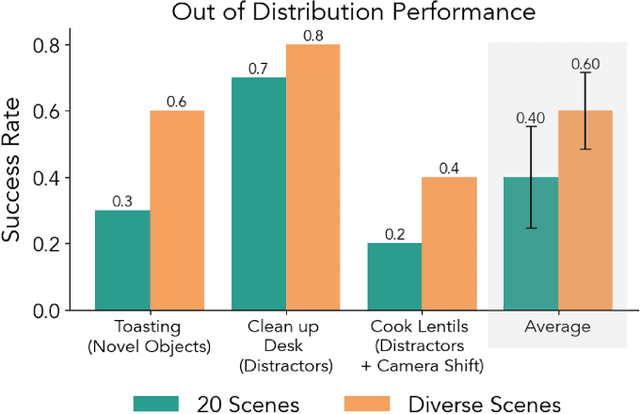
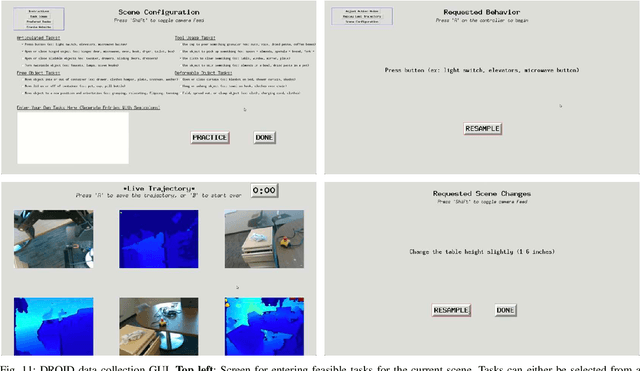
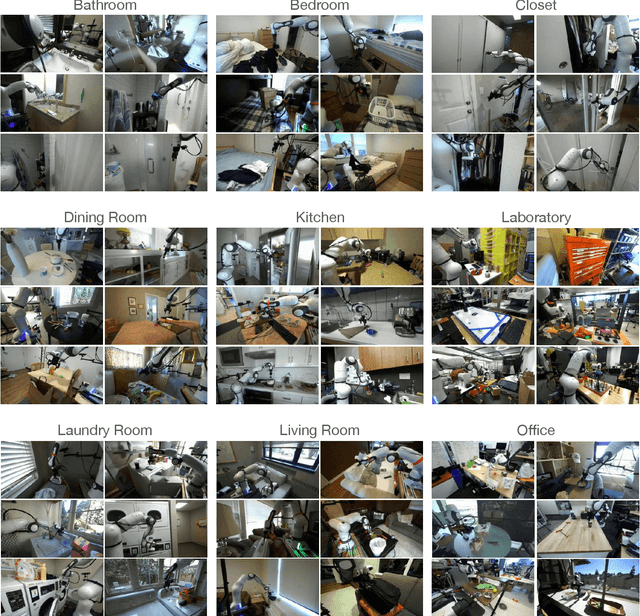
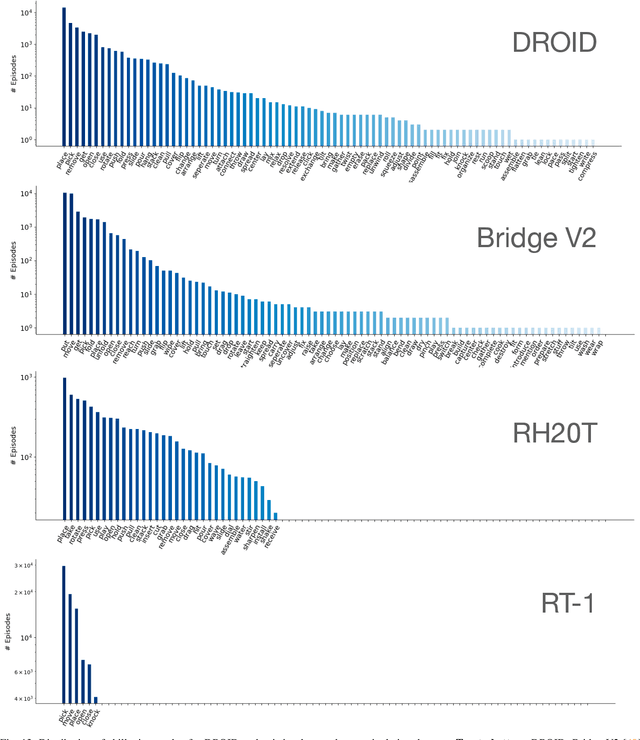
The creation of large, diverse, high-quality robot manipulation datasets is an important stepping stone on the path toward more capable and robust robotic manipulation policies. However, creating such datasets is challenging: collecting robot manipulation data in diverse environments poses logistical and safety challenges and requires substantial investments in hardware and human labour. As a result, even the most general robot manipulation policies today are mostly trained on data collected in a small number of environments with limited scene and task diversity. In this work, we introduce DROID (Distributed Robot Interaction Dataset), a diverse robot manipulation dataset with 76k demonstration trajectories or 350 hours of interaction data, collected across 564 scenes and 84 tasks by 50 data collectors in North America, Asia, and Europe over the course of 12 months. We demonstrate that training with DROID leads to policies with higher performance and improved generalization ability. We open source the full dataset, policy learning code, and a detailed guide for reproducing our robot hardware setup.