 Add to Chrome
 Add to Firefox
 Add to Edge
Autonomous Agricultural Tractor: Integrated Weed Detection and LiDAR Navigation for Precision Paddy Farming
Aug 19, 2026
Site-specific weed management in paddy farming offers substantial reductions in herbicide use over conventional broadcast spraying, but field deployment has been limited by three persistent challenges: robust crop-row navigation under canopy where GNSS degrades, real-time visual discrimination between rice and morphologically diverse weeds, and the asymmetric cost of misclassifying rice as weed, which is irreversible. This paper presents AgriNav, an integrated autonomous tractor system built around four ROS-coupled modules: a custom PyTorch reimplementation of WeedDet for rice detection, a parallel lightweight 1.68M-parameter CNN-FPN variant with asymmetric class weighting, an inverted-logic discrimination module that protects the rice class through a hardcoded confidence-gate veto, and a 6-state constant-velocity-turn-rate Extended Kalman Filter fusing GNSS, IMU, and wheel odometry with three-level outage bridging. Our primary system-level contribution is a four-mechanism LiDAR-camera fusion bridge that uses the navigation LiDAR for region-of-interest constraint, world-coordinate projection, ground-plane filtering, and bidirectional confidence fusion at zero additional hardware cost. Simulation experiments demonstrate continuous position tracking through a 20-second GNSS outage, crop row detection confidence above 0.9 throughout operation, and rice-detection confidences from 0.32 to 0.95 across paddy, aerial, and post-flood imagery. The LiDAR ROI constraint reduces detection inference region by an estimated 30 to 50 percent.

TheoremExplainAgent: Towards Multimodal Explanations for LLM Theorem Understanding
Feb 26, 2025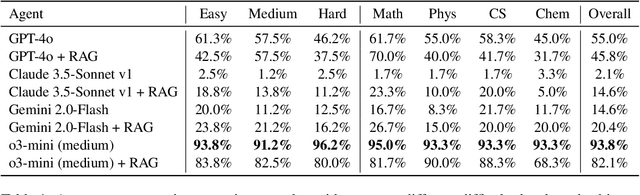
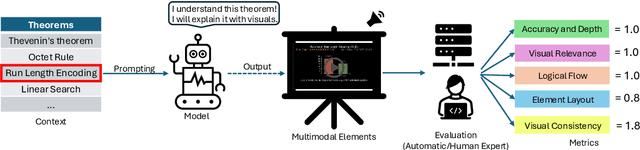
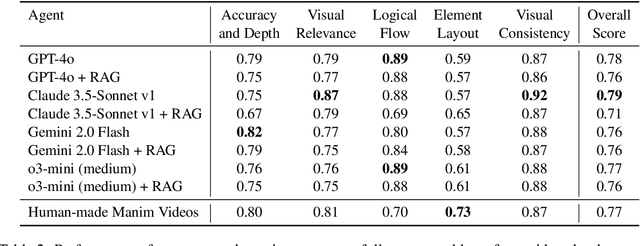

Understanding domain-specific theorems often requires more than just text-based reasoning; effective communication through structured visual explanations is crucial for deeper comprehension. While large language models (LLMs) demonstrate strong performance in text-based theorem reasoning, their ability to generate coherent and pedagogically meaningful visual explanations remains an open challenge. In this work, we introduce TheoremExplainAgent, an agentic approach for generating long-form theorem explanation videos (over 5 minutes) using Manim animations. To systematically evaluate multimodal theorem explanations, we propose TheoremExplainBench, a benchmark covering 240 theorems across multiple STEM disciplines, along with 5 automated evaluation metrics. Our results reveal that agentic planning is essential for generating detailed long-form videos, and the o3-mini agent achieves a success rate of 93.8% and an overall score of 0.77. However, our quantitative and qualitative studies show that most of the videos produced exhibit minor issues with visual element layout. Furthermore, multimodal explanations expose deeper reasoning flaws that text-based explanations fail to reveal, highlighting the importance of multimodal explanations.