 Add to Chrome
 Add to Firefox
 Add to Edge
Operationalising the Superficial Alignment Hypothesis via Task Complexity
Feb 17, 2026
The superficial alignment hypothesis (SAH) posits that large language models learn most of their knowledge during pre-training, and that post-training merely surfaces this knowledge. The SAH, however, lacks a precise definition, which has led to (i) different and seemingly orthogonal arguments supporting it, and (ii) important critiques to it. We propose a new metric called task complexity: the length of the shortest program that achieves a target performance on a task. In this framework, the SAH simply claims that pre-trained models drastically reduce the complexity of achieving high performance on many tasks. Our definition unifies prior arguments supporting the SAH, interpreting them as different strategies to find such short programs. Experimentally, we estimate the task complexity of mathematical reasoning, machine translation, and instruction following; we then show that these complexities can be remarkably low when conditioned on a pre-trained model. Further, we find that pre-training enables access to strong performances on our tasks, but it can require programs of gigabytes of length to access them. Post-training, on the other hand, collapses the complexity of reaching this same performance by several orders of magnitude. Overall, our results highlight that task adaptation often requires surprisingly little information -- often just a few kilobytes.

Tracr-Injection: Distilling Algorithms into Pre-trained Language Models
May 19, 2025Motivated by the surge of large language models, there has been a push to formally characterize the symbolic abilities intrinsic to the transformer architecture. A programming language, called RASP, has been proposed, which can be directly compiled into transformer weights to implement these algorithms. However, the tasks that can be implemented in RASP are often uncommon to learn from natural unsupervised data, showing a mismatch between theoretical capabilities of the transformer architecture, and the practical learnability of these capabilities from unsupervised data. We propose tracr-injection, a method that allows us to distill algorithms written in RASP directly into a pre-trained language model. We showcase our method by injecting 3 different algorithms into a language model. We show how our method creates an interpretable subspace within the model's residual stream, which can be decoded into the variables present in the code of the RASP algorithm. Additionally, we found that the proposed method can improve out-of-distribution performance compared to our baseline, indicating that indeed a more symbolic mechanism is taking place in the inner workings of the model. We release the code used to run our experiments.
From Insights to Actions: The Impact of Interpretability and Analysis Research on NLP
Jun 18, 2024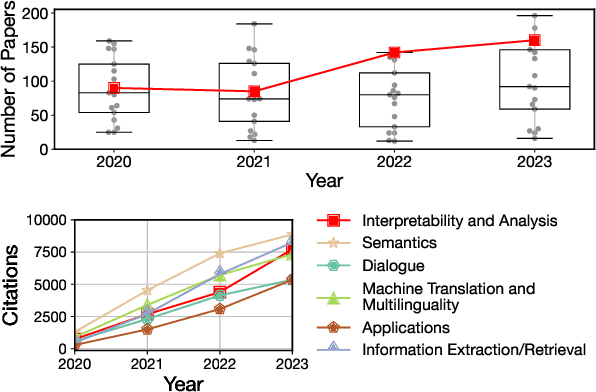
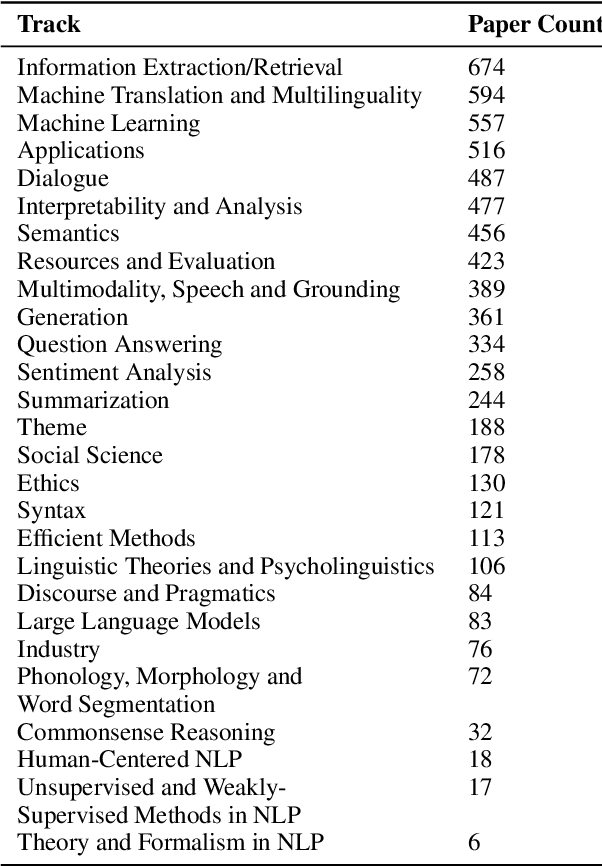

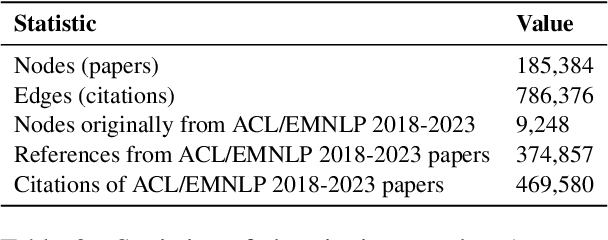
Interpretability and analysis (IA) research is a growing subfield within NLP with the goal of developing a deeper understanding of the behavior or inner workings of NLP systems and methods. Despite growing interest in the subfield, a commonly voiced criticism is that it lacks actionable insights and therefore has little impact on NLP. In this paper, we seek to quantify the impact of IA research on the broader field of NLP. We approach this with a mixed-methods analysis of: (1) a citation graph of 185K+ papers built from all papers published at ACL and EMNLP conferences from 2018 to 2023, and (2) a survey of 138 members of the NLP community. Our quantitative results show that IA work is well-cited outside of IA, and central in the NLP citation graph. Through qualitative analysis of survey responses and manual annotation of 556 papers, we find that NLP researchers build on findings from IA work and perceive it is important for progress in NLP, multiple subfields, and rely on its findings and terminology for their own work. Many novel methods are proposed based on IA findings and highly influenced by them, but highly influential non-IA work cites IA findings without being driven by them. We end by summarizing what is missing in IA work today and provide a call to action, to pave the way for a more impactful future of IA research.
Eigenpruning
Apr 04, 2024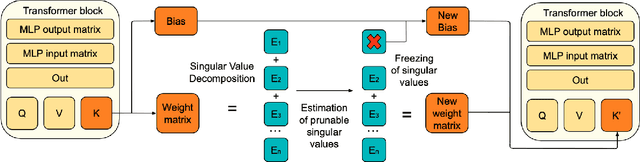


We introduce eigenpruning, a method that removes singular values from weight matrices in an LLM to improve its performance in a particular task. This method is inspired by interpretability methods designed to automatically find subnetworks of a model which solve a specific task. In our tests, the pruned model outperforms the original model by a large margin, while only requiring minimal computation to prune the weight matrices. In the case of a small synthetic task in integer multiplication, the Phi-2 model can improve its accuracy in the test set from 13.75% to 97.50%. Interestingly, these results seem to indicate the existence of a computation path that can solve the task very effectively, but it was not being used by the original model. Finally, we plan to open-source our implementation in the camera-ready version of our work.