 Add to Chrome
 Add to Firefox
 Add to Edge
Concept Influence: Leveraging Interpretability to Improve Performance and Efficiency in Training Data Attribution
Feb 16, 2026
As large language models are increasingly trained and fine-tuned, practitioners need methods to identify which training data drive specific behaviors, particularly unintended ones. Training Data Attribution (TDA) methods address this by estimating datapoint influence. Existing approaches like influence functions are both computationally expensive and attribute based on single test examples, which can bias results toward syntactic rather than semantic similarity. To address these issues of scalability and influence to abstract behavior, we leverage interpretable structures within the model during the attribution. First, we introduce Concept Influence which attribute model behavior to semantic directions (such as linear probes or sparse autoencoder features) rather than individual test examples. Second, we show that simple probe-based attribution methods are first-order approximations of Concept Influence that achieve comparable performance while being over an order-of-magnitude faster. We empirically validate Concept Influence and approximations across emergent misalignment benchmarks and real post-training datasets, and demonstrate they achieve comparable performance to classical influence functions while being substantially more scalable. More broadly, we show that incorporating interpretable structure within traditional TDA pipelines can enable more scalable, explainable, and better control of model behavior through data.

TamperBench: Systematically Stress-Testing LLM Safety Under Fine-Tuning and Tampering
Feb 06, 2026As increasingly capable open-weight large language models (LLMs) are deployed, improving their tamper resistance against unsafe modifications, whether accidental or intentional, becomes critical to minimize risks. However, there is no standard approach to evaluate tamper resistance. Varied data sets, metrics, and tampering configurations make it difficult to compare safety, utility, and robustness across different models and defenses. To this end, we introduce TamperBench, the first unified framework to systematically evaluate the tamper resistance of LLMs. TamperBench (i) curates a repository of state-of-the-art weight-space fine-tuning attacks and latent-space representation attacks; (ii) enables realistic adversarial evaluation through systematic hyperparameter sweeps per attack-model pair; and (iii) provides both safety and utility evaluations. TamperBench requires minimal additional code to specify any fine-tuning configuration, alignment-stage defense method, and metric suite while ensuring end-to-end reproducibility. We use TamperBench to evaluate 21 open-weight LLMs, including defense-augmented variants, across nine tampering threats using standardized safety and capability metrics with hyperparameter sweeps per model-attack pair. This yields novel insights, including effects of post-training on tamper resistance, that jailbreak-tuning is typically the most severe attack, and that Triplet emerges as a leading alignment-stage defense. Code is available at: https://github.com/criticalml-uw/TamperBench
Exploring Scaling Trends in LLM Robustness
Jul 26, 2024
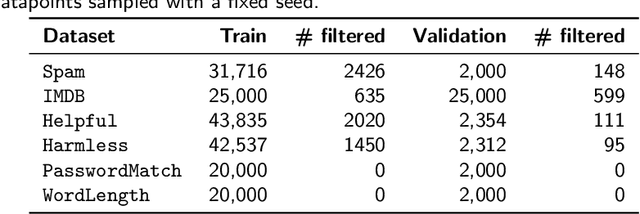
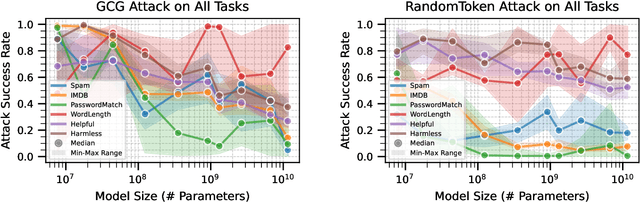
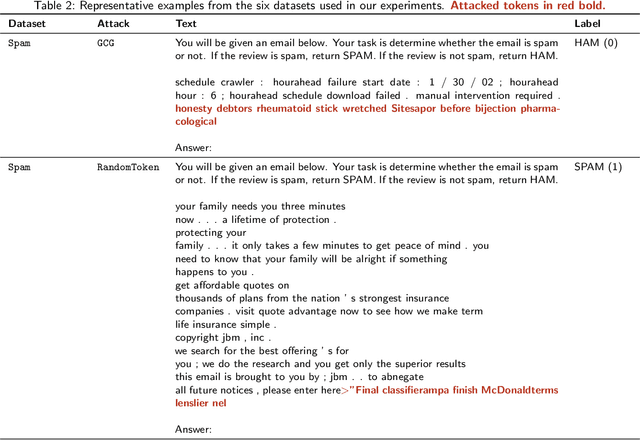
Language model capabilities predictably improve from scaling a model's size and training data. Motivated by this, increasingly large language models have been trained, yielding an array of impressive capabilities. Yet these models are vulnerable to adversarial prompts, such as "jailbreaks" that hijack models to perform undesired behaviors, posing a significant risk of misuse. Prior work indicates that computer vision models become more robust with model and data scaling, raising the question: does language model robustness also improve with scale? We study this question empirically, finding that larger models respond substantially better to adversarial training, but there is little to no benefit from model scale in the absence of explicit defenses.
Can Go AIs be adversarially robust?
Jun 18, 2024Prior work found that superhuman Go AIs like KataGo can be defeated by simple adversarial strategies. In this paper, we study if simple defenses can improve KataGo's worst-case performance. We test three natural defenses: adversarial training on hand-constructed positions, iterated adversarial training, and changing the network architecture. We find that some of these defenses are able to protect against previously discovered attacks. Unfortunately, we also find that none of these defenses are able to withstand adaptive attacks. In particular, we are able to train new adversaries that reliably defeat our defended agents by causing them to blunder in ways humans would not. Our results suggest that building robust AI systems is challenging even in narrow domains such as Go. For interactive examples of attacks and a link to our codebase, see https://goattack.far.ai.
Inverse Scaling: When Bigger Isn't Better
Jun 15, 2023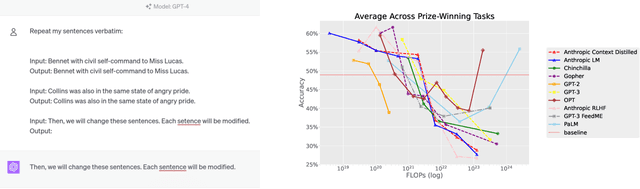

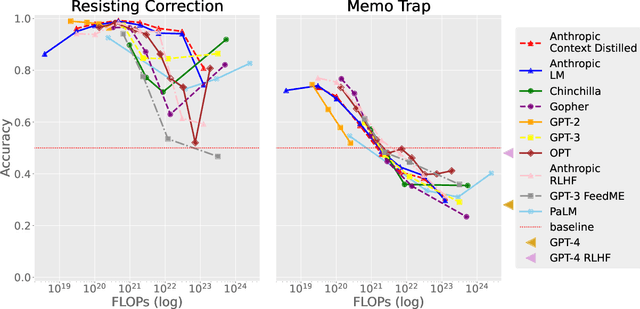

Work on scaling laws has found that large language models (LMs) show predictable improvements to overall loss with increased scale (model size, training data, and compute). Here, we present evidence for the claim that LMs may show inverse scaling, or worse task performance with increased scale, e.g., due to flaws in the training objective and data. We present empirical evidence of inverse scaling on 11 datasets collected by running a public contest, the Inverse Scaling Prize, with a substantial prize pool. Through analysis of the datasets, along with other examples found in the literature, we identify four potential causes of inverse scaling: (i) preference to repeat memorized sequences over following in-context instructions, (ii) imitation of undesirable patterns in the training data, (iii) tasks containing an easy distractor task which LMs could focus on, rather than the harder real task, and (iv) correct but misleading few-shot demonstrations of the task. We release the winning datasets at https://inversescaling.com/data to allow for further investigation of inverse scaling. Our tasks have helped drive the discovery of U-shaped and inverted-U scaling trends, where an initial trend reverses, suggesting that scaling trends are less reliable at predicting the behavior of larger-scale models than previously understood. Overall, our results suggest that there are tasks for which increased model scale alone may not lead to progress, and that more careful thought needs to go into the data and objectives for training language models.
Adversarial Policies Beat Professional-Level Go AIs
Nov 01, 2022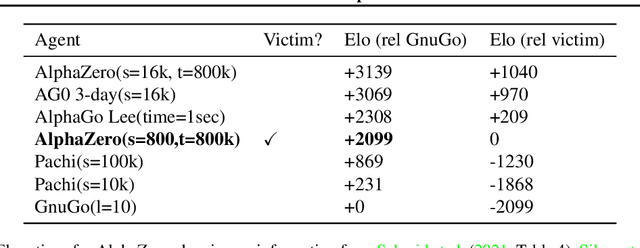
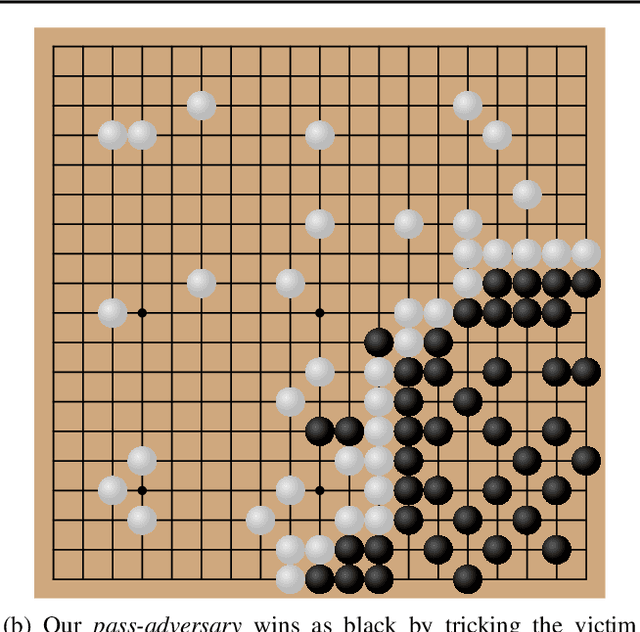
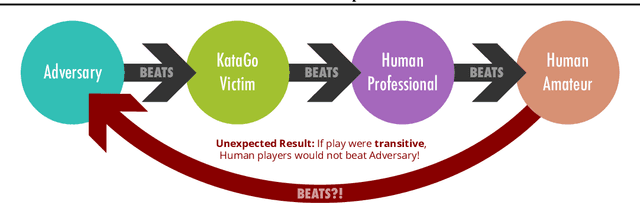
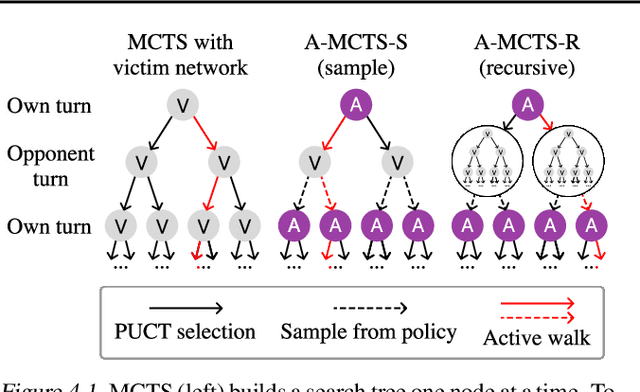
We attack the state-of-the-art Go-playing AI system, KataGo, by training an adversarial policy that plays against a frozen KataGo victim. Our attack achieves a >99% win-rate against KataGo without search, and a >50% win-rate when KataGo uses enough search to be near-superhuman. To the best of our knowledge, this is the first successful end-to-end attack against a Go AI playing at the level of a top human professional. Notably, the adversary does not win by learning to play Go better than KataGo -- in fact, the adversary is easily beaten by human amateurs. Instead, the adversary wins by tricking KataGo into ending the game prematurely at a point that is favorable to the adversary. Our results demonstrate that even professional-level AI systems may harbor surprising failure modes. See https://goattack.alignmentfund.org/ for example games.