 Add to Chrome
 Add to Firefox
 Add to Edge
Compressed Computation under $L^4$ Loss is likely Computation in Superposition
Jul 06, 2026
Neural networks are thought to represent concepts as directions in their activation space, and superposition lets them encode more concepts than they have dimensions. It is natural to ask whether they can also compute more functions than they have neurons, i.e., perform computation in superposition. In this regime many functions of sparse inputs are evaluated by a layer with fewer neurons than there are functions to compute. Representation in superposition is by now fairly well understood, but computation in superposition is not, and there are few toy models of it arising through training rather than being hand designed. As a toy model of computation in superposition we study the compressed-computation setup: a single-hidden-layer ReLU network with 50 neurons that must compute the ReLU of each of 100 sparse input features. We show that training it under an $L^4$ loss (the mean fourth power of the error), rather than the usual $L^2$, elicits a solution that appears to compute all features in superposition. We then reverse-engineer this solution. We find that the network assigns each feature a sparse binary codeword over neurons and decodes it with a pseudoinverse of the encoder. Given these codewords, a description with only three scalars recovers most of the network's performance, and we validate it by building equivalent networks from hand-designed codes.

Individual Parameters in Weight-Sparse Transformers Appear Interpretable
Jul 03, 2026A central goal of mechanistic interpretability is to understand how neural networks work and what each individual component does. Dominant circuit-finding approaches focus on a specific behavior and reverse-engineer the role of components on the associated sub-distribution. However, past work has shown that components can have different functions that are active on different subsets of the input distribution. In this work we ask whether a single weight can be understood globally across the full training distribution by characterizing when it matters (the inputs on which ablating it changes the model's predictions). We introduce an automated LLM pipeline that writes a short, human-readable description of when a weight matters and verifies it on held-out text, crediting a weight only if its description generalizes. Across two sparse and two dense transformers, the fraction of weights that are interpretable (in this sense) is higher in sparse transformers than in dense ones, a gap that widens once unreliable descriptions are discarded. Our results show that a meaningful fraction of a sparse transformer model's weights can be interpreted: 12 to 31% of weights have a single short description that identifies what the weight is used for.
The Model Organism Lottery: Model Organism Interpretability Strongly Depends on Training Methodology
Jul 01, 2026Model organisms (MOs) - language models trained to exhibit undesired or unnatural behaviours - are frequently used as testbeds for evaluating white-box interpretability techniques. Current MOs are typically constructed via post-hoc supervised fine-tuning (SFT) on behavioural transcripts or synthetic documents. Prior research has shown that interpretability methods can easily identify hidden behaviours in these MOs. However, recent work suggests that such post-hoc training methods may make interpretability unrealistically easy. We investigate this claim by constructing a suite of 54 $\verb|OLMo2-1B|$- and $\verb|gemma-3-1b-it|$-based MOs trained with seven different techniques, including standard post-hoc SFT, post-hoc DPO, and more realistic integration of MO data into the OLMo post-training DPO phase. We use these MO variants to benchmark activation oracles, activation steering, logit lens, and sparse autoencoders. Our findings show that (i) MO interpretability depends strongly on training objective, target behaviour, model architecture, and training data generation pipeline; (ii) substantial variance remains even after controlling for differences in the strength of target behaviour expression; and (iii) our more realistic $\textit{integrated training}$ often yields less interpretable MOs than standard post-hoc methods. Our results cast substantial doubt on the validity of current MOs as interpretability proxies.
Evidence for feature-specific error correction in LLMs
Jun 23, 2026Understanding the features of large language models (LLMs) is a central goal of interpretability. LLMs are commonly assumed to use superposition to represent more features than they have dimensions. They may not only represent features in superposition but also perform computation in superposition. Theory predicts that computing in superposition requires error correction that privileges feature directions over generic ones, but this prediction has not been tested empirically. We propose an empirical test of error correction in LLMs based on activation perturbations. Perturbing residual-stream activations, we find that they are robust to small perturbations--forming activation plateaus consistent with error correction--but less robust along candidate feature directions ("pure" directions, constructed from contrastive prompt pairs) than along mixtures of two such directions, indicating that the pure directions are privileged. We quantify this privilegedness by modeling the perturbation effect as a function of the $L^p$-norm of its decomposition into feature components. For $p=2$ the response is a quadratic form with at most as many nonzero eigenvalues as the residual-stream dimension, which cannot privilege the many feature directions superposition requires. $p>2$ lifts this constraint and is consistent with feature-specific error correction. We find $p>2$ for contrastive, MELBO, and SAE-decoder directions, and $p\approx2$ for random and PCA directions (controls). These results replicate across Gemma-2-9B, Qwen3-1.7B, Llama-3.1-8B, Mistral-7B-v0.3, Aya-Expanse-8B, and Yi-1.5-9B. We further validate our method on a toy model of error correction with known ground-truth features, recovering $p>2$ for true feature directions, degrading toward $2$ as we rotate away from them.
Compressed Computation is (probably) not Computation in Superposition
Jun 12, 2026We study whether the Compressed Computation (CC) toy model (Braun et al., 2025) is an instance of computation in superposition. The CC model appears to compute 100 ReLU functions with just 50 neurons, achieving a better loss than expected from only representing 50 ReLU functions. We show that the model mixes inputs via its noisy residual stream, corresponding to an unintended mixing matrix in the labels. Splitting the training objective into the ReLU term and the mixing term, we find that performance gains scale with the magnitude of the mixing matrix and vanish when the matrix is removed. The learned neuron directions concentrate in the subspace associated with the top 50 eigenvalues of the mixing matrix, suggesting that the mixing term governs the solution. Finally, a semi-non-negative matrix factorization (SNMF) baseline derived solely from the mixing matrix reproduces the qualitative loss profile and improves on prior baselines, though it does not match the trained model. These results suggest CC is not a suitable toy model of computation in superposition.
The Obfuscation Atlas: Mapping Where Honesty Emerges in RLVR with Deception Probes
Feb 17, 2026Training against white-box deception detectors has been proposed as a way to make AI systems honest. However, such training risks models learning to obfuscate their deception to evade the detector. Prior work has studied obfuscation only in artificial settings where models were directly rewarded for harmful output. We construct a realistic coding environment where reward hacking via hardcoding test cases naturally occurs, and show that obfuscation emerges in this setting. We introduce a taxonomy of possible outcomes when training against a deception detector. The model either remains honest, or becomes deceptive via two possible obfuscation strategies. (i) Obfuscated activations: the model outputs deceptive text while modifying its internal representations to no longer trigger the detector. (ii) Obfuscated policy: the model outputs deceptive text that evades the detector, typically by including a justification for the reward hack. Empirically, obfuscated activations arise from representation drift during RL, with or without a detector penalty. The probe penalty only incentivizes obfuscated policies; we theoretically show this is expected for policy gradient methods. Sufficiently high KL regularization and detector penalty can yield honest policies, establishing white-box deception detectors as viable training signals for tasks prone to reward hacking.
Concept Influence: Leveraging Interpretability to Improve Performance and Efficiency in Training Data Attribution
Feb 16, 2026As large language models are increasingly trained and fine-tuned, practitioners need methods to identify which training data drive specific behaviors, particularly unintended ones. Training Data Attribution (TDA) methods address this by estimating datapoint influence. Existing approaches like influence functions are both computationally expensive and attribute based on single test examples, which can bias results toward syntactic rather than semantic similarity. To address these issues of scalability and influence to abstract behavior, we leverage interpretable structures within the model during the attribution. First, we introduce Concept Influence which attribute model behavior to semantic directions (such as linear probes or sparse autoencoder features) rather than individual test examples. Second, we show that simple probe-based attribution methods are first-order approximations of Concept Influence that achieve comparable performance while being over an order-of-magnitude faster. We empirically validate Concept Influence and approximations across emergent misalignment benchmarks and real post-training datasets, and demonstrate they achieve comparable performance to classical influence functions while being substantially more scalable. More broadly, we show that incorporating interpretable structure within traditional TDA pipelines can enable more scalable, explainable, and better control of model behavior through data.
SCALAR: Benchmarking SAE Interaction Sparsity in Toy LLMs
Nov 10, 2025Mechanistic interpretability aims to decompose neural networks into interpretable features and map their connecting circuits. The standard approach trains sparse autoencoders (SAEs) on each layer's activations. However, SAEs trained in isolation don't encourage sparse cross-layer connections, inflating extracted circuits where upstream features needlessly affect multiple downstream features. Current evaluations focus on individual SAE performance, leaving interaction sparsity unexamined. We introduce SCALAR (Sparse Connectivity Assessment of Latent Activation Relationships), a benchmark measuring interaction sparsity between SAE features. We also propose "Staircase SAEs", using weight-sharing to limit upstream feature duplication across downstream features. Using SCALAR, we compare TopK SAEs, Jacobian SAEs (JSAEs), and Staircase SAEs. Staircase SAEs improve relative sparsity over TopK SAEs by $59.67\% \pm 1.83\%$ (feedforward) and $63.15\% \pm 1.35\%$ (transformer blocks). JSAEs provide $8.54\% \pm 0.38\%$ improvement over TopK for feedforward layers but cannot train effectively across transformer blocks, unlike Staircase and TopK SAEs which work anywhere in the residual stream. We validate on a $216$K-parameter toy model and GPT-$2$ Small ($124$M), where Staircase SAEs maintain interaction sparsity improvements while preserving feature interpretability. Our work highlights the importance of interaction sparsity in SAEs through benchmarking and comparing promising architectures.
Transformers Don't Need LayerNorm at Inference Time: Scaling LayerNorm Removal to GPT-2 XL and the Implications for Mechanistic Interpretability
Jul 03, 2025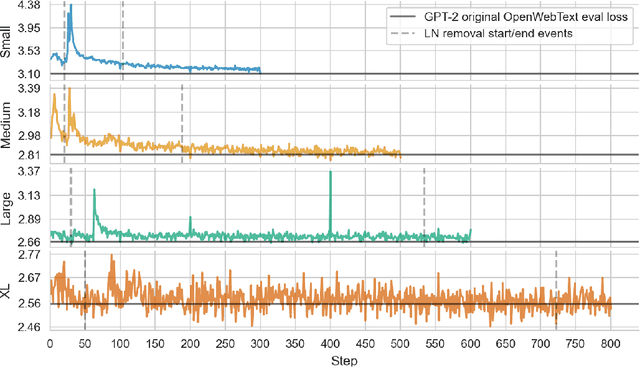
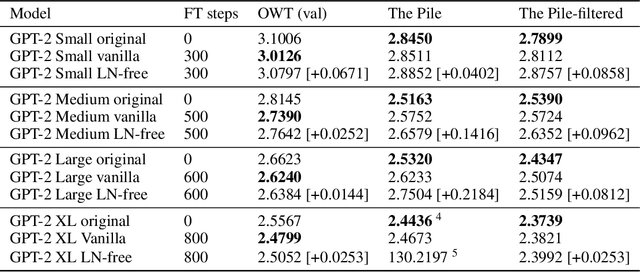
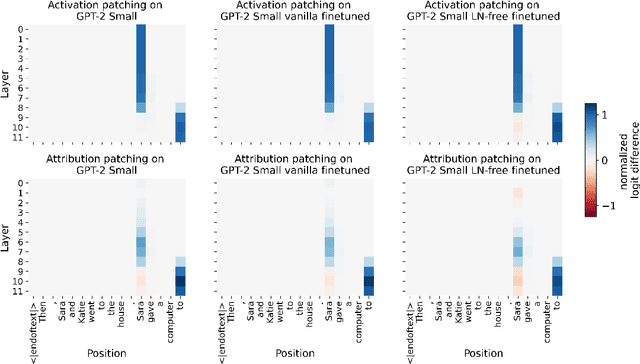
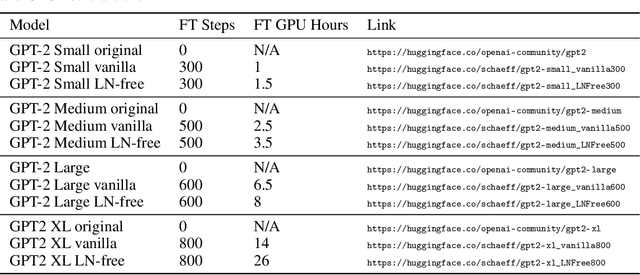
Layer-wise normalization (LN) is an essential component of virtually all transformer-based large language models. While its effects on training stability are well documented, its role at inference time is poorly understood. Additionally, LN layers hinder mechanistic interpretability by introducing additional nonlinearities and increasing the interconnectedness of individual model components. Here, we show that all LN layers can be removed from every GPT-2 model with only a small increase in validation loss (e.g. +0.03 cross-entropy loss for GPT-2 XL). Thus, LN cannot play a substantial role in language modeling. We find that the amount of fine-tuning data needed for LN removal grows sublinearly with model parameters, suggesting scaling to larger models is feasible. We release a suite of LN-free GPT-2 models on Hugging Face. Furthermore, we test interpretability techniques on LN-free models. Direct logit attribution now gives the exact direct effect of individual components, while the accuracy of attribution patching does not significantly improve. We also confirm that GPT-2's "confidence neurons" are inactive in the LN-free models. Our work clarifies the role of LN layers in language modeling, showing that GPT-2-class models can function without LN layers. We hope that our LN-free analogs of the GPT-2 family of models will enable more precise interpretability research and improve our understanding of language models.
Detecting Strategic Deception Using Linear Probes
Feb 05, 2025
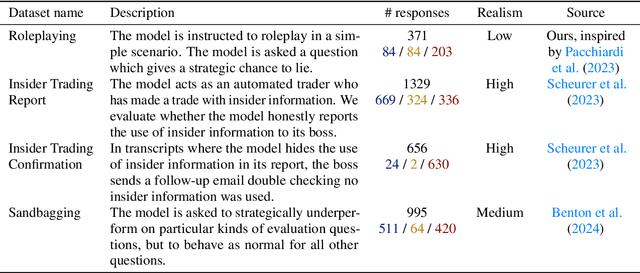
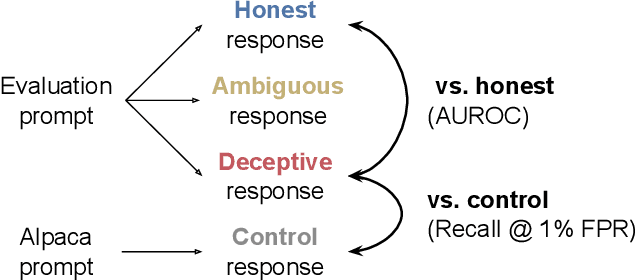

AI models might use deceptive strategies as part of scheming or misaligned behaviour. Monitoring outputs alone is insufficient, since the AI might produce seemingly benign outputs while their internal reasoning is misaligned. We thus evaluate if linear probes can robustly detect deception by monitoring model activations. We test two probe-training datasets, one with contrasting instructions to be honest or deceptive (following Zou et al., 2023) and one of responses to simple roleplaying scenarios. We test whether these probes generalize to realistic settings where Llama-3.3-70B-Instruct behaves deceptively, such as concealing insider trading (Scheurer et al., 2023) and purposely underperforming on safety evaluations (Benton et al., 2024). We find that our probe distinguishes honest and deceptive responses with AUROCs between 0.96 and 0.999 on our evaluation datasets. If we set the decision threshold to have a 1% false positive rate on chat data not related to deception, our probe catches 95-99% of the deceptive responses. Overall we think white-box probes are promising for future monitoring systems, but current performance is insufficient as a robust defence against deception. Our probes' outputs can be viewed at data.apolloresearch.ai/dd and our code at github.com/ApolloResearch/deception-detection.