 Add to Chrome
 Add to Firefox
 Add to Edge
LKValues: Aligning Large Language Models with Sri Lankan Societal Values
Jul 22, 2026
Value alignment of Large Language Models (LLMs) has been shown to be culturally biased toward Western norms. This results in the mishandling of local values in multilingual societies such as Sri Lanka that have their unique cultural dynamics. Existing benchmarks overlook Sri Lankan-contextualized values in its official language Sinhala, hindering culturally sensitive evaluation and fine-tuning. To bridge this gap, we propose LKValues, the first survey-grounded resource suite for Sri Lankan value alignment. From a trilingual survey of 205 respondents, blending adapted global frameworks and LLM-elicited local constructs, we derive 40 majority-endorsed societal values. Using these values, we construct LKvaluesIT, a Sinhala-English news-derived instruction corpus containing 150k scenario-based instances, and LKvaluesBench, a value-sensitive evaluation benchmark of 1,000 instances. We evaluate a set of proprietary and open-weight LLMs with LKvaluesBench. We fine-tune three open-weight base models (Qwen3.5-4B-Base, Qwen3.5-9B-Base, and Aya-Expanse-8B-Base). Our experiments show that newer and larger LLMs still exhibit low-resource and cultural value-alignment gaps. LKValues fine-tuning improves Qwen-family models in English and Sinhala, reducing invalid outputs and cross-lingual disparities, though gains remain model-family dependent. These highlight LKValues efficacy in embedding Sri Lankan values, offering a replicable pipeline for low-resource, country-specific pluralist value alignment. The dataset is publicly available at https://github.com/NextME14/LKValues.

TimeLens2: Generalist Video Temporal Grounding with Multimodal LLMs
Jul 19, 2026Video multimodal large language models (MLLMs) can describe what happens in a video, but rarely identify when the supporting evidence occurs. We study generalist video temporal grounding, in which one model predicts a variable-cardinality set of evidence intervals across video lengths, domains, query forms, and viewpoints. Existing training strategies are misaligned with this set-valued task: long-video labels often rely on brittle one-pass annotation, while reinforcement-learning rewards either fail to distinguish non-overlapping predictions or require fragile segment matching. TimeLens2 treats temporal evidence as an interval set throughout supervision and optimization. TimeLens2-93K constructs reliable multi-span supervision through caption-derived proposals, independent localization, cross-agent consensus, semantic verification, and boundary refinement. Our temporal Wasserstein reward computes exact one-dimensional \(W_1\) between uniform distributions over merged interval supports, providing dense, matching-free feedback under unequal cardinalities and equivalent fragmentation; temporal IoU complements it with precise-overlap feedback. Across seven benchmarks, TimeLens2-2B outperforms all size-matched baselines on every benchmark, while the 4B and 8B variants achieve state-of-the-art performance, surpassing open-source models with up to 397B parameters. The 2B, 4B, and 8B variants improve over their Qwen3-VL backbones by 14.2, 13.0, and 18.1 mIoU points, respectively.
BRICKS-WM: Building Reusability via Interface Composition Kinetics for Structured World Models
Jun 15, 2026Model-based Reinforcement Learning (MBRL) has achieved remarkable success in continuous control by leveraging latent world models. However, prevailing approaches typically rely on monolithic latent dynamics, entangling environment dynamics into a coupled process. This coupling severely limits reusability: altering the agent necessitates retraining the entire world from scratch, even if the environment remains constant. To address this, we introduce BRICKS-WM (Building Reusability via Interface Composition Kinetics for Structured World Models), a framework for the modular assembly of structured world models. Driven by the insight that the physical world is composed of independent entities, we posit that global dynamics can be modeled as a composition of distinct dynamical modules interacting via latent interfaces. As a minimal instantiation, we factorize the latent state space into an actuated Agent module and an external Background module, bridged by a learned latent interface. Unlike prior object-centric methods that prioritize visual segmentation, BRICKS-WM enforces a functional separation in transition dynamics, ensuring that background dynamics remains agnostic to the agent's dynamics. Empirically, BRICKS-WM achieves control performance comparable to strong monolithic baselines when trained from scratch, and enables the reuse of frozen background dynamics across agents.
SELF-EMO: Emotional Self-Evolution from Recognition to Consistent Expression
Apr 20, 2026Emotion Recognition in Conversation (ERC) has become a fundamental capability for large language models (LLMs) in human-centric interaction. Beyond accurate recognition, coherent emotional expression is also crucial, yet both are limited by the scarcity and static nature of high-quality annotated data. In this work, we propose SELF-EMO, a self-evolution framework grounded in the hypothesis that better emotion prediction leads to more consistent emotional responses. We introduce two auxiliary tasks, emotional understanding and emotional expression, and design a role-based self-play paradigm where the model acts as both an emotion recognizer and a dialogue responder. Through iterative interactions, the model generates diverse conversational trajectories, enabling scalable data generation. To ensure quality, we adopt a data flywheel mechanism that filters candidate predictions and responses using a smoothed IoU-based reward and feeds selected samples back for continuous self-improvement without external supervision. We further develop SELF-GRPO, a reinforcement learning algorithm that stabilizes optimization with multi-label alignment rewards and group-level consistency signals. Experiments on IEMOCAP, MELD, and EmoryNLP show that SELF-EMO achieves state-of-the-art performance, improving accuracy by +6.33% on Qwen3-4B and +8.54% on Qwen3-8B, demonstrating strong effectiveness and generalization.
DEP: A Decentralized Large Language Model Evaluation Protocol
Mar 01, 2026With the rapid development of Large Language Models (LLMs), a large number of benchmarks have been proposed. However, most benchmarks lack unified evaluation standard and require the manual implementation of custom scripts, making results hard to ensure consistency and reproducibility. Furthermore, mainstream evaluation frameworks are centralized, with datasets and answers, which increases the risk of benchmark leakage. To address these issues, we propose a Decentralized Evaluation Protocol (DEP), a decentralized yet unified and standardized evaluation framework through a matching server without constraining benchmarks. The server can be mounted locally or deployed remotely, and once adapted, it can be reused over the long term. By decoupling users, LLMs, and benchmarks, DEP enables modular, plug-and-play evaluation: benchmark files and evaluation logic stay exclusively on the server side. In remote setting, users cannot access the ground truth, thereby achieving data isolation and leak-proof evaluation. To facilitate practical adoption, we develop DEP Toolkit, a protocol-compatible toolkit that supports features such as breakpoint resume, concurrent requests, and congestion control. We also provide detailed documentation for adapting new benchmarks to DEP. Using DEP toolkit, we evaluate multiple LLMs across benchmarks. Experimental results verify the effectiveness of DEP and show that it reduces the cost of deploying benchmark evaluations. As of February 2026, we have adapted over 60 benchmarks and continue to promote community co-construction to support unified evaluation across various tasks and domains.
Self-Motivated Multi-Agent Exploration
Jan 05, 2023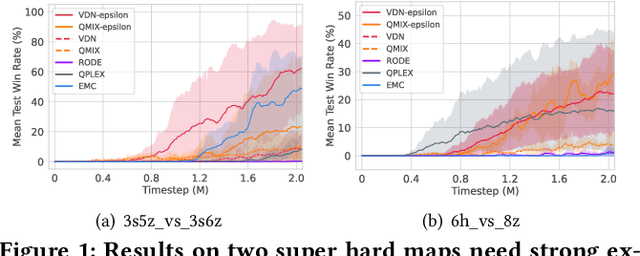
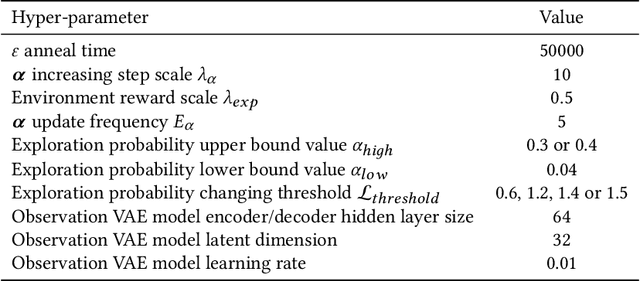
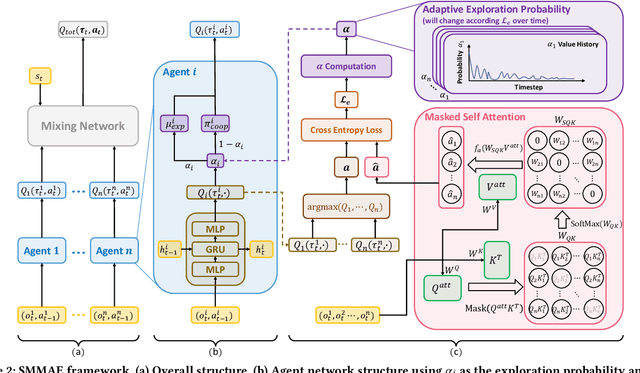
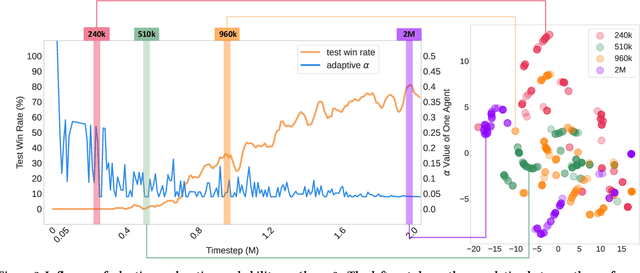
In cooperative multi-agent reinforcement learning (CMARL), it is critical for agents to achieve a balance between self-exploration and team collaboration. However, agents can hardly accomplish the team task without coordination and they would be trapped in a local optimum where easy cooperation is accessed without enough individual exploration. Recent works mainly concentrate on agents' coordinated exploration, which brings about the exponentially grown exploration of the state space. To address this issue, we propose Self-Motivated Multi-Agent Exploration (SMMAE), which aims to achieve success in team tasks by adaptively finding a trade-off between self-exploration and team cooperation. In SMMAE, we train an independent exploration policy for each agent to maximize their own visited state space. Each agent learns an adjustable exploration probability based on the stability of the joint team policy. The experiments on highly cooperative tasks in StarCraft II micromanagement benchmark (SMAC) demonstrate that SMMAE can explore task-related states more efficiently, accomplish coordinated behaviours and boost the learning performance.
Learn From the Past: Experience Ensemble Knowledge Distillation
Feb 25, 2022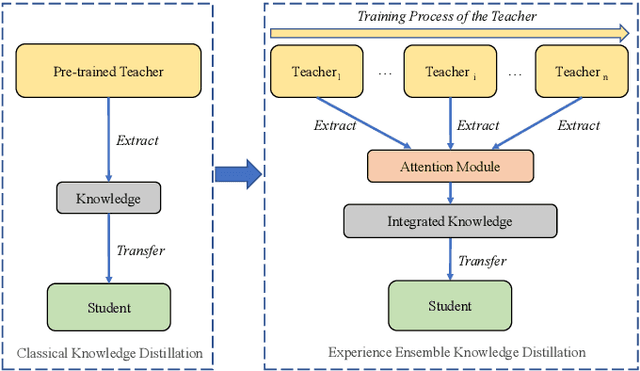
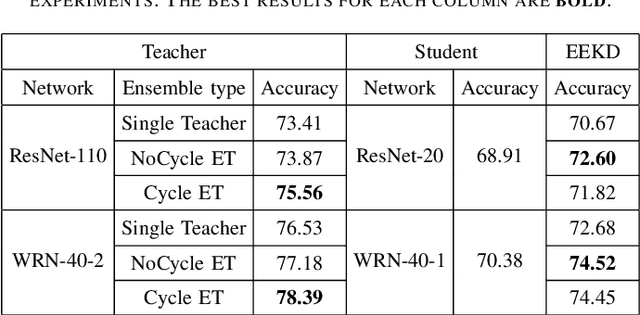
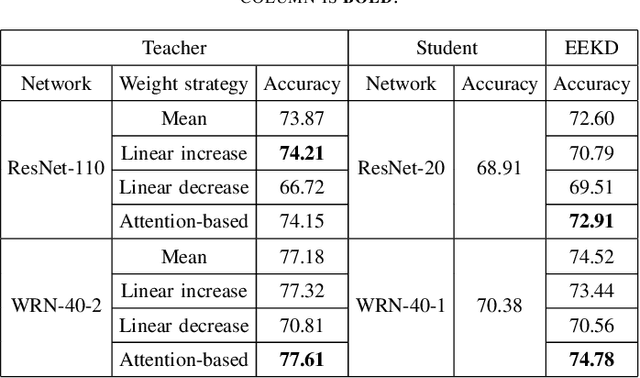
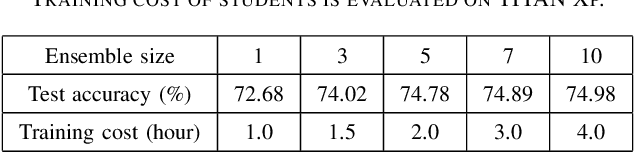
Traditional knowledge distillation transfers "dark knowledge" of a pre-trained teacher network to a student network, and ignores the knowledge in the training process of the teacher, which we call teacher's experience. However, in realistic educational scenarios, learning experience is often more important than learning results. In this work, we propose a novel knowledge distillation method by integrating the teacher's experience for knowledge transfer, named experience ensemble knowledge distillation (EEKD). We save a moderate number of intermediate models from the training process of the teacher model uniformly, and then integrate the knowledge of these intermediate models by ensemble technique. A self-attention module is used to adaptively assign weights to different intermediate models in the process of knowledge transfer. Three principles of constructing EEKD on the quality, weights and number of intermediate models are explored. A surprising conclusion is found that strong ensemble teachers do not necessarily produce strong students. The experimental results on CIFAR-100 and ImageNet show that EEKD outperforms the mainstream knowledge distillation methods and achieves the state-of-the-art. In particular, EEKD even surpasses the standard ensemble distillation on the premise of saving training cost.
LINDA: Multi-Agent Local Information Decomposition for Awareness of Teammates
Oct 15, 2021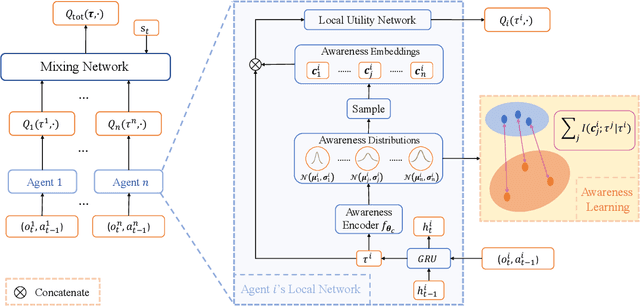
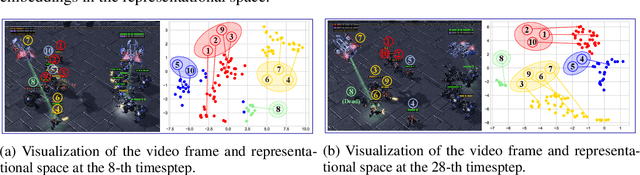
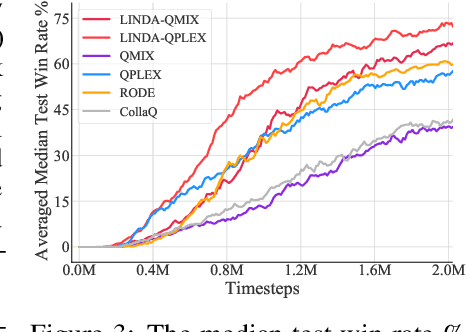
In cooperative multi-agent reinforcement learning (MARL), where agents only have access to partial observations, efficiently leveraging local information is critical. During long-time observations, agents can build \textit{awareness} for teammates to alleviate the problem of partial observability. However, previous MARL methods usually neglect this kind of utilization of local information. To address this problem, we propose a novel framework, multi-agent \textit{Local INformation Decomposition for Awareness of teammates} (LINDA), with which agents learn to decompose local information and build awareness for each teammate. We model the awareness as stochastic random variables and perform representation learning to ensure the informativeness of awareness representations by maximizing the mutual information between awareness and the actual trajectory of the corresponding agent. LINDA is agnostic to specific algorithms and can be flexibly integrated to different MARL methods. Sufficient experiments show that the proposed framework learns informative awareness from local partial observations for better collaboration and significantly improves the learning performance, especially on challenging tasks.