 Add to Chrome
 Add to Firefox
 Add to Edge
Multi-/Uni-Cast Non-Orthogonal Multiple Access-Based INAC
May 26, 2026
With the rapid development of satellite communication and navigation, there is an urgent need to integrate both technologies to achieve reliable communication and precise navigation services within the same satellite system. By combining multi-/uni-cast (MUC) and non-orthogonal multiple access (NOMA) technologies, we propose a novel MUC-NOMA-based integrated navigation and communication (INAC) signal structure, in which the navigation and communication signals share a common pseudo noise (PN) sequence, thereby integrating satellite communication and navigation at the signal level. According to different power allocation strategies, two scenarios are defined: multi-cast-oriented (MO-) INAC and uni-cast-oriented (UO-) INAC, where a greater portion of power is assigned to either the multi-cast or the uni-cast signal, respectively. To mitigate co-channel interference, we employ successive interference cancellation (SIC) at the receiver and design a signal processing algorithm for the proposed INAC signal. Then, closed-form expressions are subsequently derived for the bit error rates (BER) of both the navigation and communication signals, along with the positioning accuracy of the navigation signal. To gain further insights, the impacts of power allocation factors and communication rates are evaluated. Our analysis results show that: i) In the MO-INAC scenario, the positioning and BER performance of navigation signal are excellent when more power is assigned to the multi-cast signal; ii) In the UO-INAC scenario, interference in the shared resources is reduced when more power is assigned to the uni-cast signal; iii) The ranging accuracy decreases as the communication data rate increases. Numerical results confirm the superior BER and positioning accuracy of the MO-INAC scenario for MEO satellites.

Integrated Positioning and Communications for PASS: A Robust Approach
May 26, 2026The pinching-antenna systems (PASS), which dynamically activate and relocate the pinching-antennas (PAs) along the dielectric waveguide, offer unprecedented potential for integrated positioning and communication. The multi-waveguide-based uplink positioning approaches for indoor environments are first proposed in this paper, and the downlink communication performance is analyzed. Two possible scenarios, multi-waveguide single-PA (MWSP) and multi-waveguide multi-PA (MWMP), are considered under the assumptions of line-of-sight channels and a single, stationary user. For the MWSP scenario, the received signal strength indication (RSSI)-based ranging method and the MWSP-based least square (LS) positioning algorithm are developed. To gain deeper insights, a comprehensive error analysis of the LS positioning algorithm is conducted. Subsequently, for the MWMP scenario, the closed-form expression of the superposed signal is derived. According to the signal power, the MWMP-based grid search algorithm is proposed and the estimation error of proposed algorithm is analyzed. Then, based on the user's positioning result, the PAs are relocated to provide downlink communication service, and the achievable data rate of MWSP and MWMP scenarios are analyzed. Numerical results validate the correctness of our analysis, which show that: i) For the MWSP scenario, a smaller geometric dilution of precision (GDoP) leads to a lower average positioning error. Furthermore, even when the GDoP is large, the regions where the distances to PAs are nearly equal achieve the best accuracy. ii) For the MWMP scenario, non-parallel waveguide deployment improves positioning accuracy, although errors increase with the number of PAs. iii) The noise has a serious double-impact on data rate. There is a trade-off between positioning accuracy and communication performance.
Learning Rate-Compatible Linear Block Codes: An Auto-Encoder Based Approach
Nov 27, 2024Artificial intelligence (AI) provides an alternative way to design channel coding with affordable complexity. However, most existing studies can only learn codes for a given size and rate, typically defined by a fixed network architecture and a set of parameters. The support of multiple code rates is essential for conserving bandwidth under varying channel conditions while it is costly to store multiple AI models or parameter sets. In this article, we propose an auto-encoder (AE) based rate-compatible linear block codes (RC-LBCs). The coding process associated with AI or non-AI decoders and multiple puncturing patterns is optimized in a data-driven manner. The superior performance of the proposed AI-based RC-LBC is demonstrated through our numerical experiments.
Exploiting Active RIS in NOMA Networks with Hardware Impairments
Nov 24, 2023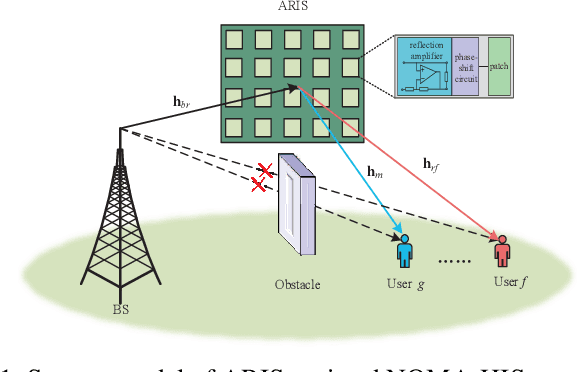
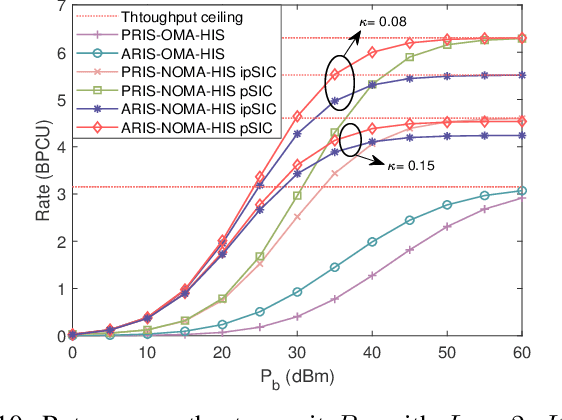
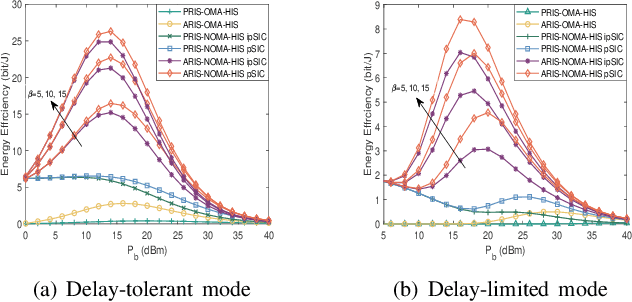
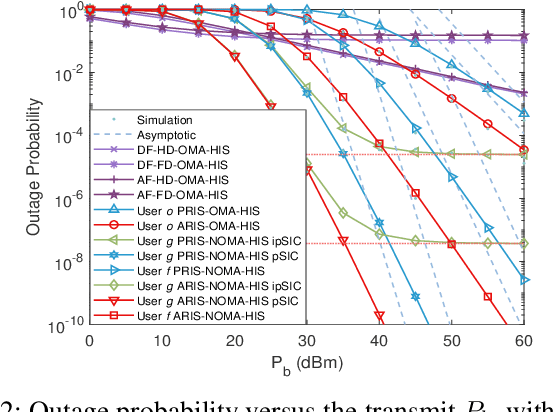
Active reconfigurable intelligent surface (ARIS) is a promising way to compensate for multiplicative fading attenuation by amplifying and reflecting event signals to selected users. This paper investigates the performance of ARIS assisted non-orthogonal multiple access (NOMA) networks over cascaded Nakagami-m fading channels. The effects of hardware impairments (HIS) and reflection coefficients on ARIS-NOMA networks with imperfect successive interference cancellation (ipSIC) and perfect successive interference cancellation (pSIC) are considered. More specifically, we develop new precise and asymptotic expressions of outage probability and ergodic data rate with ipSIC/pSIC for ARIS-NOMA-HIS networks. According to the approximated analyses, the diversity orders and multiplexing gains for couple of non-orthogonal users are attained in detail. Additionally, the energy efficiency of ARIS-NOMA-HIS networks is surveyed in delay-limited and delay-tolerant transmission schemes. The simulation findings are presented to demonstrate that: i) The outage behaviors and ergodic data rates of ARIS-NOMA-HIS networks precede that of ARIS aided orthogonal multiple access (OMA) and passive reconfigurable intelligent surface (PRIS) aided OMA; ii) As the reflection coefficient of ARIS increases, ARIS-NOMA-HIS networks have the ability to provide the strengthened outage performance; and iii) ARIS-NOMA-HIS networks are more energy efficient than ARIS/PRIS-OMA networks and conventional cooperative schemes.
Performance Analysis of NOMA-RIS aided Integrated Navigation and Communication (INAC) Networks
May 16, 2023Satellite communication constitutes a promising solution for the sixth generation (6G) wireless networks in terms of providing global communication services. In order to provide a cost-effective satellite network, we propose a novel medium-earth-orbit (MEO) satellite aided integrated-navigation-and-communication (INAC) network. To overcome the severe path loss of MEO satellites, we conceive a network for simultaneous serving navigation and communication for ground users by adopting the non-orthogonal multiple access (NOMA) technique and the reconfigurable intelligent surface technique. Based on the power allocation strategies, communication-oriented (CO-) and navigation-oriented (NO-) INAC scenarios are proposed. We first derive the closed-form expressions for the new channel statistics, outage probability and channel capacity of the INAC-user. For gleaning further insights, the diversity orders and navigation accuracy are evaluated for illustrating the performance of the INAC networks. According to our analysis, when RIS elements are sufficient, the proposed INAC network can perform better than conventional terrestrial communication networks in terms of channel capacity. Numerical results are provided for confirming that the NO-INAC and CO-INAC scenarios have superior performance for communication in the low signal-to-noise-ratio (SNR) regimes and high SNR regimes, respectively, which indicates a hybrid CO/NO-INAC network is preferable.