 Add to Chrome
 Add to Firefox
 Add to Edge
The MiniMax-M2 Series: Mini Activations Unleashing Max Real-World Intelligence
May 26, 2026
We introduce the MiniMax-M2 series, a family of Mixture-of-Experts language models built around the principle that mini activations can unleash maximum real-world intelligence. The flagship M2 contains 229.9B total parameters with only 9.8B activated per token. Designed end-to-end for agentic deployment, the M2 series rests on three components: (i) agent-driven data pipelines producing large-scale, verifiable trajectories across agentic coding and agentic cowork, each grounded in an executable workspace and an artifact-aligned reward; (ii) Forge, a scalable agent-native RL system that adapts to long-horizon agent trajectories, paired with windowed-FIFO scheduling, prefix-tree merging, inference optimization, and a clean training-inference-agent decoupling that supports both white-box and black-box agents; (iii) the latest M2.7 checkpoint takes an early step toward self-evolution -- autonomously debugging training runs and modifying its own scaffold. Across M2 through M2.7, this combination translates a mini-activation footprint into frontier-tier performance on agentic coding, deep search, office-task, and reasoning benchmarks.

Optimization-Free Graph Embedding via Distributional Kernel for Community Detection
Feb 14, 2026Neighborhood Aggregation Strategy (NAS) is a widely used approach in graph embedding, underpinning both Graph Neural Networks (GNNs) and Weisfeiler-Lehman (WL) methods. However, NAS-based methods are identified to be prone to over-smoothing-the loss of node distinguishability with increased iterations-thereby limiting their effectiveness. This paper identifies two characteristics in a network, i.e., the distributions of nodes and node degrees that are critical for expressive representation but have been overlooked in existing methods. We show that these overlooked characteristics contribute significantly to over-smoothing of NAS-methods. To address this, we propose a novel weighted distribution-aware kernel that embeds nodes while taking their distributional characteristics into consideration. Our method has three distinguishing features: (1) it is the first method to explicitly incorporate both distributional characteristics; (2) it requires no optimization; and (3) it effectively mitigates the adverse effects of over-smoothing, allowing WL to preserve node distinguishability and expressiveness even after many iterations of embedding. Experiments demonstrate that our method achieves superior community detection performance via spectral clustering, outperforming existing graph embedding methods, including deep learning methods, on standard benchmarks.
Rethinking Divisive Hierarchical Clustering from a Distributional Perspective
Jan 27, 2026We uncover that current objective-based Divisive Hierarchical Clustering (DHC) methods produce a dendrogram that does not have three desired properties i.e., no unwarranted splitting, group similar clusters into a same subset, ground-truth correspondence. This shortcoming has their root cause in using a set-oriented bisecting assessment criterion. We show that this shortcoming can be addressed by using a distributional kernel, instead of the set-oriented criterion; and the resultant clusters achieve a new distribution-oriented objective to maximize the total similarity of all clusters (TSC). Our theoretical analysis shows that the resultant dendrogram guarantees a lower bound of TSC. The empirical evaluation shows the effectiveness of our proposed method on artificial and Spatial Transcriptomics (bioinformatics) datasets. Our proposed method successfully creates a dendrogram that is consistent with the biological regions in a Spatial Transcriptomics dataset, whereas other contenders fail.
Mass Distribution versus Density Distribution in the Context of Clustering
Jan 14, 2026This paper investigates two fundamental descriptors of data, i.e., density distribution versus mass distribution, in the context of clustering. Density distribution has been the de facto descriptor of data distribution since the introduction of statistics. We show that density distribution has its fundamental limitation -- high-density bias, irrespective of the algorithms used to perform clustering. Existing density-based clustering algorithms have employed different algorithmic means to counter the effect of the high-density bias with some success, but the fundamental limitation of using density distribution remains an obstacle to discovering clusters of arbitrary shapes, sizes and densities. Using the mass distribution as a better foundation, we propose a new algorithm which maximizes the total mass of all clusters, called mass-maximization clustering (MMC). The algorithm can be easily changed to maximize the total density of all clusters in order to examine the fundamental limitation of using density distribution versus mass distribution. The key advantage of the MMC over the density-maximization clustering is that the maximization is conducted without a bias towards dense clusters.
MiniMax-M1: Scaling Test-Time Compute Efficiently with Lightning Attention
Jun 16, 2025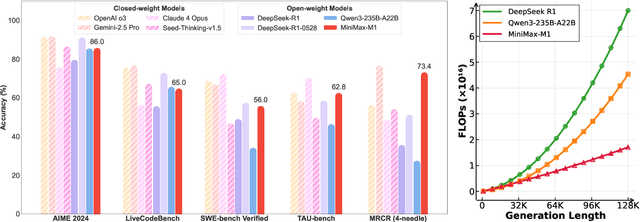

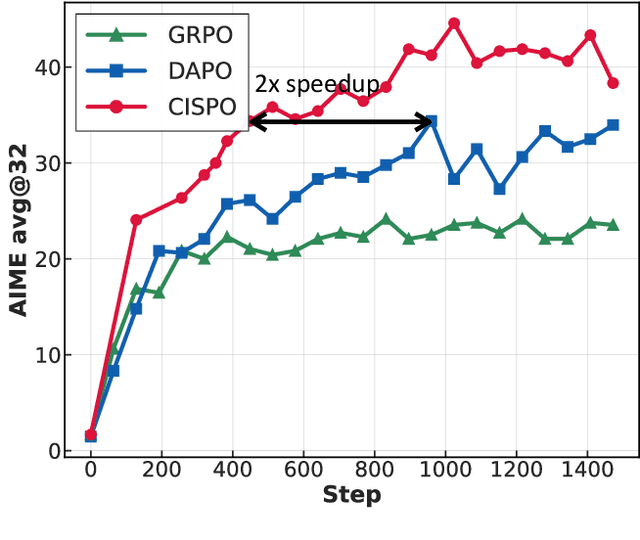
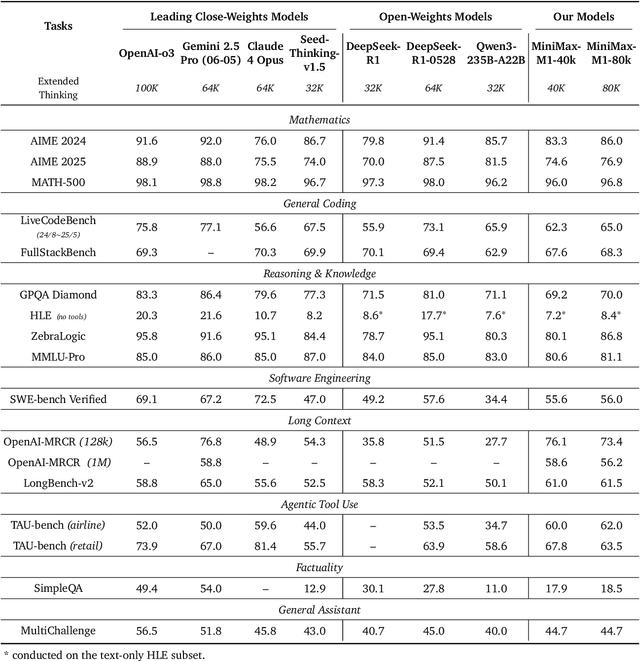
We introduce MiniMax-M1, the world's first open-weight, large-scale hybrid-attention reasoning model. MiniMax-M1 is powered by a hybrid Mixture-of-Experts (MoE) architecture combined with a lightning attention mechanism. The model is developed based on our previous MiniMax-Text-01 model, which contains a total of 456 billion parameters with 45.9 billion parameters activated per token. The M1 model natively supports a context length of 1 million tokens, 8x the context size of DeepSeek R1. Furthermore, the lightning attention mechanism in MiniMax-M1 enables efficient scaling of test-time compute. These properties make M1 particularly suitable for complex tasks that require processing long inputs and thinking extensively. MiniMax-M1 is trained using large-scale reinforcement learning (RL) on diverse problems including sandbox-based, real-world software engineering environments. In addition to M1's inherent efficiency advantage for RL training, we propose CISPO, a novel RL algorithm to further enhance RL efficiency. CISPO clips importance sampling weights rather than token updates, outperforming other competitive RL variants. Combining hybrid-attention and CISPO enables MiniMax-M1's full RL training on 512 H800 GPUs to complete in only three weeks, with a rental cost of just $534,700. We release two versions of MiniMax-M1 models with 40K and 80K thinking budgets respectively, where the 40K model represents an intermediate phase of the 80K training. Experiments on standard benchmarks show that our models are comparable or superior to strong open-weight models such as the original DeepSeek-R1 and Qwen3-235B, with particular strengths in complex software engineering, tool utilization, and long-context tasks. We publicly release MiniMax-M1 at https://github.com/MiniMax-AI/MiniMax-M1.
MiniMax-01: Scaling Foundation Models with Lightning Attention
Jan 14, 2025We introduce MiniMax-01 series, including MiniMax-Text-01 and MiniMax-VL-01, which are comparable to top-tier models while offering superior capabilities in processing longer contexts. The core lies in lightning attention and its efficient scaling. To maximize computational capacity, we integrate it with Mixture of Experts (MoE), creating a model with 32 experts and 456 billion total parameters, of which 45.9 billion are activated for each token. We develop an optimized parallel strategy and highly efficient computation-communication overlap techniques for MoE and lightning attention. This approach enables us to conduct efficient training and inference on models with hundreds of billions of parameters across contexts spanning millions of tokens. The context window of MiniMax-Text-01 can reach up to 1 million tokens during training and extrapolate to 4 million tokens during inference at an affordable cost. Our vision-language model, MiniMax-VL-01 is built through continued training with 512 billion vision-language tokens. Experiments on both standard and in-house benchmarks show that our models match the performance of state-of-the-art models like GPT-4o and Claude-3.5-Sonnet while offering 20-32 times longer context window. We publicly release MiniMax-01 at https://github.com/MiniMax-AI.