 Add to Chrome
 Add to Firefox
 Add to Edge
Optimization-Free Graph Embedding via Distributional Kernel for Community Detection
Feb 14, 2026
Neighborhood Aggregation Strategy (NAS) is a widely used approach in graph embedding, underpinning both Graph Neural Networks (GNNs) and Weisfeiler-Lehman (WL) methods. However, NAS-based methods are identified to be prone to over-smoothing-the loss of node distinguishability with increased iterations-thereby limiting their effectiveness. This paper identifies two characteristics in a network, i.e., the distributions of nodes and node degrees that are critical for expressive representation but have been overlooked in existing methods. We show that these overlooked characteristics contribute significantly to over-smoothing of NAS-methods. To address this, we propose a novel weighted distribution-aware kernel that embeds nodes while taking their distributional characteristics into consideration. Our method has three distinguishing features: (1) it is the first method to explicitly incorporate both distributional characteristics; (2) it requires no optimization; and (3) it effectively mitigates the adverse effects of over-smoothing, allowing WL to preserve node distinguishability and expressiveness even after many iterations of embedding. Experiments demonstrate that our method achieves superior community detection performance via spectral clustering, outperforming existing graph embedding methods, including deep learning methods, on standard benchmarks.

Subgraph Centralization: A Necessary Step for Graph Anomaly Detection
Jan 17, 2023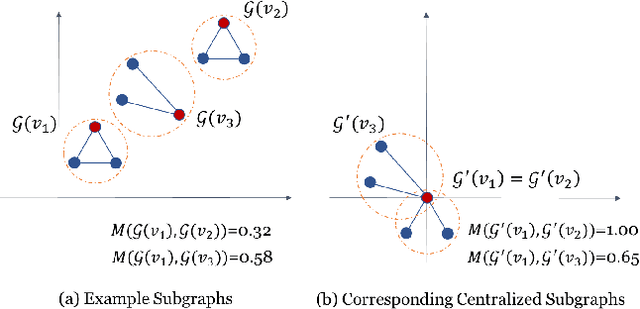
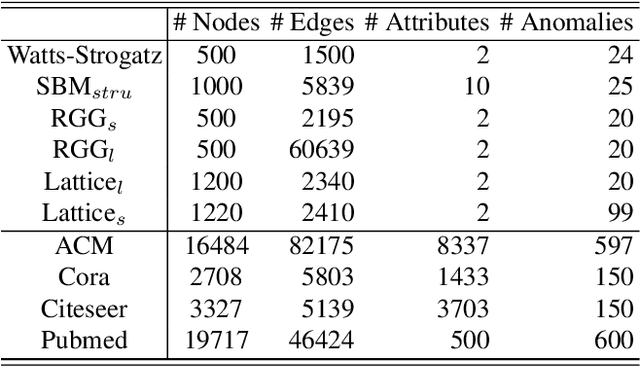
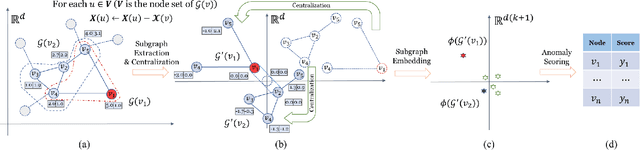
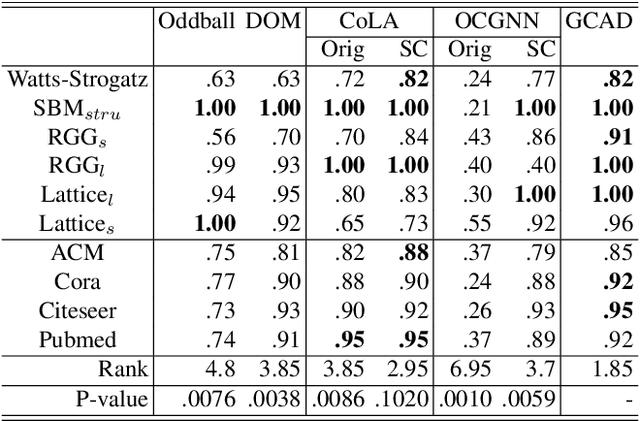
Graph anomaly detection has attracted a lot of interest recently. Despite their successes, existing detectors have at least two of the three weaknesses: (a) high computational cost which limits them to small-scale networks only; (b) existing treatment of subgraphs produces suboptimal detection accuracy; and (c) unable to provide an explanation as to why a node is anomalous, once it is identified. We identify that the root cause of these weaknesses is a lack of a proper treatment for subgraphs. A treatment called Subgraph Centralization for graph anomaly detection is proposed to address all the above weaknesses. Its importance is shown in two ways. First, we present a simple yet effective new framework called Graph-Centric Anomaly Detection (GCAD). The key advantages of GCAD over existing detectors including deep-learning detectors are: (i) better anomaly detection accuracy; (ii) linear time complexity with respect to the number of nodes; and (iii) it is a generic framework that admits an existing point anomaly detector to be used to detect node anomalies in a network. Second, we show that Subgraph Centralization can be incorporated into two existing detectors to overcome the above-mentioned weaknesses.