 Add to Chrome
 Add to Firefox
 Add to Edge
Mage-Flow: An Efficient Native-Resolution Foundation Model for Image Generation and Editing
Jul 21, 2026
Large-scale visual generators are increasingly capable but costly to train, fine-tune, and deploy. We introduce Mage-Flow, a compact 4B-scale generative stack for efficient text-to-image generation and instruction-based image editing. The stack is built from two co-designed components: Mage-VAE, a lightweight high-fidelity latent tokenizer, and a Native-Resolution Multimodal Diffusion Transformer trained with rectified flow matching. Mage-VAE uses one-step diffusion-style encoding and decoding with anchor-latent regularization, preserving the reconstruction quality of strong public VAEs while reducing tokenization cost by more than an order of magnitude. Together with native-resolution packing and stack-level CUDA kernel fusion, the stack supports flexible-resolution training and improves end-to-end training throughput by about $2.5\times$. Built on this foundation, we develop a complete model family with Base, RL-aligned, and Turbo variants for both generation and editing. Diffusion-NFT improves prompt following, text rendering, aesthetic quality, and editing fidelity, while few-step distillation with adversarial perceptual guidance produces 4-step Turbo models for low-latency inference. Despite its compact scale, Mage-Flow and Mage-Flow-Edit achieves competitive performance across standard generation and editing benchmarks. More importantly, the Turbo variants make high-resolution generation and editing practical for interactive use: at $1024^2$ resolution on a single NVIDIA A100 GPU, Mage-Flow-Turbo generates an image in 0.59s, and Mage-Flow-Edit-Turbo edits an image in 1.02s, while maintaining a small memory footprint. These results show that careful tokenizer--backbone--system co-design can deliver strong high-resolution generation and editing within an efficient 4B model family.

Text Grouping Adapter: Adapting Pre-trained Text Detector for Layout Analysis
May 13, 2024
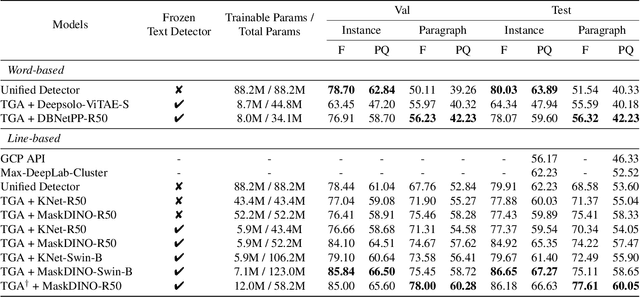
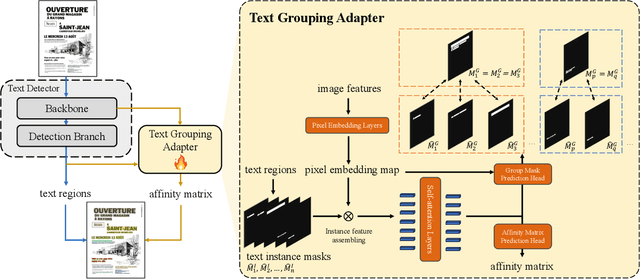

Significant progress has been made in scene text detection models since the rise of deep learning, but scene text layout analysis, which aims to group detected text instances as paragraphs, has not kept pace. Previous works either treated text detection and grouping using separate models, or train a model from scratch while using a unified one. All of them have not yet made full use of the already well-trained text detectors and easily obtainable detection datasets. In this paper, we present Text Grouping Adapter (TGA), a module that can enable the utilization of various pre-trained text detectors to learn layout analysis, allowing us to adopt a well-trained text detector right off the shelf or just fine-tune it efficiently. Designed to be compatible with various text detector architectures, TGA takes detected text regions and image features as universal inputs to assemble text instance features. To capture broader contextual information for layout analysis, we propose to predict text group masks from text instance features by one-to-many assignment. Our comprehensive experiments demonstrate that, even with frozen pre-trained models, incorporating our TGA into various pre-trained text detectors and text spotters can achieve superior layout analysis performance, simultaneously inheriting generalized text detection ability from pre-training. In the case of full parameter fine-tuning, we can further improve layout analysis performance.