 Add to Chrome
 Add to Firefox
 Add to Edge
Investigation of Adapter for Automatic Speech Recognition in Noisy Environment
Feb 29, 2024
Adapting an automatic speech recognition (ASR) system to unseen noise environments is crucial. Integrating adapters into neural networks has emerged as a potent technique for transfer learning. This study thoroughly investigates adapter-based ASR adaptation in noisy environments. We conducted experiments using the CHiME--4 dataset. The results show that inserting the adapter in the shallow layer yields superior effectiveness, and there is no significant difference between adapting solely within the shallow layer and adapting across all layers. The simulated data helps the system to improve its performance under real noise conditions. Nonetheless, when the amount of data is the same, the real data is more effective than the simulated data. Multi-condition training is still useful for adapter training. Furthermore, integrating adapters into speech enhancement-based ASR systems yields substantial improvements.

Evaluation of a semi-autonomous attentive listening system with takeover prompting
Feb 21, 2024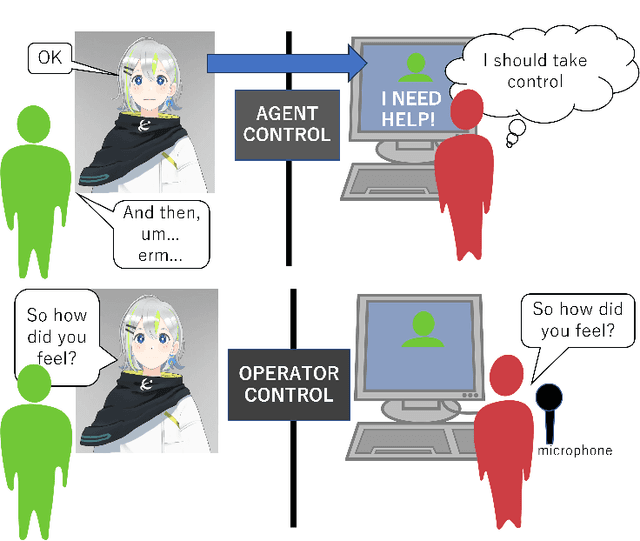
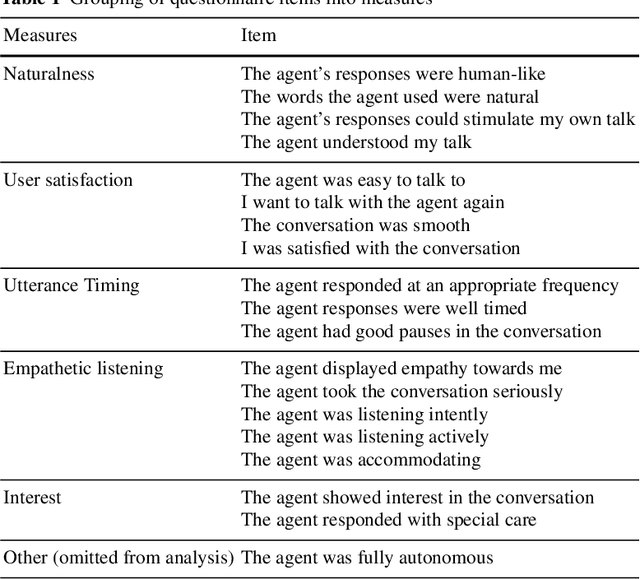

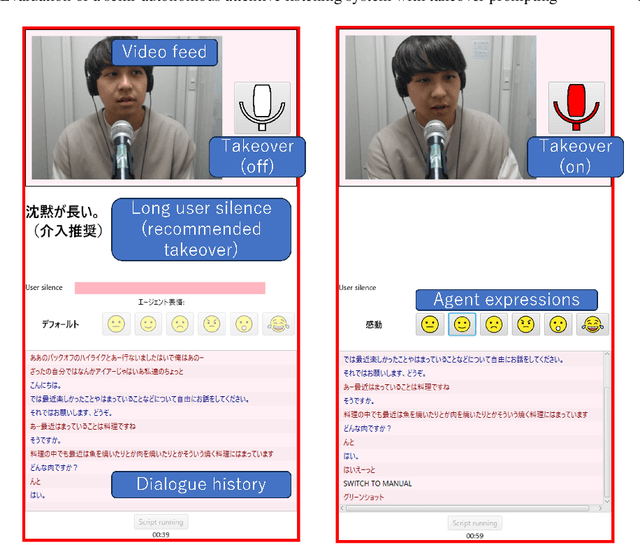
The handling of communication breakdowns and loss of engagement is an important aspect of spoken dialogue systems, particularly for chatting systems such as attentive listening, where the user is mostly speaking. We presume that a human is best equipped to handle this task and rescue the flow of conversation. To this end, we propose a semi-autonomous system, where a remote operator can take control of an autonomous attentive listening system in real-time. In order to make human intervention easy and consistent, we introduce automatic detection of low interest and engagement to provide explicit takeover prompts to the remote operator. We implement this semi-autonomous system which detects takeover points for the operator and compare it to fully tele-operated and fully autonomous attentive listening systems. We find that the semi-autonomous system is generally perceived more positively than the autonomous system. The results suggest that identifying points of conversation when the user starts to lose interest may help us improve a fully autonomous dialogue system.
Acknowledgment of Emotional States: Generating Validating Responses for Empathetic Dialogue
Feb 20, 2024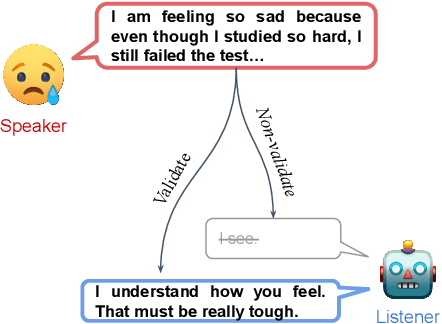
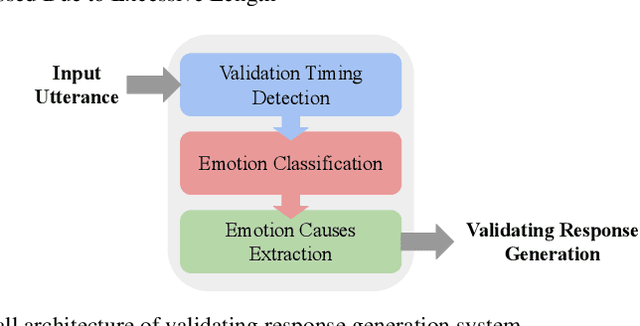

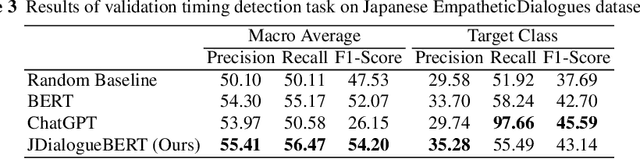
In the realm of human-AI dialogue, the facilitation of empathetic responses is important. Validation is one of the key communication techniques in psychology, which entails recognizing, understanding, and acknowledging others' emotional states, thoughts, and actions. This study introduces the first framework designed to engender empathetic dialogue with validating responses. Our approach incorporates a tripartite module system: 1) validation timing detection, 2) users' emotional state identification, and 3) validating response generation. Utilizing Japanese EmpatheticDialogues dataset - a textual-based dialogue dataset consisting of 8 emotional categories from Plutchik's wheel of emotions - the Task Adaptive Pre-Training (TAPT) BERT-based model outperforms both random baseline and the ChatGPT performance, in term of F1-score, in all modules. Further validation of our model's efficacy is confirmed in its application to the TUT Emotional Storytelling Corpus (TESC), a speech-based dialogue dataset, by surpassing both random baseline and the ChatGPT. This consistent performance across both textual and speech-based dialogues underscores the effectiveness of our framework in fostering empathetic human-AI communication.
MOS-FAD: Improving Fake Audio Detection Via Automatic Mean Opinion Score Prediction
Jan 25, 2024Automatic Mean Opinion Score (MOS) prediction is employed to evaluate the quality of synthetic speech. This study extends the application of predicted MOS to the task of Fake Audio Detection (FAD), as we expect that MOS can be used to assess how close synthesized speech is to the natural human voice. We propose MOS-FAD, where MOS can be leveraged at two key points in FAD: training data selection and model fusion. In training data selection, we demonstrate that MOS enables effective filtering of samples from unbalanced datasets. In the model fusion, our results demonstrate that incorporating MOS as a gating mechanism in FAD model fusion enhances overall performance.
An Analysis of User Behaviors for Objectively Evaluating Spoken Dialogue Systems
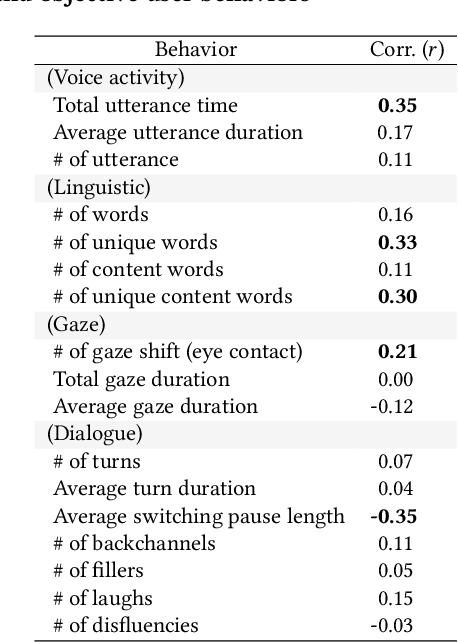
Jan 23, 2024Establishing evaluation schemes for spoken dialogue systems is important, but it can also be challenging. While subjective evaluations are commonly used in user experiments, objective evaluations are necessary for research comparison and reproducibility. To address this issue, we propose a framework for indirectly but objectively evaluating systems based on users' behaviors. In this paper, to this end, we investigate the relationship between user behaviors and subjective evaluation scores in social dialogue tasks: attentive listening, job interview, and first-meeting conversation. The results reveal that in dialogue tasks where user utterances are primary, such as attentive listening and job interview, indicators like the number of utterances and words play a significant role in evaluation. Observing disfluency also can indicate the effectiveness of formal tasks, such as job interview. On the other hand, in dialogue tasks with high interactivity, such as first-meeting conversation, behaviors related to turn-taking, like average switch pause length, become more important. These findings suggest that selecting appropriate user behaviors can provide valuable insights for objective evaluation in each social dialogue task.
Enhancing Personality Recognition in Dialogue by Data Augmentation and Heterogeneous Conversational Graph Networks
Jan 11, 2024
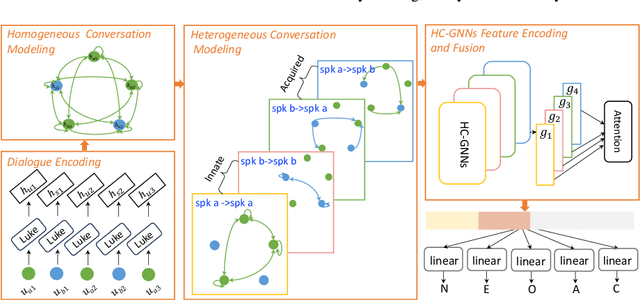
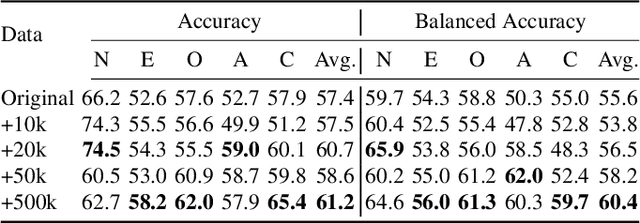
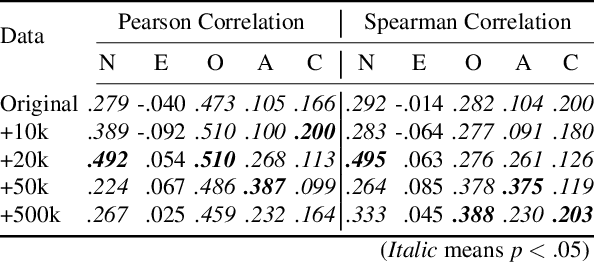
Personality recognition is useful for enhancing robots' ability to tailor user-adaptive responses, thus fostering rich human-robot interactions. One of the challenges in this task is a limited number of speakers in existing dialogue corpora, which hampers the development of robust, speaker-independent personality recognition models. Additionally, accurately modeling both the interdependencies among interlocutors and the intra-dependencies within the speaker in dialogues remains a significant issue. To address the first challenge, we introduce personality trait interpolation for speaker data augmentation. For the second, we propose heterogeneous conversational graph networks to independently capture both contextual influences and inherent personality traits. Evaluations on the RealPersonaChat corpus demonstrate our method's significant improvements over existing baselines.
Real-time and Continuous Turn-taking Prediction Using Voice Activity Projection
Jan 10, 2024A demonstration of a real-time and continuous turn-taking prediction system is presented. The system is based on a voice activity projection (VAP) model, which directly maps dialogue stereo audio to future voice activities. The VAP model includes contrastive predictive coding (CPC) and self-attention transformers, followed by a cross-attention transformer. We examine the effect of the input context audio length and demonstrate that the proposed system can operate in real-time with CPU settings, with minimal performance degradation.
Zero- and Few-shot Sound Event Localization and Detection
Sep 17, 2023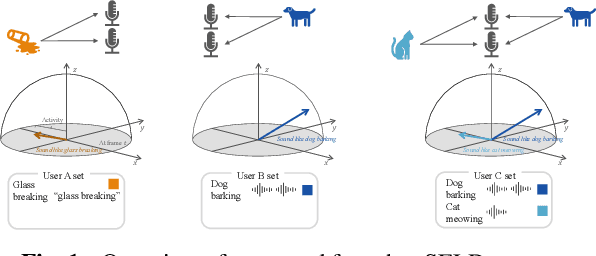


Sound event localization and detection (SELD) systems estimate direction-of-arrival (DOA) and temporal activation for sets of target classes. Neural network (NN)-based SELD systems have performed well in various sets of target classes, but they only output the DOA and temporal activation of preset classes that are trained before inference. To customize target classes after training, we tackle zero- and few-shot SELD tasks, in which we set new classes with a text sample or a few audio samples. While zero-shot sound classification tasks are achievable by embedding from contrastive language-audio pretraining (CLAP), zero-shot SELD tasks require assigning an activity and a DOA to each embedding, especially in overlapping cases. To tackle the assignment problem in overlapping cases, we propose an embed-ACCDOA model, which is trained to output track-wise CLAP embedding and corresponding activity-coupled Cartesian direction-of-arrival (ACCDOA). In our experimental evaluations on zero- and few-shot SELD tasks, the embed-ACCDOA model showed a better location-dependent scores than a straightforward combination of the CLAP audio encoder and a DOA estimation model. Moreover, the proposed combination of the embed-ACCDOA model and CLAP audio encoder with zero- or few-shot samples performed comparably to an official baseline system trained with complete train data in an evaluation dataset.
Towards Objective Evaluation of Socially-Situated Conversational Robots: Assessing Human-Likeness through Multimodal User Behaviors
Aug 21, 2023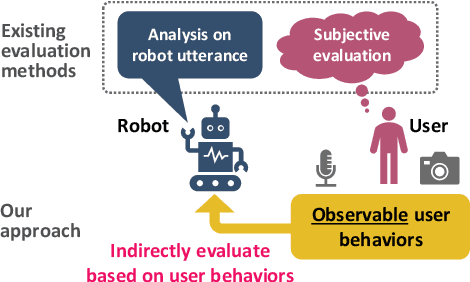
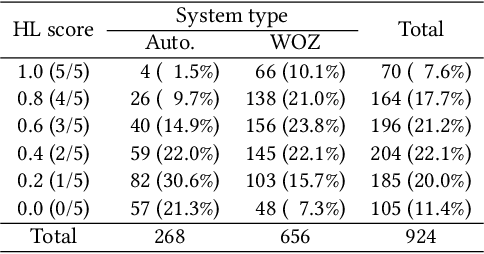
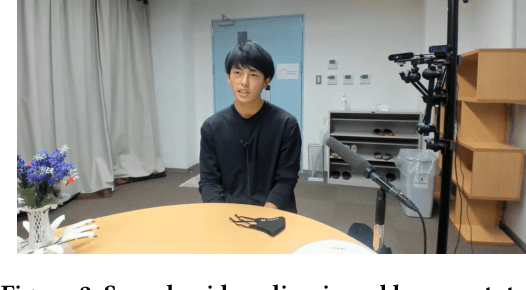
This paper tackles the challenging task of evaluating socially situated conversational robots and presents a novel objective evaluation approach that relies on multimodal user behaviors. In this study, our main focus is on assessing the human-likeness of the robot as the primary evaluation metric. While previous research often relied on subjective evaluations from users, our approach aims to evaluate the robot's human-likeness based on observable user behaviors indirectly, thus enhancing objectivity and reproducibility. To begin, we created an annotated dataset of human-likeness scores, utilizing user behaviors found in an attentive listening dialogue corpus. We then conducted an analysis to determine the correlation between multimodal user behaviors and human-likeness scores, demonstrating the feasibility of our proposed behavior-based evaluation method.
Reasoning before Responding: Integrating Commonsense-based Causality Explanation for Empathetic Response Generation
Jul 28, 2023Recent approaches to empathetic response generation try to incorporate commonsense knowledge or reasoning about the causes of emotions to better understand the user's experiences and feelings. However, these approaches mainly focus on understanding the causalities of context from the user's perspective, ignoring the system's perspective. In this paper, we propose a commonsense-based causality explanation approach for diverse empathetic response generation that considers both the user's perspective (user's desires and reactions) and the system's perspective (system's intentions and reactions). We enhance ChatGPT's ability to reason for the system's perspective by integrating in-context learning with commonsense knowledge. Then, we integrate the commonsense-based causality explanation with both ChatGPT and a T5-based model. Experimental evaluations demonstrate that our method outperforms other comparable methods on both automatic and human evaluations.