 Add to Chrome
 Add to Firefox
 Add to Edge
RUMBA: Russian User Memory Benchmark
Jul 23, 2026
The ability to handle long-term memory in LLMs is becoming increasingly critical, yet existing benchmarks remain English-centric and rely on aggregate retrieval metrics, failing to capture interactions between long-range context, temporal information, and reasoning. To address this, we introduce RUMBA (Russian User Memory BenchmArk) - a new benchmark for long-term conversational memory that provides a fine-grained taxonomy of memory-centric question types and a unified methodology accounting for semantic type, session scope, temporal reasoning, and the explicitness of temporal expressions. RUMBA consists of timestamped user-assistant dialogues with QA pairs requiring retrieval, combination, and reasoning across sessions. While designed for Russian, we also provide an aligned English subset under the same methodology. We evaluate contemporary memory systems and long-context models, and show how RUMBA serves as a diagnostic tool to analyze model behavior across benchmark slices and identify strengths and failure modes of different memory mechanisms.

A Family of Pretrained Transformer Language Models for Russian
Sep 19, 2023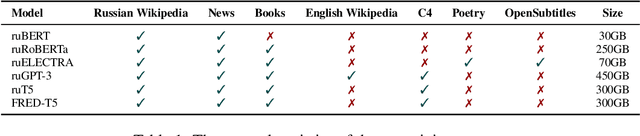
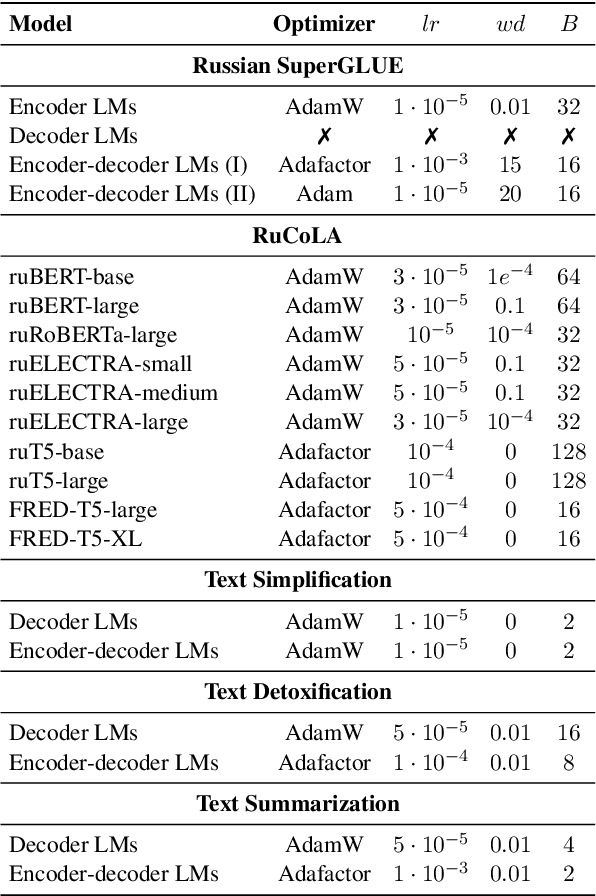
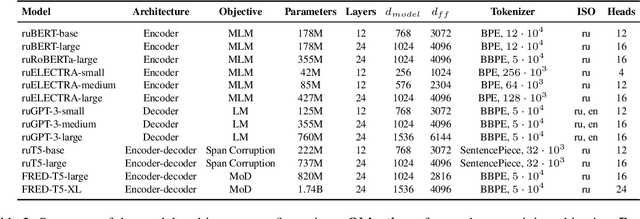
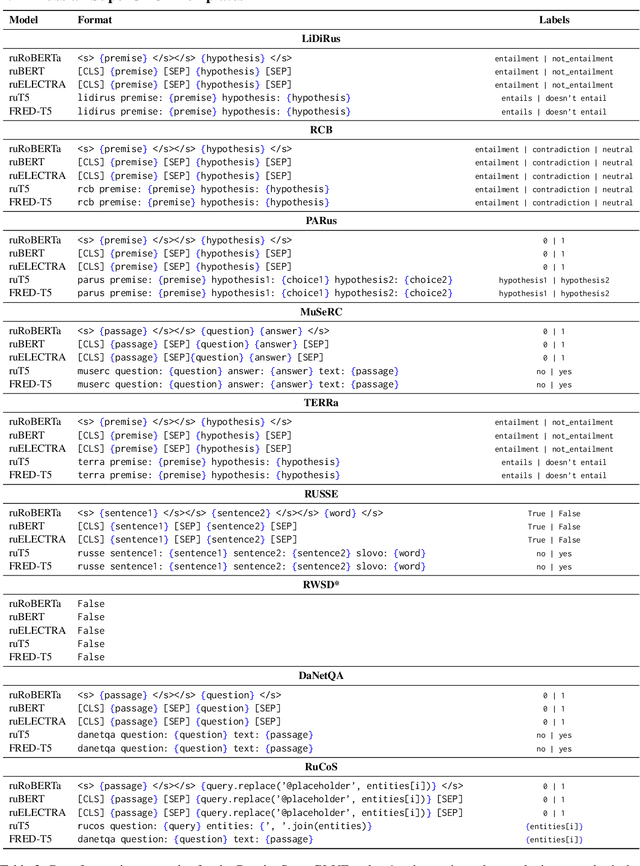
Nowadays, Transformer language models (LMs) represent a fundamental component of the NLP research methodologies and applications. However, the development of such models specifically for the Russian language has received little attention. This paper presents a collection of 13 Russian Transformer LMs based on the encoder (ruBERT, ruRoBERTa, ruELECTRA), decoder (ruGPT-3), and encoder-decoder (ruT5, FRED-T5) models in multiple sizes. Access to these models is readily available via the HuggingFace platform. We provide a report of the model architecture design and pretraining, and the results of evaluating their generalization abilities on Russian natural language understanding and generation datasets and benchmarks. By pretraining and releasing these specialized Transformer LMs, we hope to broaden the scope of the NLP research directions and enable the development of industrial solutions for the Russian language.
A Methodology for Generative Spelling Correction via Natural Spelling Errors Emulation across Multiple Domains and Languages
Aug 18, 2023

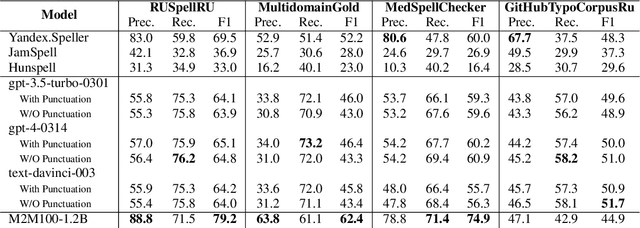

Modern large language models demonstrate impressive capabilities in text generation and generalization. However, they often struggle with solving text editing tasks, particularly when it comes to correcting spelling errors and mistypings. In this paper, we present a methodology for generative spelling correction (SC), which was tested on English and Russian languages and potentially can be extended to any language with minor changes. Our research mainly focuses on exploring natural spelling errors and mistypings in texts and studying the ways those errors can be emulated in correct sentences to effectively enrich generative models' pre-train procedure. We investigate the impact of such emulations and the models' abilities across different text domains. In this work, we investigate two spelling corruption techniques: 1) first one mimics human behavior when making a mistake through leveraging statistics of errors from particular dataset and 2) second adds the most common spelling errors, keyboard miss clicks, and some heuristics within the texts. We conducted experiments employing various corruption strategies, models' architectures and sizes on the pre-training and fine-tuning stages and evaluated the models using single-domain and multi-domain test sets. As a practical outcome of our work, we introduce SAGE (Spell checking via Augmentation and Generative distribution Emulation) is a library for automatic generative SC that includes a family of pre-trained generative models and built-in augmentation algorithms.