 Add to Chrome
 Add to Firefox
 Add to Edge
QuantCode-Bench: A Benchmark for Evaluating the Ability of Large Language Models to Generate Executable Algorithmic Trading Strategies
Apr 16, 2026
Large language models have demonstrated strong performance on general-purpose programming tasks, yet their ability to generate executable algorithmic trading strategies remains underexplored. Unlike standard code benchmarks, trading-strategy generation requires simultaneous mastery of domain-specific financial logic, knowledge of a specialized API, and the ability to produce code that is not only syntactically correct but also leads to actual trades on historical data. In this work, we present QuantCode-Bench, a benchmark for the systematic evaluation of modern LLMs in generating strategies for the Backtrader framework from textual descriptions in English. The benchmark contains 400 tasks of varying difficulty collected from Reddit, TradingView, StackExchange, GitHub, and synthetic sources. Evaluation is conducted through a multi-stage pipeline that checks syntactic correctness, successful backtest execution, the presence of trades, and semantic alignment with the task description using an LLM judge. We compare state-of-the-art models in two settings: single-turn, where the strategy must be generated correctly on the first attempt, and agentic multi-turn, where the model receives iterative feedback and may repair its errors. We analyze the failure modes across different stages of the pipeline and show that the main limitations of current models are not related to syntax, but rather to the correct operationalization of trading logic, proper API usage, and adherence to task semantics. These findings suggest that trading strategy generation constitutes a distinct class of domain-specific code generation tasks in which success requires not only technical correctness, but also alignment between natural-language descriptions, financial logic, and the observable behavior of the strategy on data.

A Family of Pretrained Transformer Language Models for Russian
Sep 19, 2023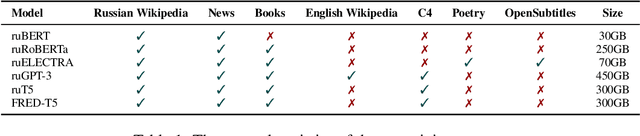
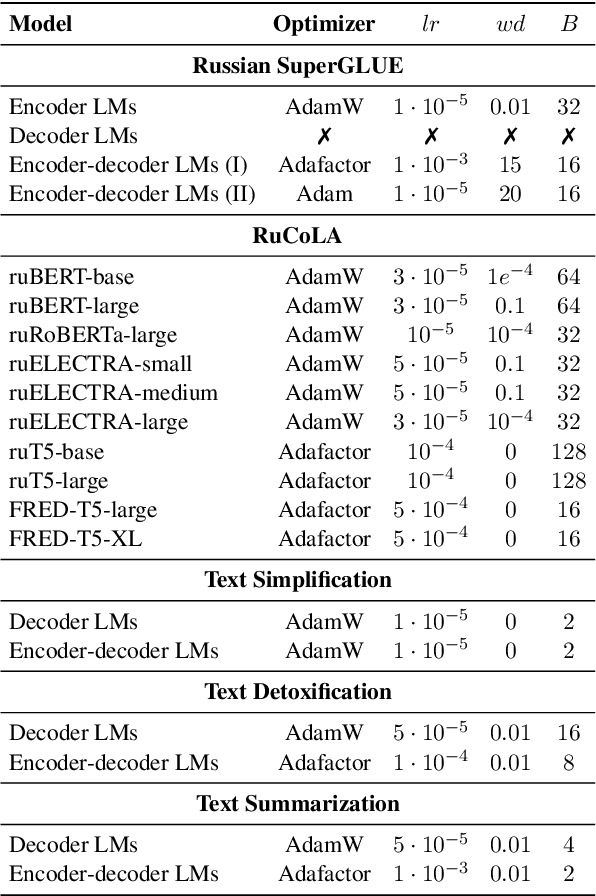
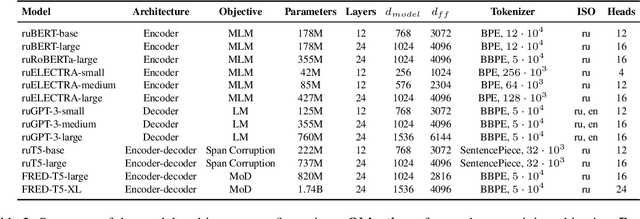
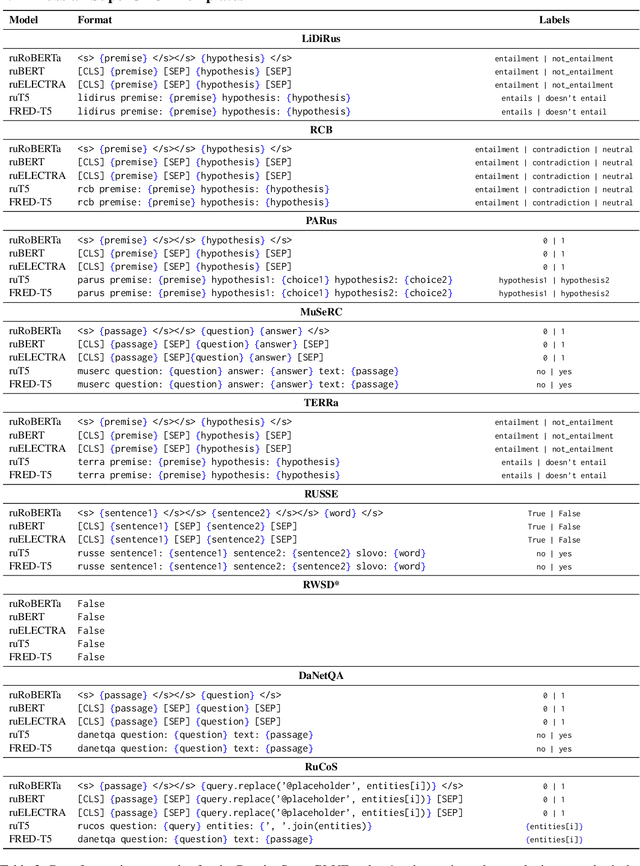
Nowadays, Transformer language models (LMs) represent a fundamental component of the NLP research methodologies and applications. However, the development of such models specifically for the Russian language has received little attention. This paper presents a collection of 13 Russian Transformer LMs based on the encoder (ruBERT, ruRoBERTa, ruELECTRA), decoder (ruGPT-3), and encoder-decoder (ruT5, FRED-T5) models in multiple sizes. Access to these models is readily available via the HuggingFace platform. We provide a report of the model architecture design and pretraining, and the results of evaluating their generalization abilities on Russian natural language understanding and generation datasets and benchmarks. By pretraining and releasing these specialized Transformer LMs, we hope to broaden the scope of the NLP research directions and enable the development of industrial solutions for the Russian language.