 Add to Chrome
 Add to Firefox
 Add to Edge
Networked Intelligence: Active Shared Context Graphs for Human-AI Team Science
Jul 16, 2026
Most AI-for-science systems focus on scaling a single reasoning process by using better models, larger context windows, long-horizon agentic execution, or digital co-scientists working with one principal user. However, challenging scientific problems are rarely solved by one reasoner alone. They are solved by teams whose members carry different priors, experimental background, tacit knowledge, and domain-trained intuitions. The open problem is therefore not only how to scale models, but how to develop "networked intelligence", scaling the connections between humans and AI systems so that a result or hypothesis produced in one context reaches another person, agent, instrument or robot that can act on it. We introduce Mycelium, an active shared workspace that automatically connects researchers and AI agents. As human users and agents work, the system captures important observations and hypotheses, tracks how they relate to the team's evolving knowledge model, and routes them to the person or agent whose next decision they can inform. We evaluate Mycelium through a real-world scientific discovery use case: a biological multi-omics campaign where shared context turned a local analytical finding into a cross-expert mechanistic constraint and ultimately into an experimental design. Finally, we describe networked intelligence as sparse conditional computation over distributed scientific contexts. This framework establishes when a scaled standalone agent is sufficient, and when isolated data and specialized expertise make a networked approach essential.

Reaction-network reasoning with frontier models for experimentally confirmed catalyst-selectivity hypotheses
Jul 09, 2026Catalysts are essential for sustainable chemical manufacturing, yet discovering novel architectures remains a bottleneck dominated by trial-and-error experimentation and computationally intensive screening. In complex reactions such as electrochemical carbon dioxide reduction, product selectivity is governed by dynamic interfacial, electrolyte, and potential factors as well as kinetic pathway competition. Conventional descriptor-based machine learning and computational potentials struggle to resolve these mechanistic branch points, primarily relying on static ground-state descriptors or bulk structural correlations rather than end-to-end topological pathway analysis. Here, we show that frontier language models, when strictly constrained to reason over explicit reaction networks, can discover novel catalysts by identifying the physical levers that govern pathway competition. We developed a human-AI co-thinking framework that enforces network invariance to extract testable hypotheses from complex chemical graphs. Applied to CO2 electroreduction, the framework identified ketene desorption and hydroxide capture as the acetate-forming pathway, and predicted a distinct adsorbed CO and CH2 coupling route to ketene. By isolating actionable control levers, specifically local alkalinity, controlled iron incorporation, and restricted interfacial proton-donor accessibility, the framework guided the prospective synthesis of a copper-iron oxide catalyst demonstrating a threefold increase in acetate selectivity over matched Cu-rich baselines. This mechanism-guided reasoning architecture shifts the computational paradigm from retrospective statistical prediction to forward-looking hypothesis generation, providing a broadly applicable blueprint for mechanism-guided materials discovery.
Optimizing Data Distribution and Kernel Performance for Efficient Training of Chemistry Foundation Models: A Case Study with MACE
Apr 14, 2025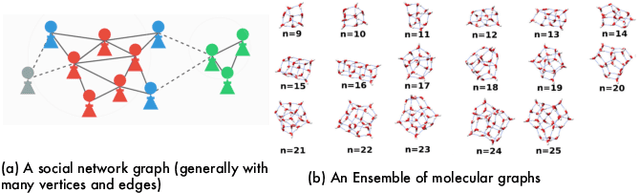
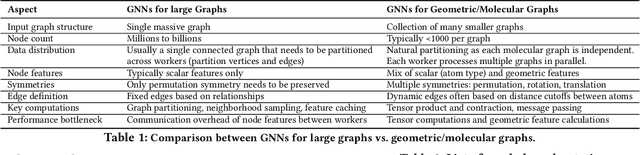
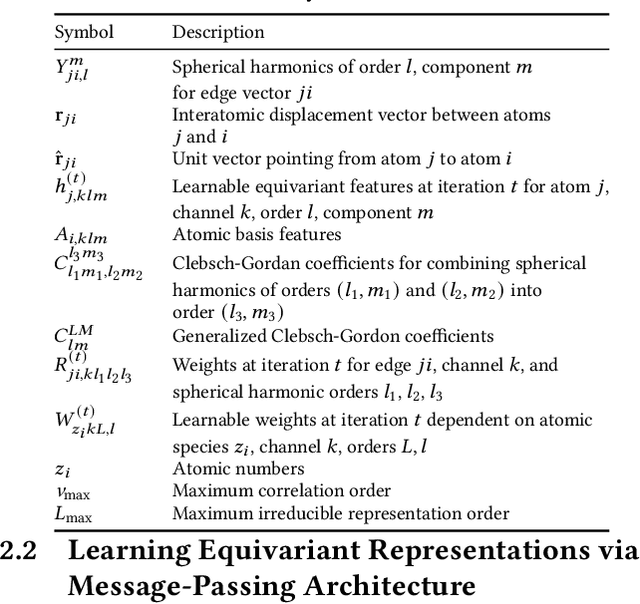
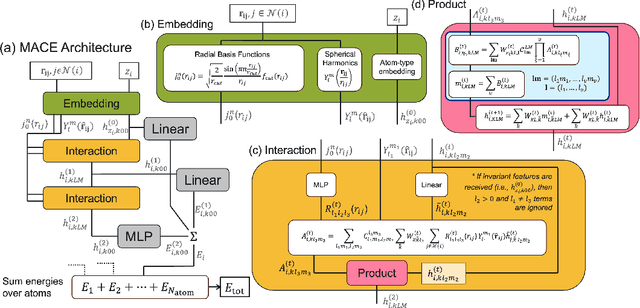
Chemistry Foundation Models (CFMs) that leverage Graph Neural Networks (GNNs) operating on 3D molecular graph structures are becoming indispensable tools for computational chemists and materials scientists. These models facilitate the understanding of matter and the discovery of new molecules and materials. In contrast to GNNs operating on a large homogeneous graphs, GNNs used by CFMs process a large number of geometric graphs of varying sizes, requiring different optimization strategies than those developed for large homogeneous GNNs. This paper presents optimizations for two critical phases of CFM training: data distribution and model training, targeting MACE - a state-of-the-art CFM. We address the challenge of load balancing in data distribution by formulating it as a multi-objective bin packing problem. We propose an iterative algorithm that provides a highly effective, fast, and practical solution, ensuring efficient data distribution. For the training phase, we identify symmetric tensor contraction as the key computational kernel in MACE and optimize this kernel to improve the overall performance. Our combined approach of balanced data distribution and kernel optimization significantly enhances the training process of MACE. Experimental results demonstrate a substantial speedup, reducing per-epoch execution time for training from 12 to 2 minutes on 740 GPUs with a 2.6M sample dataset.
Thinking Fast and Laterally: Multi-Agentic Approach for Reasoning about Uncertain Emerging Events
Dec 10, 2024This paper introduces lateral thinking to implement System-2 reasoning capabilities in AI systems, focusing on anticipatory and causal reasoning under uncertainty. We present a framework for systematic generation and modeling of lateral thinking queries and evaluation datasets. We introduce Streaming Agentic Lateral Thinking (SALT), a multi-agent framework designed to process complex, low-specificity queries in streaming data environments. SALT implements lateral thinking-inspired System-2 reasoning through a dynamic communication structure between specialized agents. Our key insight is that lateral information flow across long-distance agent interactions, combined with fine-grained belief management, yields richer information contexts and enhanced reasoning. Preliminary quantitative and qualitative evaluations indicate SALT's potential to outperform single-agent systems in handling complex lateral reasoning tasks in a streaming environment.
ChemReasoner: Heuristic Search over a Large Language Model's Knowledge Space using Quantum-Chemical Feedback
Feb 21, 2024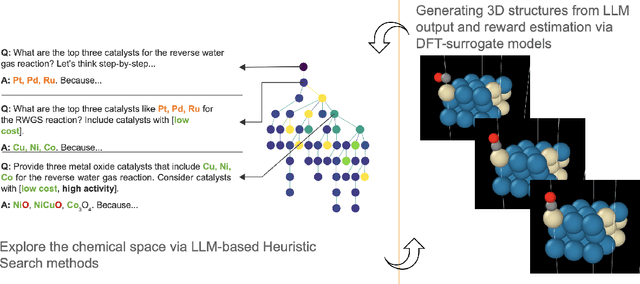
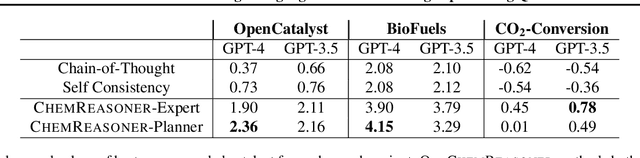
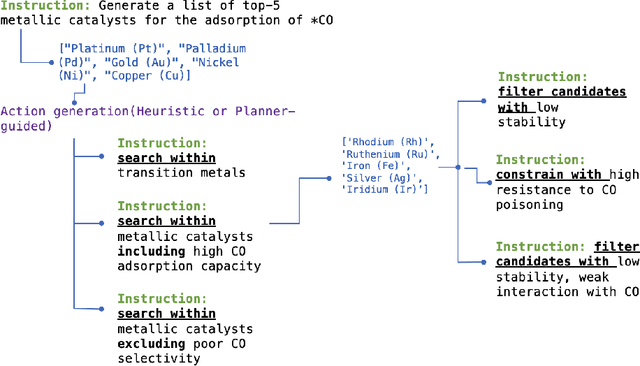
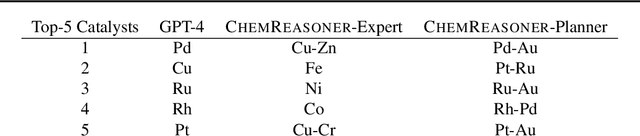
The discovery of new catalysts is essential for the design of new and more efficient chemical processes in order to transition to a sustainable future. We introduce an AI-guided computational screening framework unifying linguistic reasoning with quantum-chemistry based feedback from 3D atomistic representations. Our approach formulates catalyst discovery as an uncertain environment where an agent actively searches for highly effective catalysts via the iterative combination of large language model (LLM)-derived hypotheses and atomistic graph neural network (GNN)-derived feedback. Identified catalysts in intermediate search steps undergo structural evaluation based on spatial orientation, reaction pathways, and stability. Scoring functions based on adsorption energies and barriers steer the exploration in the LLM's knowledge space toward energetically favorable, high-efficiency catalysts. We introduce planning methods that automatically guide the exploration without human input, providing competitive performance against expert-enumerated chemical descriptor-based implementations. By integrating language-guided reasoning with computational chemistry feedback, our work pioneers AI-accelerated, trustworthy catalyst discovery.
GLaM: Fine-Tuning Large Language Models for Domain Knowledge Graph Alignment via Neighborhood Partitioning and Generative Subgraph Encoding
Feb 16, 2024


Integrating large language models (LLMs) with knowledge graphs derived from domain-specific data represents an important advancement towards more powerful and factual reasoning. As these models grow more capable, it is crucial to enable them to perform multi-step inferences over real-world knowledge graphs while minimizing hallucination. While large language models excel at conversation and text generation, their ability to reason over domain-specialized graphs of interconnected entities remains limited. For example, can we query a LLM to identify the optimal contact in a professional network for a specific goal, based on relationships and attributes in a private database? The answer is no--such capabilities lie beyond current methods. However, this question underscores a critical technical gap that must be addressed. Many high-value applications in areas such as science, security, and e-commerce rely on proprietary knowledge graphs encoding unique structures, relationships, and logical constraints. We introduce a fine-tuning framework for developing Graph-aligned LAnguage Models (GLaM) that transforms a knowledge graph into an alternate text representation with labeled question-answer pairs. We demonstrate that grounding the models in specific graph-based knowledge expands the models' capacity for structure-based reasoning. Our methodology leverages the large-language model's generative capabilities to create the dataset and proposes an efficient alternate to retrieval-augmented generation styled methods.
Evaluating Emerging AI/ML Accelerators: IPU, RDU, and NVIDIA/AMD GPUs
Nov 08, 2023The relentless advancement of artificial intelligence (AI) and machine learning (ML) applications necessitates the development of specialized hardware accelerators capable of handling the increasing complexity and computational demands. Traditional computing architectures, based on the von Neumann model, are being outstripped by the requirements of contemporary AI/ML algorithms, leading to a surge in the creation of accelerators like the Graphcore Intelligence Processing Unit (IPU), Sambanova Reconfigurable Dataflow Unit (RDU), and enhanced GPU platforms. These hardware accelerators are characterized by their innovative data-flow architectures and other design optimizations that promise to deliver superior performance and energy efficiency for AI/ML tasks. This research provides a preliminary evaluation and comparison of these commercial AI/ML accelerators, delving into their hardware and software design features to discern their strengths and unique capabilities. By conducting a series of benchmark evaluations on common DNN operators and other AI/ML workloads, we aim to illuminate the advantages of data-flow architectures over conventional processor designs and offer insights into the performance trade-offs of each platform. The findings from our study will serve as a valuable reference for the design and performance expectations of research prototypes, thereby facilitating the development of next-generation hardware accelerators tailored for the ever-evolving landscape of AI/ML applications. Through this analysis, we aspire to contribute to the broader understanding of current accelerator technologies and to provide guidance for future innovations in the field.
Monte Carlo Thought Search: Large Language Model Querying for Complex Scientific Reasoning in Catalyst Design
Oct 22, 2023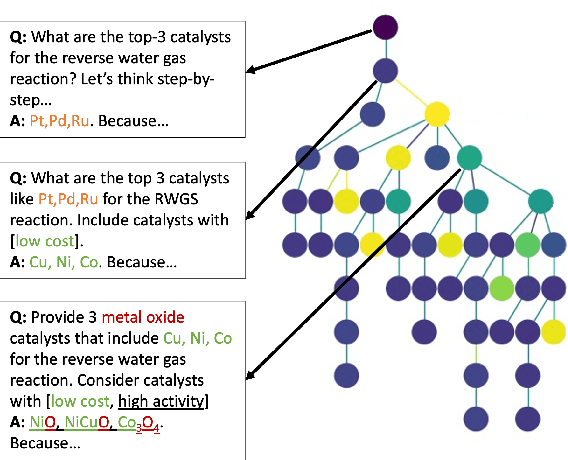
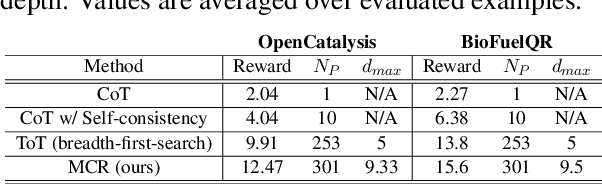
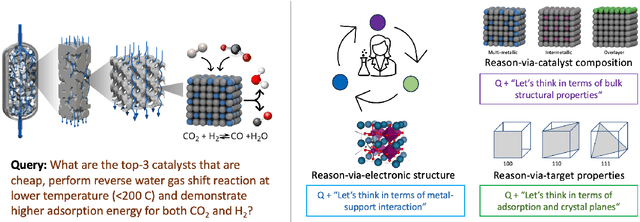
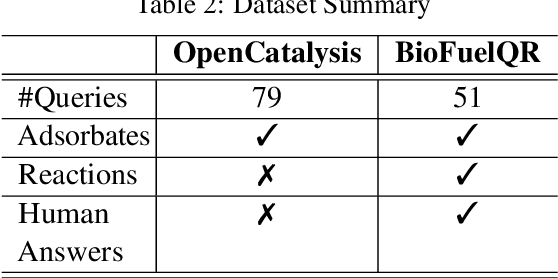
Discovering novel catalysts requires complex reasoning involving multiple chemical properties and resultant trade-offs, leading to a combinatorial growth in the search space. While large language models (LLM) have demonstrated novel capabilities for chemistry through complex instruction following capabilities and high quality reasoning, a goal-driven combinatorial search using LLMs has not been explored in detail. In this work, we present a Monte Carlo Tree Search-based approach that improves beyond state-of-the-art chain-of-thought prompting variants to augment scientific reasoning. We introduce two new reasoning datasets: 1) a curation of computational chemistry simulations, and 2) diverse questions written by catalysis researchers for reasoning about novel chemical conversion processes. We improve over the best baseline by 25.8\% and find that our approach can augment scientist's reasoning and discovery process with novel insights.
Robust Explanations for Deep Neural Networks via Pseudo Neural Tangent Kernel Surrogate Models
May 23, 2023


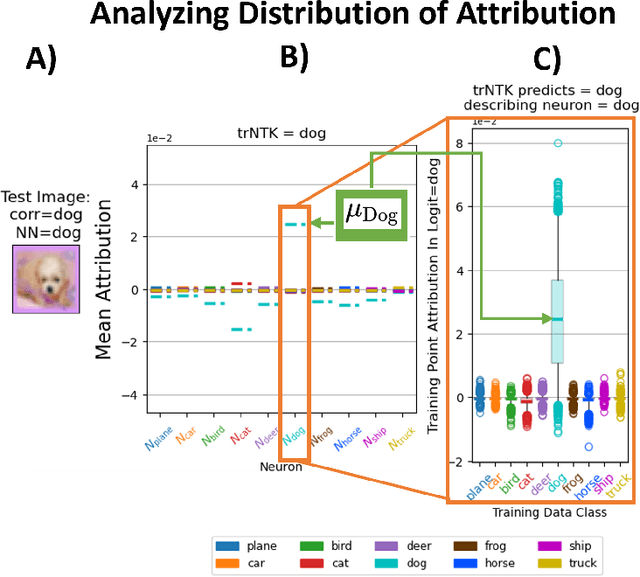
One of the ways recent progress has been made on explainable AI has been via explain-by-example strategies, specifically, through data attribution tasks. The feature spaces used to attribute decisions to training data, however, have not been compared against one another as to whether they form a truly representative surrogate model of the neural network (NN). Here, we demonstrate the efficacy of surrogate linear feature spaces to neural networks through two means: (1) we establish that a normalized psuedo neural tangent kernel (pNTK) is more correlated to the neural network decision functions than embedding based and influence based alternatives in both computer vision and large language model architectures; (2) we show that the attributions created from the normalized pNTK more accurately select perturbed training data in a data poisoning attribution task than these alternatives. Based on these observations, we conclude that kernel linear models are effective surrogate models across multiple classification architectures and that pNTK-based kernels are the most appropriate surrogate feature space of all kernels studied.
BitGNN: Unleashing the Performance Potential of Binary Graph Neural Networks on GPUs
May 04, 2023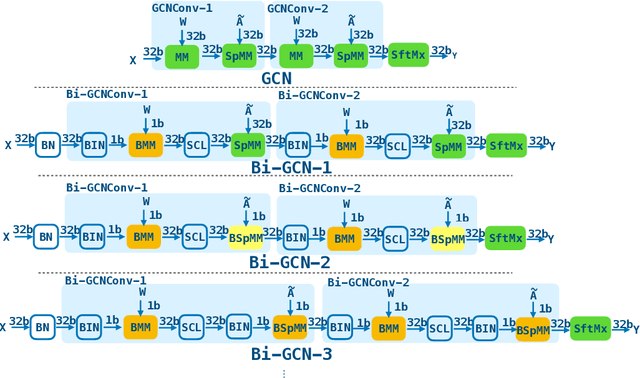

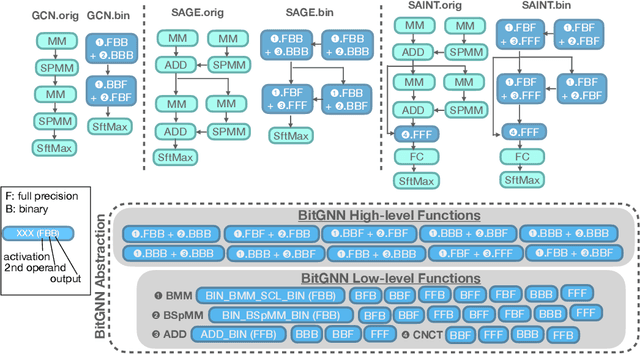
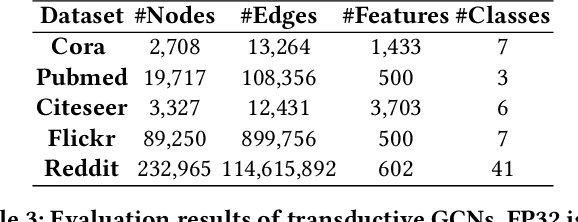
Recent studies have shown that Binary Graph Neural Networks (GNNs) are promising for saving computations of GNNs through binarized tensors. Prior work, however, mainly focused on algorithm designs or training techniques, leaving it open to how to materialize the performance potential on accelerator hardware fully. This work redesigns the binary GNN inference backend from the efficiency perspective. It fills the gap by proposing a series of abstractions and techniques to map binary GNNs and their computations best to fit the nature of bit manipulations on GPUs. Results on real-world graphs with GCNs, GraphSAGE, and GraphSAINT show that the proposed techniques outperform state-of-the-art binary GNN implementations by 8-22X with the same accuracy maintained. BitGNN code is publicly available.