 Add to Chrome
 Add to Firefox
 Add to Edge
Identifying Informative Environments for Cognition Parameter Inference via Bayesian Experimental Design
Aug 03, 2026
Computational cognitive modeling seeks to infer latent cognitive mechanisms underlying observed behavior. Bayesian inverse planning provides a principled framework for such inference, but its success depends critically on the experimental environment. Existing approaches typically treat environments as fixed, leaving open the question of which cognitive experiments are most informative for cognition parameter inference. We formulate the design of cognitive planning experiments as a Bayesian Experimental Design (BED) problem, treating the experimental environment as the design variable. We establish an exact Monte Carlo BED benchmark and introduce an amortized Bayesian experimental design framework for efficient posterior inference and design evaluation. Experiments on the Mouselab-MDP process-tracing paradigm show that amortized BED closely matches the environment rankings of exact Monte Carlo BED while substantially reducing computational cost. We further show that no single environment is uniformly optimal across cognitive inference objectives, revealing trade-offs between expected information gain, posterior recoverability, and information efficiency. These results provide a principled framework for designing informative cognitive experiments for Bayesian parameter inference.

Understanding Human Actions through the Lens of Executable Models
Apr 20, 2026Human-centred systems require an understanding of human actions in the physical world. Temporally extended sequences of actions are intentional and structured, yet existing methods for recognising what actions are performed often do not attempt to capture their structure, particularly how the actions are executed. This, however, is crucial for assessing the quality of the action's execution and its differences from other actions. To capture the internal mechanics of actions, we introduce a domain-specific language EXACT that represents human motions as underspecified motion programs, interpreted as reward-generating functions for zero-shot policy inference using forward-backwards representations. By leveraging the compositional nature of EXACT motion programs, we combine individual policies into an executable neuro-symbolic model that uses program structure for compositional modelling. We evaluate the utility of the proposed pipeline for creating executable action models by analysing motion-capture data to understand human actions, for the tasks of human action segmentation and action anomaly detection. Our results show that the use of executable action models improves data efficiency and captures intuitive relationships between actions compared with monolithic, task-specific approaches.
Generating Driving Simulations via Conversation
Oct 13, 2024Cyber-physical systems like autonomous vehicles are tested in simulation before deployment, using domain-specific programs for scenario specification. To aid the testing of autonomous vehicles in simulation, we design a natural language interface, using an instruction-following large language model, to assist a non-coding domain expert in synthesising the desired scenarios and vehicle behaviours. We show that using it to convert utterances to the symbolic program is feasible, despite the very small training dataset. Human experiments show that dialogue is critical to successful simulation generation, leading to a 4.5 times higher success rate than a generation without engaging in extended conversation.
SECURE: Semantics-aware Embodied Conversation under Unawareness for Lifelong Robot Learning
Sep 26, 2024

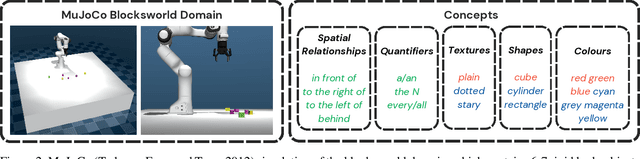
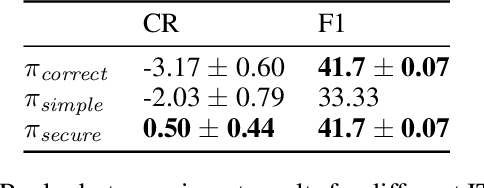
This paper addresses a challenging interactive task learning scenario we call rearrangement under unawareness: to manipulate a rigid-body environment in a context where the robot is unaware of a concept that's key to solving the instructed task. We propose SECURE, an interactive task learning framework designed to solve such problems by fixing a deficient domain model using embodied conversation. Through dialogue, the robot discovers and then learns to exploit unforeseen possibilities. Using SECURE, the robot not only learns from the user's corrective feedback when it makes a mistake, but it also learns to make strategic dialogue decisions for revealing useful evidence about novel concepts for solving the instructed task. Together, these abilities allow the robot to generalise to subsequent tasks using newly acquired knowledge. We demonstrate that a robot that is semantics-aware -- that is, it exploits the logical consequences of both sentence and discourse semantics in the learning and inference process -- learns to solve rearrangement under unawareness more effectively than a robot that lacks such capabilities.