 Add to Chrome
 Add to Firefox
 Add to Edge
Live Music Diffusion Models: Efficient Fine-Tuning and Post-Training of Interactive Diffusion Music Generators
May 21, 2026
Interactive streaming music generation promises the use of generative models for live performance and co-creation that is impossible with offline models. However, SOTA models exist in the discrete-AR regime, requiring industrial levels of compute for both training and inference. In this work, we investigate whether audio diffusion models, with their wide support in the open-source community but non-streaming bidirectional nature, can be repurposed efficiently into interactive models accessible on consumer hardware. By taking a critical look at the modern pipeline for block-wise outpainting diffusion, we identify critical inefficiencies during inference that result in strictly worse computational efficiency than their discrete-AR counterparts. We propose Live Music Diffusion Models (LMDMs), a simple modification of the generative diffusion process that recovers, and then outperforms, the inference complexity of the discrete Live Music Models (LMMs) through block-wise KV Caching. Unlike LMMs, LMDMs further enable stable post-training alignment through our novel ARC-Forcing paradigm, reducing error accumulation without any explicit RL or reward models. We demonstrate the application of LMDMs in a number of creative domains, including text-conditioned generation, sketch-based music synthesis, and jamming. We finally show how LMDMs can be used as a generative instrument in a real artist-AI collaboration, utilizing LMDMs as a "generative delay" to transform musicians' improvisation live for variable timbral effects while running locally on a consumer gaming laptop.

SpeakEasy: Enhancing Text-to-Speech Interactions for Expressive Content Creation
Apr 07, 2025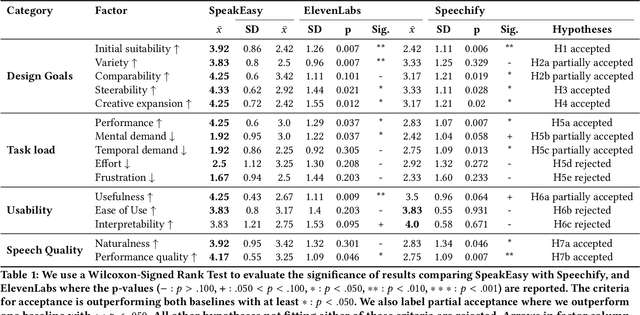
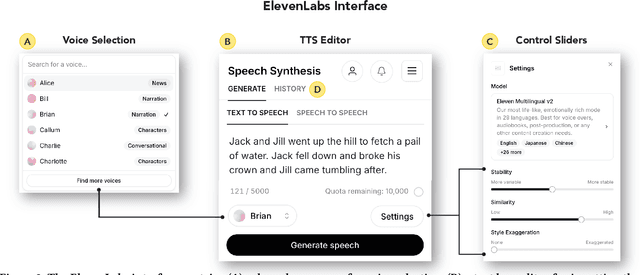
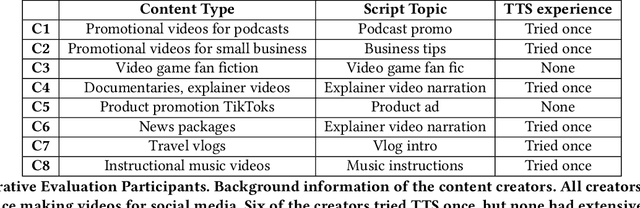
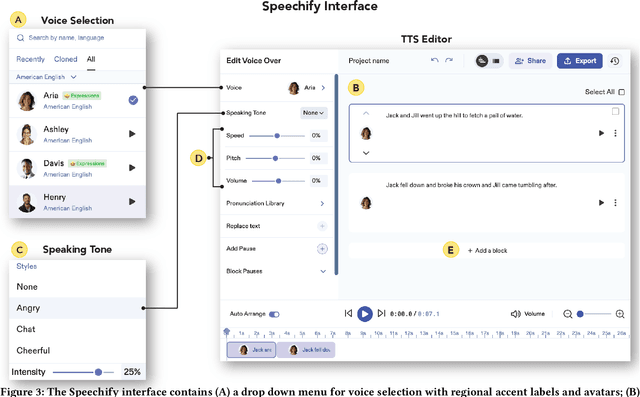
Novice content creators often invest significant time recording expressive speech for social media videos. While recent advancements in text-to-speech (TTS) technology can generate highly realistic speech in various languages and accents, many struggle with unintuitive or overly granular TTS interfaces. We propose simplifying TTS generation by allowing users to specify high-level context alongside their script. Our Wizard-of-Oz system, SpeakEasy, leverages user-provided context to inform and influence TTS output, enabling iterative refinement with high-level feedback. This approach was informed by two 8-subject formative studies: one examining content creators' experiences with TTS, and the other drawing on effective strategies from voice actors. Our evaluation shows that participants using SpeakEasy were more successful in generating performances matching their personal standards, without requiring significantly more effort than leading industry interfaces.
SynthScribe: Deep Multimodal Tools for Synthesizer Sound Retrieval and Exploration
Dec 07, 2023Synthesizers are powerful tools that allow musicians to create dynamic and original sounds. Existing commercial interfaces for synthesizers typically require musicians to interact with complex low-level parameters or to manage large libraries of premade sounds. To address these challenges, we implement SynthScribe -- a fullstack system that uses multimodal deep learning to let users express their intentions at a much higher level. We implement features which address a number of difficulties, namely 1) searching through existing sounds, 2) creating completely new sounds, 3) making meaningful modifications to a given sound. This is achieved with three main features: a multimodal search engine for a large library of synthesizer sounds; a user centered genetic algorithm by which completely new sounds can be created and selected given the users preferences; a sound editing support feature which highlights and gives examples for key control parameters with respect to a text or audio based query. The results of our user studies show SynthScribe is capable of reliably retrieving and modifying sounds while also affording the ability to create completely new sounds that expand a musicians creative horizon.
Promptify: Text-to-Image Generation through Interactive Prompt Exploration with Large Language Models
Apr 18, 2023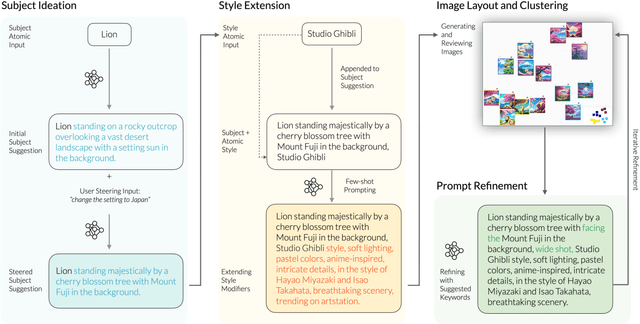
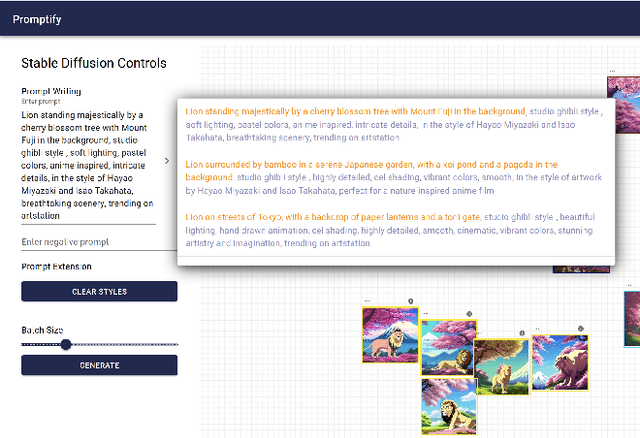
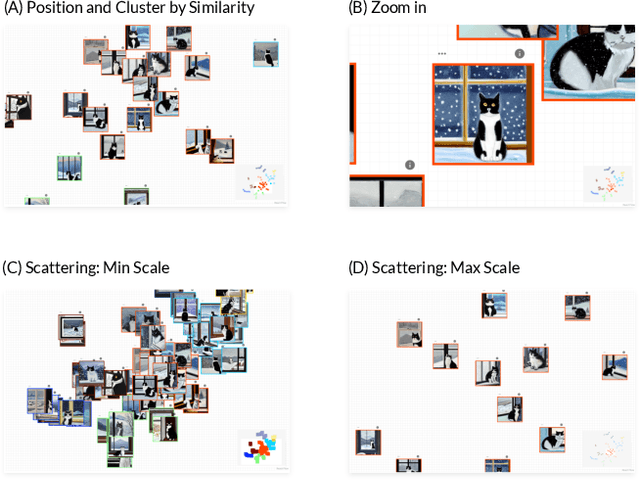
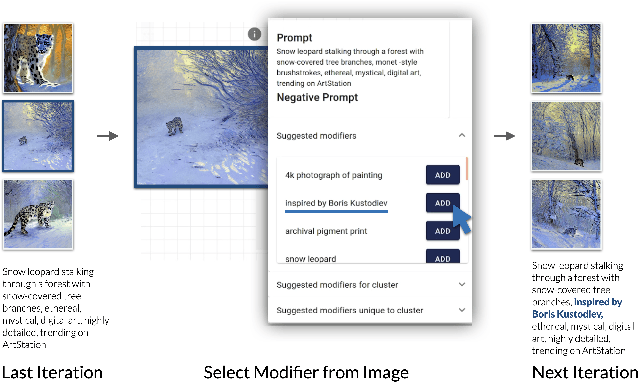
Text-to-image generative models have demonstrated remarkable capabilities in generating high-quality images based on textual prompts. However, crafting prompts that accurately capture the user's creative intent remains challenging. It often involves laborious trial-and-error procedures to ensure that the model interprets the prompts in alignment with the user's intention. To address the challenges, we present Promptify, an interactive system that supports prompt exploration and refinement for text-to-image generative models. Promptify utilizes a suggestion engine powered by large language models to help users quickly explore and craft diverse prompts. Our interface allows users to organize the generated images flexibly, and based on their preferences, Promptify suggests potential changes to the original prompt. This feedback loop enables users to iteratively refine their prompts and enhance desired features while avoiding unwanted ones. Our user study shows that Promptify effectively facilitates the text-to-image workflow and outperforms an existing baseline tool widely used for text-to-image generation.