 Add to Chrome
 Add to Firefox
 Add to Edge
Live Music Diffusion Models: Efficient Fine-Tuning and Post-Training of Interactive Diffusion Music Generators
May 21, 2026
Interactive streaming music generation promises the use of generative models for live performance and co-creation that is impossible with offline models. However, SOTA models exist in the discrete-AR regime, requiring industrial levels of compute for both training and inference. In this work, we investigate whether audio diffusion models, with their wide support in the open-source community but non-streaming bidirectional nature, can be repurposed efficiently into interactive models accessible on consumer hardware. By taking a critical look at the modern pipeline for block-wise outpainting diffusion, we identify critical inefficiencies during inference that result in strictly worse computational efficiency than their discrete-AR counterparts. We propose Live Music Diffusion Models (LMDMs), a simple modification of the generative diffusion process that recovers, and then outperforms, the inference complexity of the discrete Live Music Models (LMMs) through block-wise KV Caching. Unlike LMMs, LMDMs further enable stable post-training alignment through our novel ARC-Forcing paradigm, reducing error accumulation without any explicit RL or reward models. We demonstrate the application of LMDMs in a number of creative domains, including text-conditioned generation, sketch-based music synthesis, and jamming. We finally show how LMDMs can be used as a generative instrument in a real artist-AI collaboration, utilizing LMDMs as a "generative delay" to transform musicians' improvisation live for variable timbral effects while running locally on a consumer gaming laptop.

Automation from the Worker's Perspective
Sep 30, 2024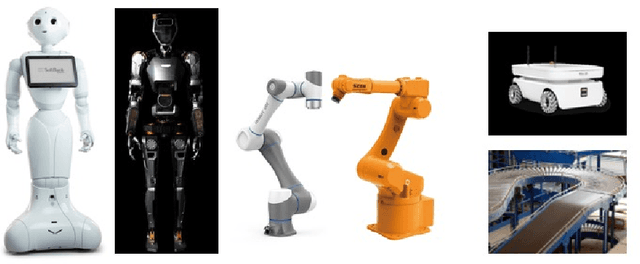
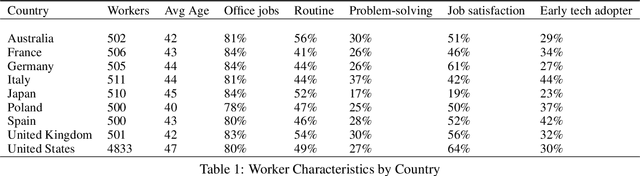
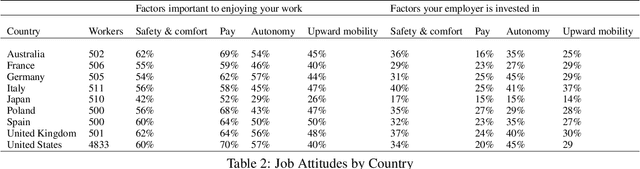
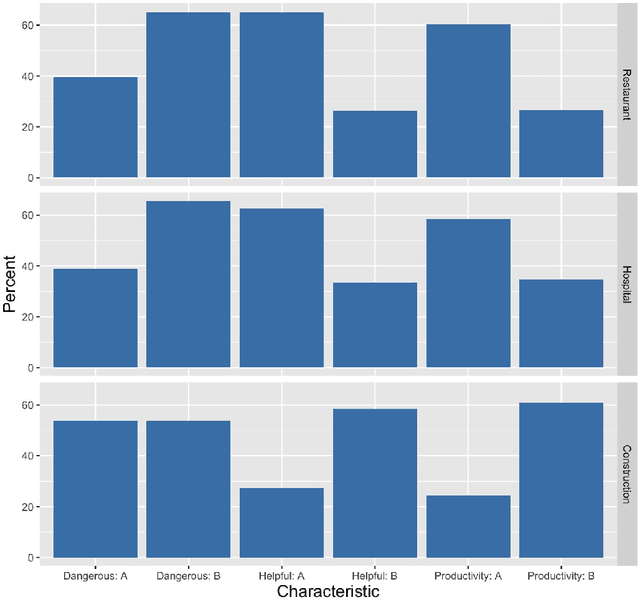
Common narratives about automation often pit new technologies against workers. The introduction of advanced machine tools, industrial robots, and AI have all been met with concern that technological progress will mean fewer jobs. However, workers themselves offer a more optimistic, nuanced perspective. Drawing on a far-reaching 2024 survey of more than 9,000 workers across nine countries, this paper finds that more workers report potential benefits from new technologies like robots and AI for their safety and comfort at work, their pay, and their autonomy on the job than report potential costs. Workers with jobs that ask them to solve complex problems, workers who feel valued by their employers, and workers who are motivated to move up in their careers are all more likely to see new technologies as beneficial. In contrast to assumptions in previous research, more formal education is in some cases associated with more negative attitudes toward automation and its impact on work. In an experimental setting, the prospect of financial incentives for workers improve their perceptions of automation technologies, whereas the prospect of increased input about how new technologies are used does not have a significant effect on workers' attitudes toward automation.