 Add to Chrome
 Add to Firefox
 Add to Edge
Spatial Representation Learning Beyond Pixels: Unifying Raster Data and Vector Semantics for Human-Centric Geospatial Foundation Models
Jun 01, 2026
Earth Observation (EO) has fundamentally transformed the monitoring of environmental processes and human activities up to planetary scale. Recent advances in self-supervised learning have given rise to Earth Observation Foundation Models (EOFMs), which leverage petabyte-scale unlabeled EO data to learn transferable representations across a wide range of downstream geospatial tasks. Despite these advances, current EOFMs remain largely confined to raster modalities, overlooking the rich, structured information encoded in openly-accessible vector data sources such as OpenStreetMap and Overture. Vector data provides explicit and compact representations of geographic entities, including geometry, topology, and semantic relationships, offering critical contextual signals that are often ambiguous or inaccessible in imagery alone. Raster and vector data thus represent complementary views of geographic space: raster data captures continuous physical and spectral patterns, while vector data encodes discrete objects and their relational structure and often represents more of the human rather than the physical systems (e.g. social or demographic data). However, existing geospatial representation learning paradigms treat these modalities in isolation, relying on imperfect and often lossy transformations to bridge them. This perspective paper calls for a paradigm shift toward joint Spatial Representation Learning (SRL) in an unified embedding space that integrate raster perception with vector-based reasoning. Building on emerging efforts in multimodal geospatial learning, we highlight conceptual foundations, technical challenges, and promising directions for aligning heterogeneous spatial data sources. We contend that such integration is essential for developing next-generation geospatial AI systems capable of more accurate, interpretable, and semantically grounded understanding of the Earth.

Open-access model for detecting openly dumped dispersed municipal solid waste from crowdsourced UAV imagery in Sub-Saharan Africa
May 04, 2026Managing municipal solid waste in rapidly urbanizing Sub-Saharan Africa remains challenging due to dispersed informal dumping and limited high-resolution datasets for spatial monitoring. We present an open-access deep learning model for automated detection of openly dumped dispersed solid waste via crowdsourced UAV imagery, trained and evaluated across 29 regions in 10 countries, encompassing diverse environmental contexts. A deep learning model trained on manually annotated image tiles achieved excellent performance in detecting openly dumped dispersed solid waste across all study regions. Predicted distributions reveal heterogeneous accumulation patterns, ranging from localized hotspots - often along waterways, where waste can exacerbate flood and public health risks - to more dispersed litter across urban areas. Waste accumulation is most strongly associated with population density and indicators of lack of local infrastructure access, whereas its relationship with broader measures of regional development is weaker, highlighting the importance of fine-scale data for understanding localized waste dynamics. By releasing the model, this study provides a ready-to-use tool for UAV imagery collected by municipalities and local mapping communities, enabling openly dumped dispersed solid waste monitoring without extensive technical expertise. This approach empowers local practitioners to convert UAV imagery into actionable insights, supporting targeted interventions and improved municipal solid waste management across Sub-Saharan Africa.
AI-based Waste Mapping for Addressing Climate-Exacerbated Flood Risk
Apr 20, 2026Urban flooding is a growing climate change-related hazard in rapidly expanding African cities, where inadequate waste management often blocks drainage systems and amplifies flood risks. This study introduces an AI-powered urban waste mapping workflow that leverages openly available aerial and street-view imagery to detect municipal solid waste at high resolution. Applied in Dar es Salaam, Tanzania, our approach reveals spatial waste patterns linked to informal settlements and socio-economic factors. Waste accumulation in waterways was found to be up to three times higher than in adjacent urban areas, highlighting critical hotspots for climate-exacerbated flooding. Unlike traditional manual mapping methods, this scalable AI approach allows city-wide monitoring and prioritization of interventions. Crucially, our collaboration with local partners ensured culturally and contextually relevant data labeling, reflecting real-world reuse practices for solid waste. The results offer actionable insights for urban planning, climate adaptation, and sustainable waste management in flood-prone urban areas.
Automated Road Crack Localization to Guide Highway Maintenance
Jan 21, 2026Highway networks are crucial for economic prosperity. Climate change-induced temperature fluctuations are exacerbating stress on road pavements, resulting in elevated maintenance costs. This underscores the need for targeted and efficient maintenance strategies. This study investigates the potential of open-source data to guide highway infrastructure maintenance. The proposed framework integrates airborne imagery and OpenStreetMap (OSM) to fine-tune YOLOv11 for highway crack localization. To demonstrate the framework's real-world applicability, a Swiss Relative Highway Crack Density (RHCD) index was calculated to inform nationwide highway maintenance. The crack classification model achieved an F1-score of $0.84$ for the positive class (crack) and $0.97$ for the negative class (no crack). The Swiss RHCD index exhibited weak correlations with Long-term Land Surface Temperature Amplitudes (LT-LST-A) (Pearson's $r\ = -0.05$) and Traffic Volume (TV) (Pearson's $r\ = 0.17$), underlining the added value of this novel index for guiding maintenance over other data. Significantly high RHCD values were observed near urban centers and intersections, providing contextual validation for the predictions. These findings highlight the value of open-source data sharing to drive innovation, ultimately enabling more efficient solutions in the public sector.
Assessing Building Heat Resilience Using UAV and Street-View Imagery with Coupled Global Context Vision Transformer
Jan 16, 2026Climate change is intensifying human heat exposure, particularly in densely built urban centers of the Global South. Low-cost construction materials and high thermal-mass surfaces further exacerbate this risk. Yet scalable methods for assessing such heat-relevant building attributes remain scarce. We propose a machine learning framework that fuses openly available unmanned aerial vehicle (UAV) and street-view (SV) imagery via a coupled global context vision transformer (CGCViT) to learn heat-relevant representations of urban structures. Thermal infrared (TIR) measurements from HotSat-1 are used to quantify the relationship between building attributes and heat-associated health risks. Our dual-modality cross-view learning approach outperforms the best single-modality models by up to $9.3\%$, demonstrating that UAV and SV imagery provide valuable complementary perspectives on urban structures. The presence of vegetation surrounding buildings (versus no vegetation), brighter roofing (versus darker roofing), and roofing made of concrete, clay, or wood (versus metal or tarpaulin) are all significantly associated with lower HotSat-1 TIR values. Deployed across the city of Dar es Salaam, Tanzania, the proposed framework illustrates how household-level inequalities in heat exposure - often linked to socio-economic disadvantage and reflected in building materials - can be identified and addressed using machine learning. Our results point to the critical role of localized, data-driven risk assessment in shaping climate adaptation strategies that deliver equitable outcomes.
Towards Generative Location Awareness for Disaster Response: A Probabilistic Cross-view Geolocalization Approach
Dec 23, 2025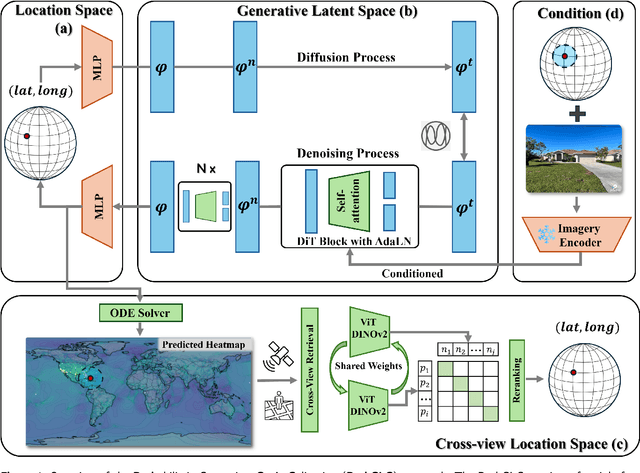
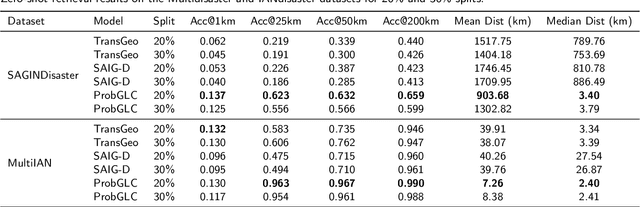
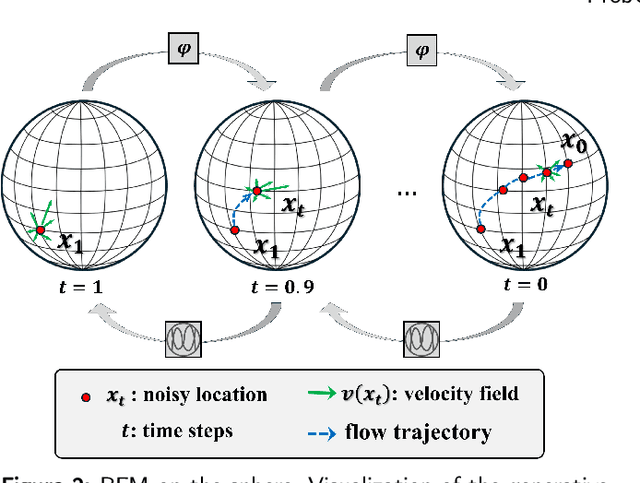
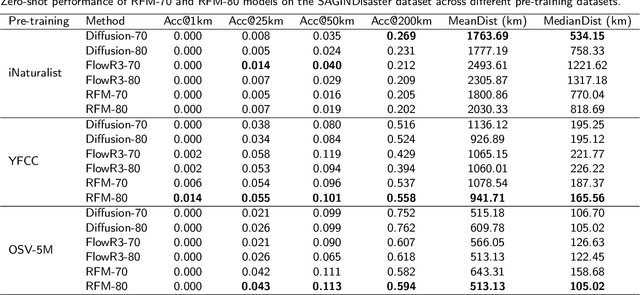
As Earth's climate changes, it is impacting disasters and extreme weather events across the planet. Record-breaking heat waves, drenching rainfalls, extreme wildfires, and widespread flooding during hurricanes are all becoming more frequent and more intense. Rapid and efficient response to disaster events is essential for climate resilience and sustainability. A key challenge in disaster response is to accurately and quickly identify disaster locations to support decision-making and resources allocation. In this paper, we propose a Probabilistic Cross-view Geolocalization approach, called ProbGLC, exploring new pathways towards generative location awareness for rapid disaster response. Herein, we combine probabilistic and deterministic geolocalization models into a unified framework to simultaneously enhance model explainability (via uncertainty quantification) and achieve state-of-the-art geolocalization performance. Designed for rapid diaster response, the ProbGLC is able to address cross-view geolocalization across multiple disaster events as well as to offer unique features of probabilistic distribution and localizability score. To evaluate the ProbGLC, we conduct extensive experiments on two cross-view disaster datasets (i.e., MultiIAN and SAGAINDisaster), consisting diverse cross-view imagery pairs of multiple disaster types (e.g., hurricanes, wildfires, floods, to tornadoes). Preliminary results confirms the superior geolocalization accuracy (i.e., 0.86 in Acc@1km and 0.97 in Acc@25km) and model explainability (i.e., via probabilistic distributions and localizability scores) of the proposed ProbGLC approach, highlighting the great potential of leveraging generative cross-view approach to facilitate location awareness for better and faster disaster response. The data and code is publicly available at https://github.com/bobleegogogo/ProbGLC
SHRUG-FM: Reliability-Aware Foundation Models for Earth Observation
Nov 13, 2025Geospatial foundation models for Earth observation often fail to perform reliably in environments underrepresented during pretraining. We introduce SHRUG-FM, a framework for reliability-aware prediction that integrates three complementary signals: out-of-distribution (OOD) detection in the input space, OOD detection in the embedding space and task-specific predictive uncertainty. Applied to burn scar segmentation, SHRUG-FM shows that OOD scores correlate with lower performance in specific environmental conditions, while uncertainty-based flags help discard many poorly performing predictions. Linking these flags to land cover attributes from HydroATLAS shows that failures are not random but concentrated in certain geographies, such as low-elevation zones and large river areas, likely due to underrepresentation in pretraining data. SHRUG-FM provides a pathway toward safer and more interpretable deployment of GFMs in climate-sensitive applications, helping bridge the gap between benchmark performance and real-world reliability.