 Add to Chrome
 Add to Firefox
 Add to Edge
DisasterTD: Disaster Toponym Disambiguation Using Multimodal LLMs and Cross-View Geolocalization
Jul 26, 2026
Social media imagery (SMI) provides timely and fine-grained ground perspectives that are valuable for situational awareness and emergency response. Unlike satellite or aerial imagery, SMI can capture disaster impacts and ground-level conditions in a timely manner. However, geographic references in SMI are often vague or ambiguous, making accurate geolocalization challenging. To address this issue, we propose DisasterTD, a disaster toponym disambiguation framework that integrates multimodal large language model (MLLMs)-based semantic reasoning with cross-view geolocalization. First, MLLMs extract toponyms and generate candidate geolocations from noisy textual inputs. Then, cross-view matching between SMI, remote sensing imagery (RSI), and optionally street-view imagery (SVI) is used to verify and refine these candidate results. We evaluate DisasterTD on the Hurricane Harvey dataset, where SMI is augmented with collected RSI and SVI to construct a cross-view benchmark for disaster geolocalization. The dataset is divided into four categories based on toponym clarity and ambiguity, allowing a fine-grained performance analysis across scenarios. Results show that DisasterTD consistently outperforms MLLM-only and cross-view-only baselines without disambiguation, achieving geolocalization accuracies of 71.62% within 1000 m, 62.36% within 500 m, 57.99% within 250 m, 52.09% within 100 m, and 47.01% within 50 m, while reducing the mean and median errors to 11.33 km and 0.68 km, respectively. The largest improvements appear in ambiguous toponyms, where semantic reasoning with cross-view evidence reduces candidate dispersion and errors. These findings demonstrate the effectiveness of integrating MLLM-based candidate generation with cross-view verification for fine-grained disaster geolocalization.

Smart Transfer: Leveraging Vision Foundation Model for Rapid Building Damage Mapping with Post-Earthquake VHR Imagery
Apr 03, 2026Living in a changing climate, human society now faces more frequent and severe natural disasters than ever before. As a consequence, rapid disaster response during the "Golden 72 Hours" of search and rescue becomes a vital humanitarian necessity and community concern. However, traditional disaster damage surveys routinely fail to generalize across distinct urban morphologies and new disaster events. Effective damage mapping typically requires exhaustive and time-consuming manual data annotation. To address this issue, we introduce Smart Transfer, a novel Geospatial Artificial Intelligence (GeoAI) framework, leveraging state-of-the-art vision Foundation Models (FMs) for rapid building damage mapping with post-earthquake Very High Resolution (VHR) imagery. Specifically, we design two novel model transfer strategies: first, Pixel-wise Clustering (PC), ensuring robust prototype-level global feature alignment; second, a Distance-Penalized Triplet (DPT), integrating patch-level spatial autocorrelation patterns by assigning stronger penalties to semantically inconsistent yet spatially adjacent patches. Extensive experiments and ablations from the recent 2023 Turkiye-Syria earthquake show promising performance in multiple cross-region transfer settings, namely Leave One Domain Out (LODO) and Specific Source Domain Combination (SSDC). Moreover, Smart Transfer provides a scalable, automated GeoAI solution to accelerate building damage mapping and support rapid disaster response, offering new opportunities to enhance disaster resilience in climate-vulnerable regions and communities. The data and code are publicly available at https://github.com/ai4city-hkust/SmartTransfer.
Towards Generative Location Awareness for Disaster Response: A Probabilistic Cross-view Geolocalization Approach
Dec 23, 2025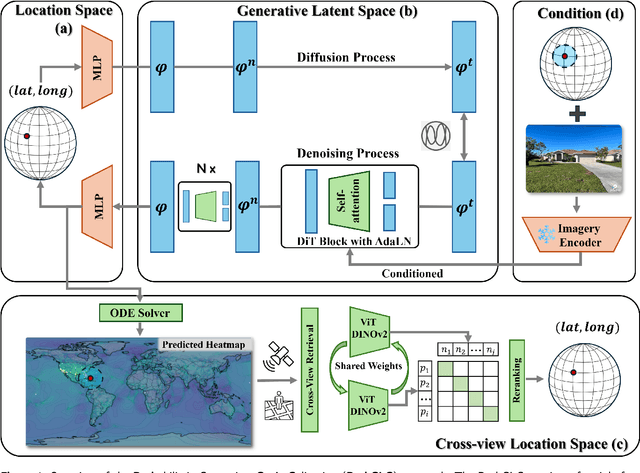
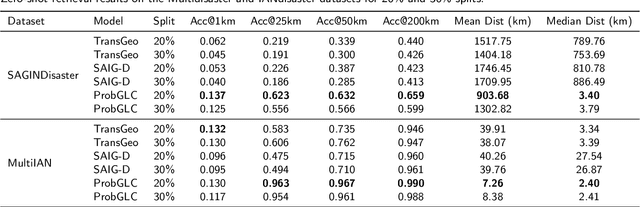
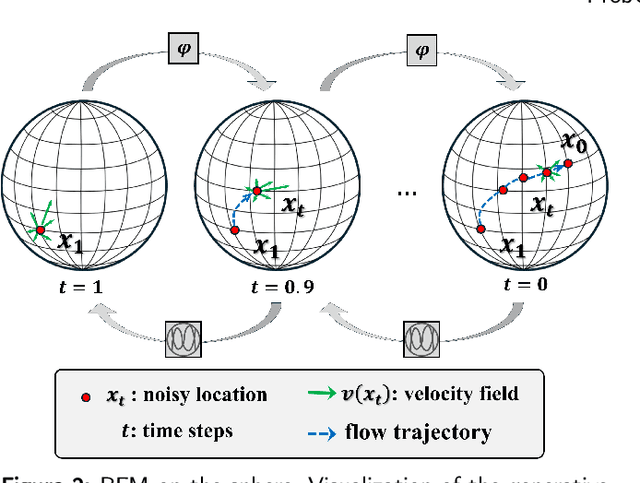
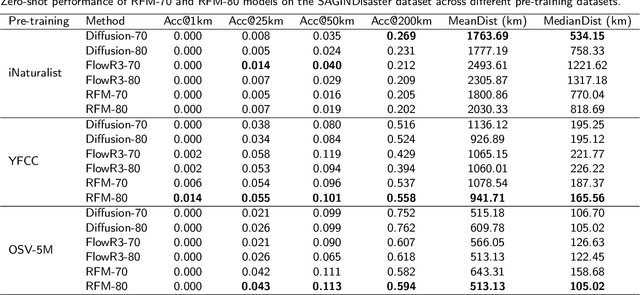
As Earth's climate changes, it is impacting disasters and extreme weather events across the planet. Record-breaking heat waves, drenching rainfalls, extreme wildfires, and widespread flooding during hurricanes are all becoming more frequent and more intense. Rapid and efficient response to disaster events is essential for climate resilience and sustainability. A key challenge in disaster response is to accurately and quickly identify disaster locations to support decision-making and resources allocation. In this paper, we propose a Probabilistic Cross-view Geolocalization approach, called ProbGLC, exploring new pathways towards generative location awareness for rapid disaster response. Herein, we combine probabilistic and deterministic geolocalization models into a unified framework to simultaneously enhance model explainability (via uncertainty quantification) and achieve state-of-the-art geolocalization performance. Designed for rapid diaster response, the ProbGLC is able to address cross-view geolocalization across multiple disaster events as well as to offer unique features of probabilistic distribution and localizability score. To evaluate the ProbGLC, we conduct extensive experiments on two cross-view disaster datasets (i.e., MultiIAN and SAGAINDisaster), consisting diverse cross-view imagery pairs of multiple disaster types (e.g., hurricanes, wildfires, floods, to tornadoes). Preliminary results confirms the superior geolocalization accuracy (i.e., 0.86 in Acc@1km and 0.97 in Acc@25km) and model explainability (i.e., via probabilistic distributions and localizability scores) of the proposed ProbGLC approach, highlighting the great potential of leveraging generative cross-view approach to facilitate location awareness for better and faster disaster response. The data and code is publicly available at https://github.com/bobleegogogo/ProbGLC