 Add to Chrome
 Add to Firefox
 Add to Edge
Music-to-Dance Generation via Atomic Movements
Jul 15, 2026
Music-driven dance generation aims to produce human motion that is both rhythmically synchronized and semantically consistent with music. While recent neural approaches have achieved impressive visual realism, they typically model motion as a continuous signal and neglect its compositional nature, making generated dances structurally incoherent and difficult to control. In this work, we introduce a structure-aware framework that models choreography as a sequence of atomic movements-semantically interpretable motion events that serve as the building blocks of dance. To construct this atomic movement vocabulary, we first segment large-scale dance data and cluster them into atomic movement groups. We then employ a large language model to semantically relabel and refine the clusters, yielding a set of interpretable and reusable atomic movements. Based on these atomic movement annotations, we design a two-stage generation framework that mirrors the human choreography process. In the atomic movement planning stage, the model predicts the type, duration, and timing of atomic movements conditioned on the input music, forming a symbolic dance allocation. In the completion stage, a transition-aware generator synthesizes smooth and stylistically coherent motion conditioned on the planned structure. Extensive experiments demonstrate that our method produces dances with significantly improved structural coherence, rhythmic alignment, and perceptual naturalness compared to existing baselines, while providing enhanced interpretability and controllable editing through explicit structural representation.

Towards Human-level Dexterous Teleoperation
Jul 13, 2026Humans routinely wield tools, swap grasps, and reposition objects within a single hand, seamlessly orchestrating contact transitions that span translation, reorientation, and finger gaiting. Endowing robot dexterous hands with this level of in-hand dexterity through teleoperation requires precise control of object motion via dynamic hand-object contact, yet current teleoperation systems remain far from this capability. To bridge this gap, we take a major step towards human-level dexterous teleoperation by introducing TeleDexter, a hand-object co-tracking controller that maps operator intent into learned, low-level contact execution. The controller is trained on consecutive co-tracking subgoals derived from human reference motions, utilizing a hybrid reward that couples sparse subgoal objectives with dense tracking rewards to enable learning across diverse interaction modalities rather than frame-wise trajectory imitation. The entire pipeline requires only single-stage RL and, with random action masking and domain randomization, transfers zero-shot to the real robot. We evaluate TeleDexter on seven challenging dexterous teleoperation tasks spanning object reorientation and long-horizon tool use across two dexterous hands, achieving a 75% average success rate where all baselines consistently fail. Furthermore, the collected demonstrations successfully train autonomous policies via behavioral cloning, marking a concrete step towards human-level dexterous teleoperation.
Mars: Situated Inductive Reasoning in an Open-World Environment
Oct 10, 2024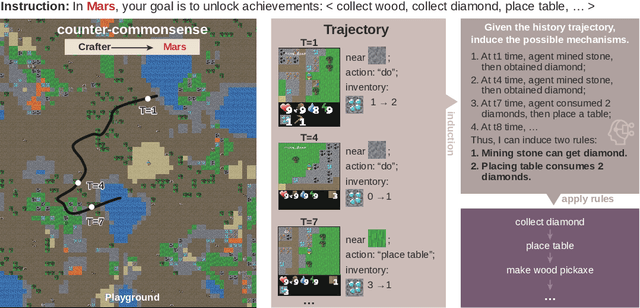
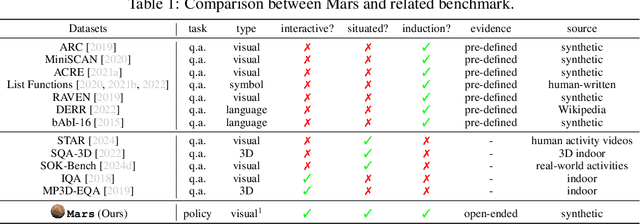
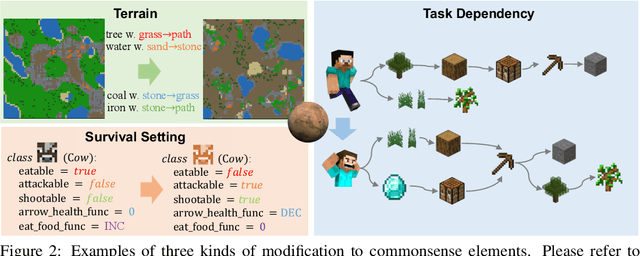
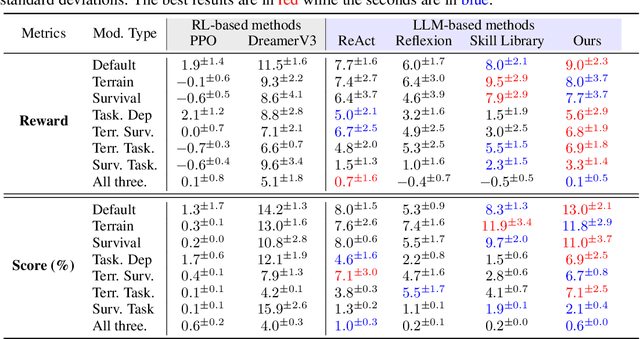
Large Language Models (LLMs) trained on massive corpora have shown remarkable success in knowledge-intensive tasks. Yet, most of them rely on pre-stored knowledge. Inducing new general knowledge from a specific environment and performing reasoning with the acquired knowledge -- \textit{situated inductive reasoning}, is crucial and challenging for machine intelligence. In this paper, we design Mars, an interactive environment devised for situated inductive reasoning. It introduces counter-commonsense game mechanisms by modifying terrain, survival setting and task dependency while adhering to certain principles. In Mars, agents need to actively interact with their surroundings, derive useful rules and perform decision-making tasks in specific contexts. We conduct experiments on various RL-based and LLM-based methods, finding that they all struggle on this challenging situated inductive reasoning benchmark. Furthermore, we explore \textit{Induction from Reflection}, where we instruct agents to perform inductive reasoning from history trajectory. The superior performance underscores the importance of inductive reasoning in Mars. Through Mars, we aim to galvanize advancements in situated inductive reasoning and set the stage for developing the next generation of AI systems that can reason in an adaptive and context-sensitive way.
CORE: Common Random Reconstruction for Distributed Optimization with Provable Low Communication Complexity
Sep 23, 2023With distributed machine learning being a prominent technique for large-scale machine learning tasks, communication complexity has become a major bottleneck for speeding up training and scaling up machine numbers. In this paper, we propose a new technique named Common randOm REconstruction(CORE), which can be used to compress the information transmitted between machines in order to reduce communication complexity without other strict conditions. Especially, our technique CORE projects the vector-valued information to a low-dimensional one through common random vectors and reconstructs the information with the same random noises after communication. We apply CORE to two distributed tasks, respectively convex optimization on linear models and generic non-convex optimization, and design new distributed algorithms, which achieve provably lower communication complexities. For example, we show for linear models CORE-based algorithm can encode the gradient vector to $\mathcal{O}(1)$-bits (against $\mathcal{O}(d)$), with the convergence rate not worse, preceding the existing results.
LEMMA: A Multi-view Dataset for Learning Multi-agent Multi-task Activities
Jul 31, 2020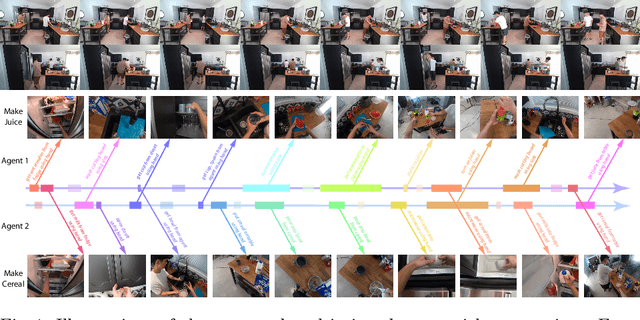
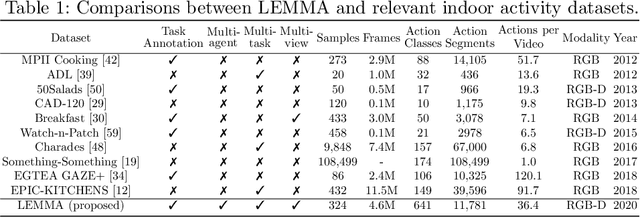
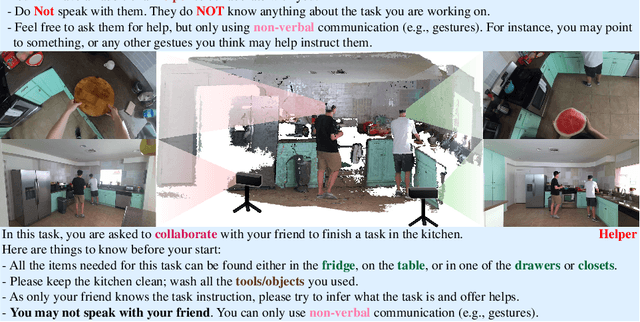
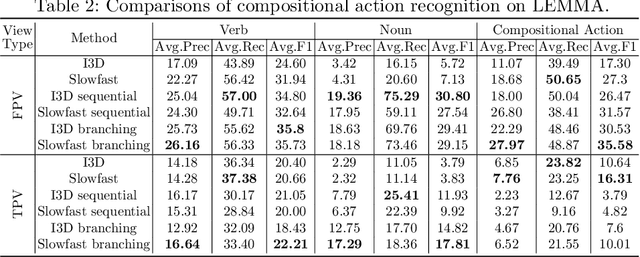
Understanding and interpreting human actions is a long-standing challenge and a critical indicator of perception in artificial intelligence. However, a few imperative components of daily human activities are largely missed in prior literature, including the goal-directed actions, concurrent multi-tasks, and collaborations among multi-agents. We introduce the LEMMA dataset to provide a single home to address these missing dimensions with meticulously designed settings, wherein the number of tasks and agents varies to highlight different learning objectives. We densely annotate the atomic-actions with human-object interactions to provide ground-truths of the compositionality, scheduling, and assignment of daily activities. We further devise challenging compositional action recognition and action/task anticipation benchmarks with baseline models to measure the capability of compositional action understanding and temporal reasoning. We hope this effort would drive the machine vision community to examine goal-directed human activities and further study the task scheduling and assignment in the real world.