 Add to Chrome
 Add to Firefox
 Add to Edge
MotionVLA: Vision-Language-Action Model for Humanoid Motion
Jun 13, 2026
Generating realistic humanoid motion from scene images and text involves both low-frequency pose semantics and high-frequency physical dynamics. However, many existing methods tokenize motion with a single shared codebook, forcing heterogeneous motion signals into the same quantization space. Our frequency-domain analysis of human motion data reveals a clear mismatch between single-codebook quantization and motion statistics: five DCT coefficients capture 93% of joint-position energy but only 37% of joint-velocity energy, which can bias quantization toward pose statistics and under-represent high-frequency velocity components. A second challenge lies in adapting a standard autoregressive model to effectively model high-frequency physical signals in motion sequences. Therefore, we propose DSFT, a dual-stream frequency tokenizer that separates motion into Base and physical streams and compresses them independently with DCT truncation and BPE. Furthermore, we present MotionVLA, a Qwen3.5-based model that arranges Base and physical tokens in a unified sequence, where Phys tokens are predicted after Base tokens. Experiments on HumanML3D and MBench show that, despite using a lightweight 2B backbone, MotionVLA reduces the Diversity gap to real data by over 50% on HumanML3D and improves Motion-Condition Consistency by 3.8% on MBench, supporting frequency-aware dual-stream decoupling as an effective formulation for autoregressive motion generation. Code: https://github.com/AIGeeksGroup/MotionVLA. Website: https://aigeeksgroup.github.io/MotionVLA.

Seedance 2.0: Advancing Video Generation for World Complexity
Apr 15, 2026Seedance 2.0 is a new native multi-modal audio-video generation model, officially released in China in early February 2026. Compared with its predecessors, Seedance 1.0 and 1.5 Pro, Seedance 2.0 adopts a unified, highly efficient, and large-scale architecture for multi-modal audio-video joint generation. This allows it to support four input modalities: text, image, audio, and video, by integrating one of the most comprehensive suites of multi-modal content reference and editing capabilities available in the industry to date. It delivers substantial, well-rounded improvements across all key sub-dimensions of video and audio generation. In both expert evaluations and public user tests, the model has demonstrated performance on par with the leading levels in the field. Seedance 2.0 supports direct generation of audio-video content with durations ranging from 4 to 15 seconds, with native output resolutions of 480p and 720p. For multi-modal inputs as reference, its current open platform supports up to 3 video clips, 9 images, and 3 audio clips. In addition, we provide Seedance 2.0 Fast version, an accelerated variant of Seedance 2.0 designed to boost generation speed for low-latency scenarios. Seedance 2.0 has delivered significant improvements to its foundational generation capabilities and multi-modal generation performance, bringing an enhanced creative experience for end users.
Unrevealed Threats: A Comprehensive Study of the Adversarial Robustness of Underwater Image Enhancement Models
Sep 10, 2024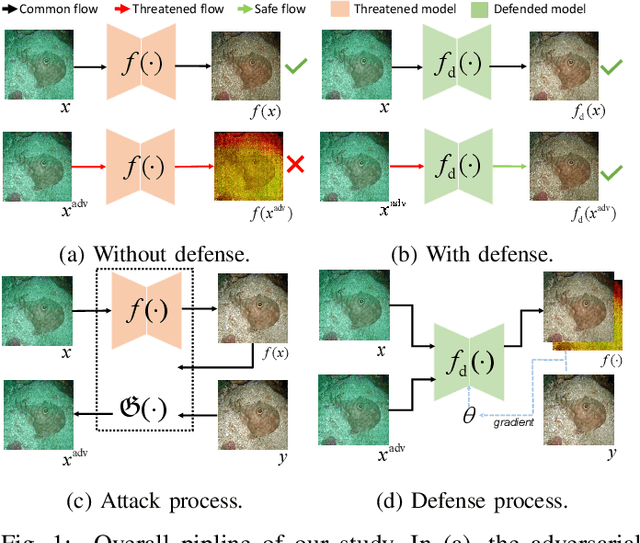
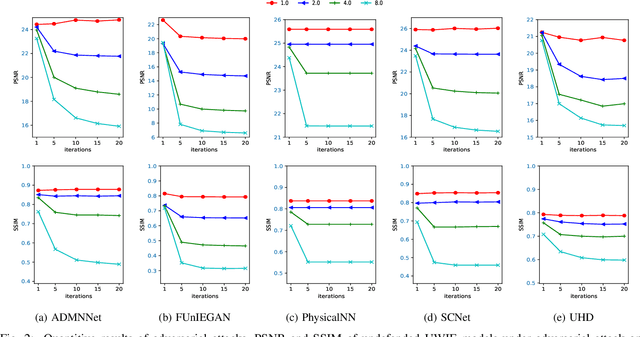
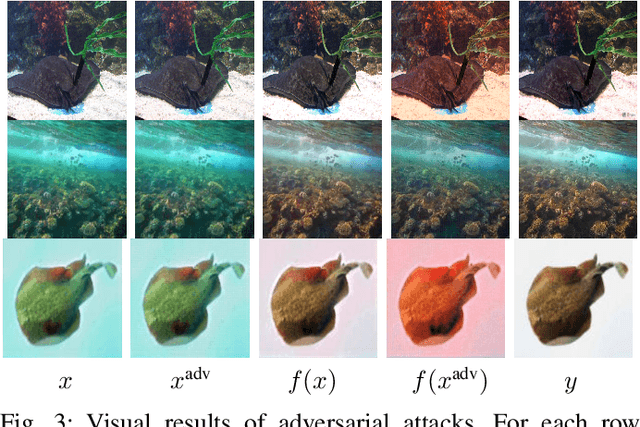
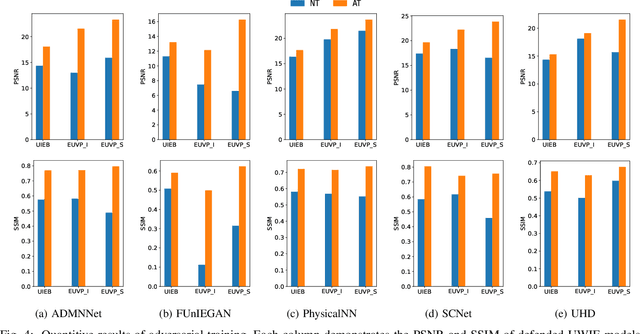
Learning-based methods for underwater image enhancement (UWIE) have undergone extensive exploration. However, learning-based models are usually vulnerable to adversarial examples so as the UWIE models. To the best of our knowledge, there is no comprehensive study on the adversarial robustness of UWIE models, which indicates that UWIE models are potentially under the threat of adversarial attacks. In this paper, we propose a general adversarial attack protocol. We make a first attempt to conduct adversarial attacks on five well-designed UWIE models on three common underwater image benchmark datasets. Considering the scattering and absorption of light in the underwater environment, there exists a strong correlation between color correction and underwater image enhancement. On the basis of that, we also design two effective UWIE-oriented adversarial attack methods Pixel Attack and Color Shift Attack targeting different color spaces. The results show that five models exhibit varying degrees of vulnerability to adversarial attacks and well-designed small perturbations on degraded images are capable of preventing UWIE models from generating enhanced results. Further, we conduct adversarial training on these models and successfully mitigated the effectiveness of adversarial attacks. In summary, we reveal the adversarial vulnerability of UWIE models and propose a new evaluation dimension of UWIE models.