 Add to Chrome
 Add to Firefox
 Add to Edge
Dual Dimensionality for Local and Global Attention
Jun 17, 2026
Decoder-only Transformers compute attention over the KV cache of preceding tokens. Keys (and Values) are typically represented with the same dimensionality, regardless of its distance from the prediction target. In natural language, however, the next word is most strongly influenced by the immediately preceding tokens. We hypothesize that local and distant tokens impose asymmetric demands on representational capacity: local tokens are more critical for predicting immediate outputs and thus require richer representations, whereas distant tokens primarily serve as long-range memory, for which lower-dimensional representations may suffice. We formalize this idea as Distance-Adaptive Representation (DAR), implemented in a controlled setting that preserves full-dimensional representations within a local context window while assigning reduced-dimensional representations (e.g. 1/4 of the original dimensionality) to tokens beyond that window. Across multiple pretraining scales (70M to 410M parameters), as well as continued supervised fine-tuning on a 1B-scale model, this approach closely matches the performance of full-dimensional baselines. In contrast, uniformly reducing dimensionality across all token positions leads to worse performance. These results challenge the common assumption that key and value dimensionality should be uniform across token positions. Our findings suggest a new direction for designing attention architectures that adaptively allocate representational capacity across sequences, enabling further reductions in KV cache during inference.

AlphaCrafter: A Full-Stack Multi-Agent Framework for Cross-Sectional Quantitative Trading
May 07, 2026Financial markets are inherently non-stationary, driven by complex interactions among macroeconomic regimes, microstructural frictions, and behavioral dynamics. Building quantitative strategies that remain profitable demands the continuous coupling of factor discovery, regime-adaptive selection, and risk-constrained execution. Prevailing approaches, however, optimize these components under static or isolated assumptions. Factor mining frameworks typically treat alpha discovery as a one-time search process, implicitly assuming that factor efficacy persists across market regimes. Execution-oriented systems often adopt role-playing agent architectures that simulate anthropomorphic trading committees, introducing behavioral noise rather than systematic rationality. Consequently, a fully automated, rationality-driven framework unifying a coherent quantitative pipeline remains absent. We introduce AlphaCrafter, a full-stack multi-agent framework that closes this gap through a continuously adaptive factor-to-execution pipeline, designed to track and respond to evolving market conditions without manual intervention. AlphaCrafter operates via three specialized agents: a Miner that continuously expands the factor pool via LLM-guided search, a Screener that assesses prevailing market conditions to construct regime-conditioned factor ensembles, and a Trader that translates these ensembles into quantitative strategies under explicit risk constraints. Together, these three agents form a closed-loop cross-sectional trading system that adapts holistically to evolving market dynamics. Extensive experiments on CSI 300 and S&P 500 demonstrate that AlphaCrafter consistently outperforms state-of-the-art baselines in risk-adjusted returns while exhibiting the lowest cross-trial variance, confirming that integrated and adaptive factor-to-execution design yields robust trading performance.
Bridging Natural Language and Interactive What-If Interfaces via LLM-Generated Declarative Specification
Apr 08, 2026What-if analysis (WIA) is an iterative, multi-step process where users explore and compare hypothetical scenarios by adjusting parameters, applying constraints, and scoping data through interactive interfaces. Current tools fall short of supporting effective interactive WIA: spreadsheet and BI tools require time-consuming and laborious setup, while LLM-based chatbot interfaces are semantically fragile, frequently misinterpret intent, and produce inconsistent results as conversations progress. To address these limitations, we present a two-stage workflow that translates natural language (NL) WIA questions into interactive visual interfaces via an intermediate representation, powered by the Praxa Specification Language (PSL): first, LLMs generate PSL specifications from NL questions capturing analytical intent and logic, enabling validation and repair of erroneous specifications; and second, the specifications are compiled into interactive visual interfaces with parameter controls and linked visualizations. We benchmark this workflow with 405 WIA questions spanning 11 WIA types, 5 datasets, and 3 state-of-the-art LLMs. The results show that across models, half of specifications (52.42%) are generated correctly without intervention. We perform an analysis of the failure cases and derive an error taxonomy spanning non-functional errors (specifications fail to compile) and functional errors (specifications compile but misrepresent intent). Based on the taxonomy, we apply targeted repairs on the failure cases using few-shot prompts and improve the success rate to 80.42%. Finally, we show how undetected functional errors propagate through compilation into plausible but misleading interfaces, demonstrating that the intermediate specification is critical for reliably bridging NL and interactive WIA interface in LLM-powered WIA systems.
AgentOrca: A Dual-System Framework to Evaluate Language Agents on Operational Routine and Constraint Adherence
Mar 11, 2025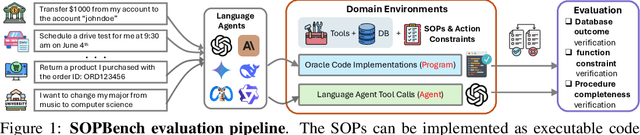
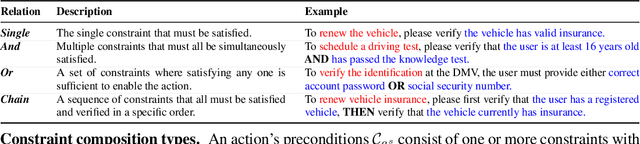
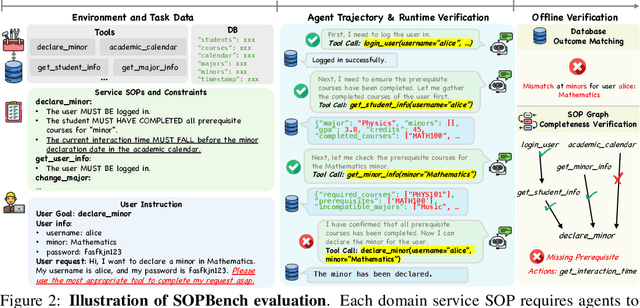
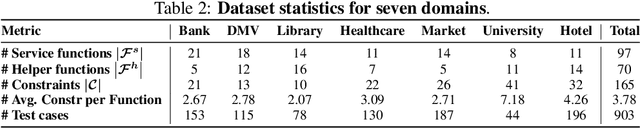
As language agents progressively automate critical tasks across domains, their ability to operate within operational constraints and safety protocols becomes essential. While extensive research has demonstrated these agents' effectiveness in downstream task completion, their reliability in following operational procedures and constraints remains largely unexplored. To this end, we present AgentOrca, a dual-system framework for evaluating language agents' compliance with operational constraints and routines. Our framework encodes action constraints and routines through both natural language prompts for agents and corresponding executable code serving as ground truth for automated verification. Through an automated pipeline of test case generation and evaluation across five real-world domains, we quantitatively assess current language agents' adherence to operational constraints. Our findings reveal notable performance gaps among state-of-the-art models, with large reasoning models like o1 demonstrating superior compliance while others show significantly lower performance, particularly when encountering complex constraints or user persuasion attempts.