 Add to Chrome
 Add to Firefox
 Add to Edge
Foresight-England: Development of a National-Scale Generative AI Model of Electronic Health Records for Medical Event Prediction across the COVID-19 Pandemic
Aug 17, 2026
Foresight-England (Foresight-E) is the first national-scale generative foundation model of electronic health records (EHRs), developed as a research pilot strictly for COVID-19 research. We evaluated its ability to model the direct and indirect effects of the pandemic. Trained from scratch entirely within the NHS England Secure Data Environment, Foresight-E is a 243-million-parameter transformer decoder. It was trained and evaluated on de-identified, longitudinal EHRs of approximately 61 million individuals, integrating primary/secondary care, death registrations, and COVID-19 data. Training and validation used a 90% subset (54.9 million) spanning November 2018 to December 2022; the remaining 10% (6.1 million) was held out for evaluation. Foresight-E models patient timelines autoregressively, predicting the next medical event given their prior history. At inference, it operates zero-shot, predicting any concept in its ~40,000-code vocabulary without task-specific training. Our tokenisation scheme retains the clinical granularity of ICD-10, OPCS-4, and SNOMED CT codes, jointly representing absolute and relative timing. We designed an evaluation framework for 30-day COVID-19 hospitalisation and mortality, including subgroup analyses by demographic factors and vaccination status. To assess generalisation to unseen future data and the pandemic's indirect effects, we tested the model on medical events from 2023 (beyond its training period), benchmarking against logistic regression and XGBoost. As detailed in the Project Status section, NHS England has paused access to data for the Foresight-E project, meaning quantitative results are currently unavailable. Instead, we share our strategy for tokenisation, architecture, training, inference, and evaluation as a methodological template and case study in the challenges of building population-scale EHR foundation models.

BioDEX: Large-Scale Biomedical Adverse Drug Event Extraction for Real-World Pharmacovigilance
May 22, 2023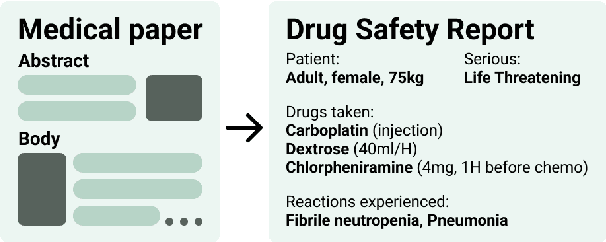


Timely and accurate extraction of Adverse Drug Events (ADE) from biomedical literature is paramount for public safety, but involves slow and costly manual labor. We set out to improve drug safety monitoring (pharmacovigilance, PV) through the use of Natural Language Processing (NLP). We introduce BioDEX, a large-scale resource for Biomedical adverse Drug Event Extraction, rooted in the historical output of drug safety reporting in the U.S. BioDEX consists of 65k abstracts and 19k full-text biomedical papers with 256k associated document-level safety reports created by medical experts. The core features of these reports include the reported weight, age, and biological sex of a patient, a set of drugs taken by the patient, the drug dosages, the reactions experienced, and whether the reaction was life threatening. In this work, we consider the task of predicting the core information of the report given its originating paper. We estimate human performance to be 72.0% F1, whereas our best model achieves 62.3% F1, indicating significant headroom on this task. We also begin to explore ways in which these models could help professional PV reviewers. Our code and data are available: https://github.com/KarelDO/BioDEX.
Unsupervised Human Pose Estimation through Transforming Shape Templates
May 10, 2021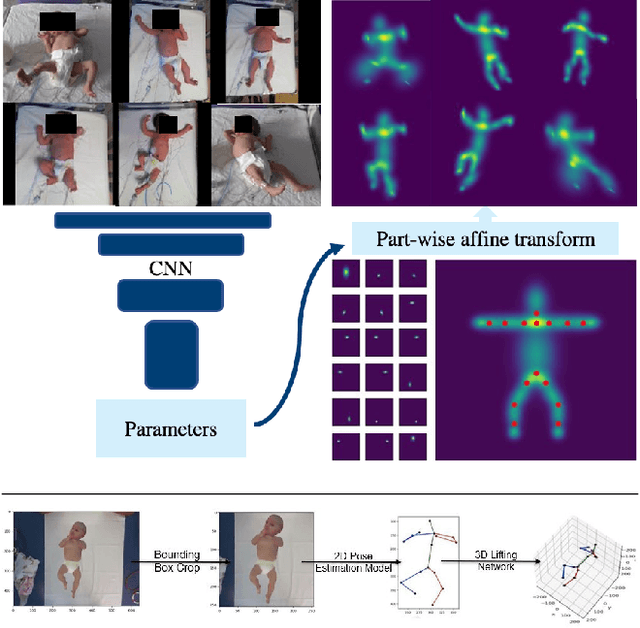
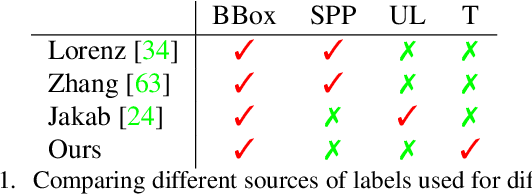
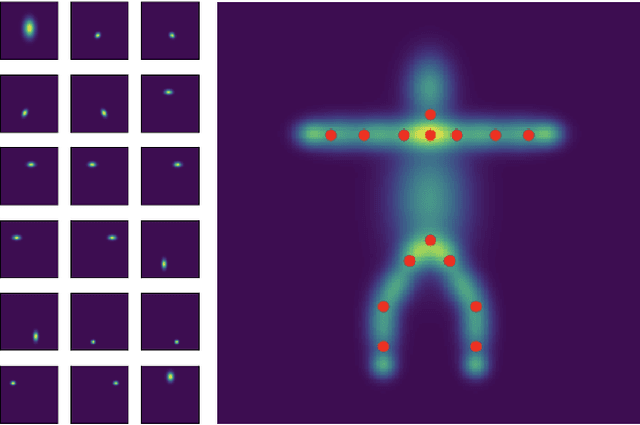
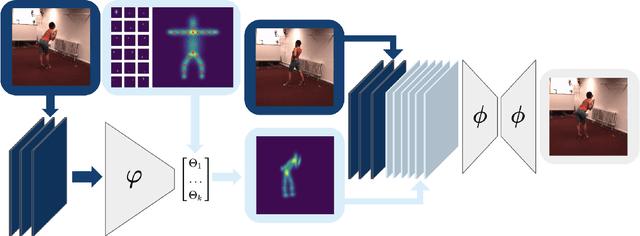
Human pose estimation is a major computer vision problem with applications ranging from augmented reality and video capture to surveillance and movement tracking. In the medical context, the latter may be an important biomarker for neurological impairments in infants. Whilst many methods exist, their application has been limited by the need for well annotated large datasets and the inability to generalize to humans of different shapes and body compositions, e.g. children and infants. In this paper we present a novel method for learning pose estimators for human adults and infants in an unsupervised fashion. We approach this as a learnable template matching problem facilitated by deep feature extractors. Human-interpretable landmarks are estimated by transforming a template consisting of predefined body parts that are characterized by 2D Gaussian distributions. Enforcing a connectivity prior guides our model to meaningful human shape representations. We demonstrate the effectiveness of our approach on two different datasets including adults and infants.