 Add to Chrome
 Add to Firefox
 Add to Edge
Retrieval or Representation? Reassessing Benchmark Gaps in Multilingual and Visually Rich RAG
Mar 04, 2026
Retrieval-augmented generation (RAG) is a common way to ground language models in external documents and up-to-date information. Classical retrieval systems relied on lexical methods such as BM25, which rank documents by term overlap with corpus-level weighting. End-to-end multimodal retrievers trained on large query-document datasets claim substantial improvements over these approaches, especially for multilingual documents with complex visual layouts. We demonstrate that better document representation is the primary driver of benchmark improvements. By systematically varying transcription and preprocessing methods while holding the retrieval mechanism fixed, we demonstrate that BM25 can recover large gaps on multilingual and visual benchmarks. Our findings call for decomposed evaluation benchmarks that separately measure transcription and retrieval capabilities, enabling the field to correctly attribute progress and focus effort where it matters.

BioDEX: Large-Scale Biomedical Adverse Drug Event Extraction for Real-World Pharmacovigilance
May 22, 2023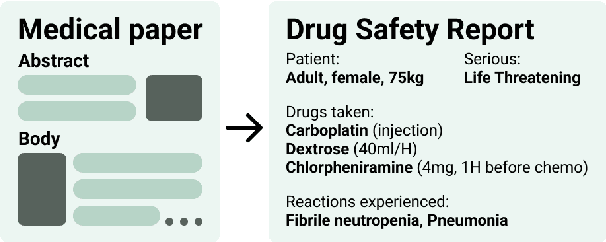


Timely and accurate extraction of Adverse Drug Events (ADE) from biomedical literature is paramount for public safety, but involves slow and costly manual labor. We set out to improve drug safety monitoring (pharmacovigilance, PV) through the use of Natural Language Processing (NLP). We introduce BioDEX, a large-scale resource for Biomedical adverse Drug Event Extraction, rooted in the historical output of drug safety reporting in the U.S. BioDEX consists of 65k abstracts and 19k full-text biomedical papers with 256k associated document-level safety reports created by medical experts. The core features of these reports include the reported weight, age, and biological sex of a patient, a set of drugs taken by the patient, the drug dosages, the reactions experienced, and whether the reaction was life threatening. In this work, we consider the task of predicting the core information of the report given its originating paper. We estimate human performance to be 72.0% F1, whereas our best model achieves 62.3% F1, indicating significant headroom on this task. We also begin to explore ways in which these models could help professional PV reviewers. Our code and data are available: https://github.com/KarelDO/BioDEX.