 Add to Chrome
 Add to Firefox
 Add to Edge
Control-Oriented Scenario Tree Construction through Reinforcement Learning
Aug 10, 2026
Multistage stochastic model predictive control (MPC) handles uncertainty by optimizing over a scenario tree, a finite branching approximation of future outcomes constructed from sampled forecasts. To build such a tree, conventional methods focus on matching the underlying probability distribution---e.g., via Wasserstein-based scenario reduction---but improved distributional accuracy does not necessarily yield better control performance. We propose a control-oriented approach that learns scenario tree construction directly from its impact on downstream decisions. Fixing the tree topology, we formulate tree construction as a sequential assignment of sampled scenarios to leaves. This assignment is parameterized by an attention-based policy over the scenario set and trained using reinforcement learning, with closed-loop control profit as the objective. Training is stabilized by an asymmetric critic that leverages realized future trajectories. We evaluate the method on a risk-averse battery arbitrage problem. Across a range of forecast set sizes, the learned construction consistently achieves the highest profit, outperforming classical forward and backward reduction methods and certainty-equivalent (single-trajectory forecast) control. The learned policy also exhibits greater robustness on challenging instances, consistently demonstrating better tail-risk characteristics. Analysis of the resulting trees indicates that our method constructs compact, selectively branching structures that capture high-impact events while keeping most trajectories nearly deterministic. These findings highlight that the value of a scenario tree depends critically on the decisions it supports, and provide an effective framework to train scenario tree constructors merely based on the closed-loop control optimization signal.

Assessing the Generalization of Graph Neural Networks for Fault Location Across Increasing Distributed Energy Resource Penetration Levels
Jul 31, 2026Accurate fault location is critical for distribution network reliability. However, increasing distributed energy resource (DER) penetration complicates fault location due to intermittent generation and bidirectional power flows that reshape fault signatures. Spatio-Temporal Graph Neural Networks (STGNNs) have shown promise by jointly modeling spatial and temporal dependencies, but their behavior under increasing DER penetration has not been studied rigorously. In this paper, we (i) systematically benchmark spatio-temporal graph attention network (STGATv2) against purely temporal (gated recurrent unit, GRU), purely spatial (GATv2) and traditional machine learning baselines, and (ii) evaluate how well models generalize across increasing DER penetration levels (10%, 25%, 50%) on a reconfigured IEEE 123-bus feeder with multiple DER injection points and moderate-to-high impedance faults. Results show that STGATv2 consistently outperforms neural baselines, achieving 92-94% macro F1 in-distribution. Notably, generalization across penetration levels is asymmetric: training at 50% penetration retains near in-distribution F1 score at lower levels, whereas training at 10% degrades considerably at 50% - with STGATv2 retaining 81-84% F1 under these drastic shifts, substantially higher than GATv2 and GRU which drop to 69-74% F1 and 73-75% F1 respectively. Under realistic measurement noise, STGATv2 maintains > 85% F1, while GRU drops as low as 33.5% F1, highlighting the critical role of topological awareness for robust fault location in active distribution networks.
Forecasting what Matters: Decision-Focused RL for Controlled EV Charging with Unknown Departure Times
Jun 17, 2026The recent growth of EV adoption poses challenges for power systems, including increased peak demand and potential grid instability. Smart control of EV charging -- e.g., based on reinforcement learning (RL) -- can alleviate these issues by learning temporal and contextual patterns from historical data. Yet, in real-world scenarios, key features, such as departure time, often are unavailable. This, in turn, makes it harder for an RL agent to learn and execute an effective charging policy. To mitigate this uncertainty, a trained forecaster can approximate the unknown features from available data. However, since these forecasting models are typically trained for accuracy (rather than their impact on a downstream agent's decision quality), their errors may propagate and hinder the overall performance of a controller that is using the forecasts. To avoid this, we propose a decision-focused RL (DF-RL) framework in which the forecaster is trained end-to-end, i.e., with feedback from the charging policy actions taken by the RL agent. Such joint training of both the forecaster and controller ultimately results in higher-quality actions: our proposed DF-RL method yields superior charging decisions compared to other baselines, achieving up to a 14% improvement in total reward and a 55% reduction of unsupplied energy (i.e., charging that failed to happen because the EV already left), relative to the RL method without departure time forecasting.
S3TS: Stochastic Scenario-Structured Tree Search for Advanced Planning Under Uncertainty
Jun 01, 2026Effective scheduling in the energy sector is essential to ensure the reliable operation of electrical grids and their connected assets by, for instance, optimizing the dispatch of generation units and storage systems. An effective planning strategy must (a) accommodate advanced and potentially non-linear system models -- exploiting the increasing data availability of modern grids, and (b) explicitly handle uncertainties arising, for instance, from the integration of renewable energy sources. While existing approaches can address either non-linearity (e.g., Monte Carlo Tree Search) or uncertainty (e.g., stochastic mathematical optimization), there is a lack of planning techniques capable of addressing both challenges simultaneously. To bridge this gap, we propose a Stochastic Scenario-Structured Tree Search (S3TS) algorithm that explicitly represents uncertainty through scenario trees while enabling the integration of advanced non-linear models. We evaluate S3TS on a simulated demand response signal publication problem, largely mimicking the imbalance settlement mechanism in Belgium. The results demonstrate near-optimal performance in linear, analytically tractable settings, with costs within 14% of the mathematically optimal solution conditioned to the scenario trees. In highly non-linear scenarios, S3TS significantly outperforms baseline methods, achieving cost reductions of up to 51% and 5.4% compared to a myopic algorithm and deterministic MCTS, respectively.
Robustness of Spatio-temporal Graph Neural Networks for Fault Location in Partially Observable Distribution Grids
Apr 22, 2026Fault location in distribution grids is critical for reliability and minimizing outage durations. Yet, it remains challenging due to partial observability, given sparse measurement infrastructure. Recent works show promising results by combining Recurrent Neural Networks (RNNs) and Graph Neural Networks (GNNs) for spatio-temporal learning. Still, many modern GNN architectures remain untested for this grid application, while existing GNN solutions have not explored GNN topology definitions beyond simply adopting the full grid topology to construct the GNN graph. We address these gaps by (i) systematically comparing a newly proposed graph-forming strategy (measured-only) to the traditional full-topology approach, and (ii) introducing STGNN (Spatio-temporal GNN) models based on GraphSAGE and an improved Graph Attention (GATv2), for distribution grid fault location; (iii) benchmarking them against state-of-the-art STGNN and RNN baselines on the IEEE 123-bus feeder. In our experiments, all evaluated STGNN variants achieve high performance and consistently outperform a pure RNN baseline, with improvements up to 11 percentage points F1. Among STGNN models, the newly explored RGATv2 and RGSAGE achieve only marginally higher F1 scores. Still, STGNNs demonstrate superior stability, with tight confidence intervals (within +/- 1.4%) compared to the RNN baseline (up to +/- 7.5%) across different experiment runs. Finally, our proposed reduced GNN topology (measured-only) shows clear benefits in both (i) model training time (6-fold reduction) and (ii) model performance (up to 11 points F1). This suggests that measured-only graphs offer a more practical, efficient, and robust framework for partially observable distribution grids.
Neural Network-Assisted Model Predictive Control for Implicit Balancing
Apr 02, 2026In Europe, balance responsible parties can deliberately take out-of-balance positions to support transmission system operators (TSOs) in maintaining grid stability and earn profit, a practice called implicit balancing. Model predictive control (MPC) is widely adopted as an effective approach for implicit balancing. The balancing market model accuracy in MPC is critical to decision quality. Previous studies modeled this market using either (i) a convex market clearing approximation, ignoring proactive manual actions by TSOs and the market sub-quarter-hour dynamics, or (ii) machine learning methods, which cannot be directly integrated into MPC. To address these shortcomings, we propose a data-driven balancing market model integrated into MPC using an input convex neural network to ensure convexity while capturing uncertainties. To keep the core network computationally efficient, we incorporate attention-based input gating mechanisms to remove irrelevant data. Evaluating on Belgian data shows that the proposed model both improves MPC decisions and reduces computational time.
CLASP: Defending Hybrid Large Language Models Against Hidden State Poisoning Attacks
Mar 12, 2026State space models (SSMs) like Mamba have gained significant traction as efficient alternatives to Transformers, achieving linear complexity while maintaining competitive performance. However, Hidden State Poisoning Attacks (HiSPAs), a recently discovered vulnerability that corrupts SSM memory through adversarial strings, pose a critical threat to these architectures and their hybrid variants. Framing the HiSPA mitigation task as a binary classification problem at the token level, we introduce the CLASP model to defend against this threat. CLASP exploits distinct patterns in Mamba's block output embeddings (BOEs) and uses an XGBoost classifier to identify malicious tokens with minimal computational overhead. We consider a realistic scenario in which both SSMs and HiSPAs are likely to be used: an LLM screening résumés to identify the best candidates for a role. Evaluated on a corpus of 2,483 résumés totaling 9.5M tokens with controlled injections, CLASP achieves 95.9% token-level F1 score and 99.3% document-level F1 score on malicious tokens detection. Crucially, the model generalizes to unseen attack patterns: under leave-one-out cross-validation, performance remains high (96.9% document-level F1), while under clustered cross-validation with structurally novel triggers, it maintains useful detection capability (91.6% average document-level F1). Operating independently of any downstream model, CLASP processes 1,032 tokens per second with under 4GB VRAM consumption, potentially making it suitable for real-world deployment as a lightweight front-line defense for SSM-based and hybrid architectures. All code and detailed results are available at https://anonymous.4open.science/r/hispikes-91C0.
Hidden State Poisoning Attacks against Mamba-based Language Models
Jan 06, 2026State space models (SSMs) like Mamba offer efficient alternatives to Transformer-based language models, with linear time complexity. Yet, their adversarial robustness remains critically unexplored. This paper studies the phenomenon whereby specific short input phrases induce a partial amnesia effect in such models, by irreversibly overwriting information in their hidden states, referred to as a Hidden State Poisoning Attack (HiSPA). Our benchmark RoBench25 allows evaluating a model's information retrieval capabilities when subject to HiSPAs, and confirms the vulnerability of SSMs against such attacks. Even a recent 52B hybrid SSM-Transformer model from the Jamba family collapses on RoBench25 under optimized HiSPA triggers, whereas pure Transformers do not. We also observe that HiSPA triggers significantly weaken the Jamba model on the popular Open-Prompt-Injections benchmark, unlike pure Transformers. Finally, our interpretability study reveals patterns in Mamba's hidden layers during HiSPAs that could be used to build a HiSPA mitigation system. The full code and data to reproduce the experiments can be found at https://anonymous.4open.science/r/hispa_anonymous-5DB0.
Model Predictive Control-Guided Reinforcement Learning for Implicit Balancing
Oct 06, 2025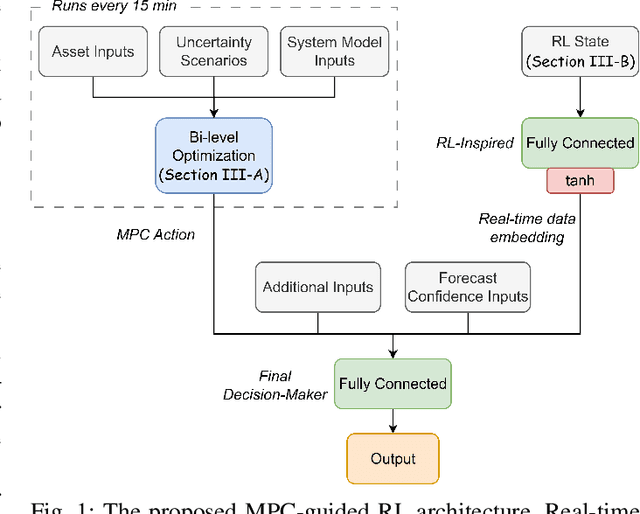
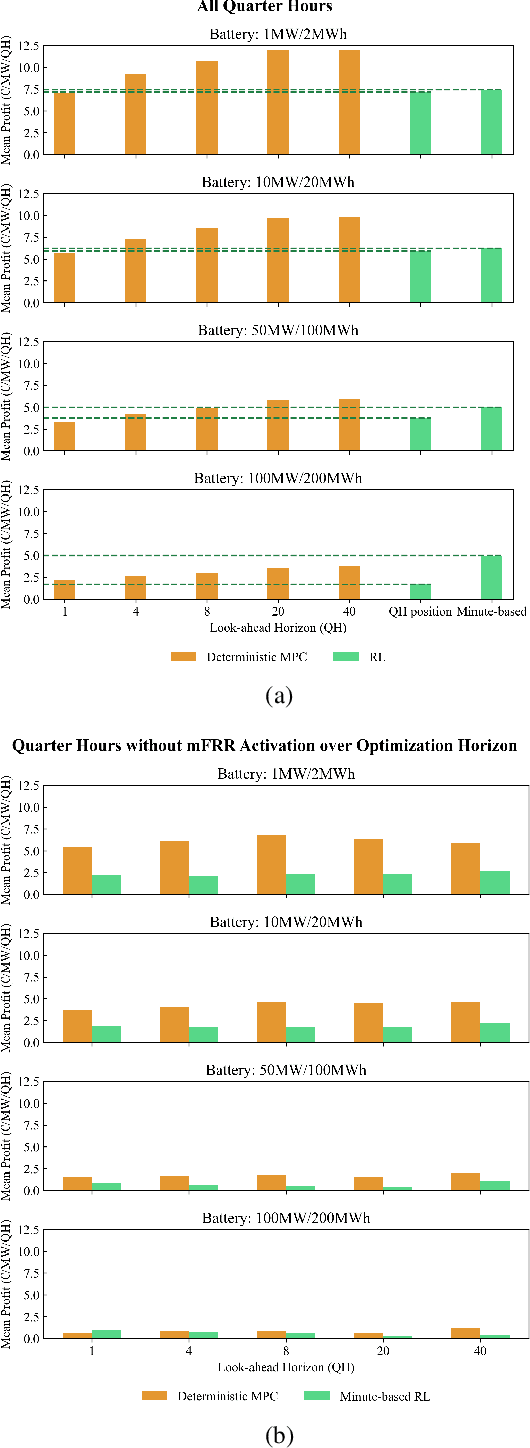
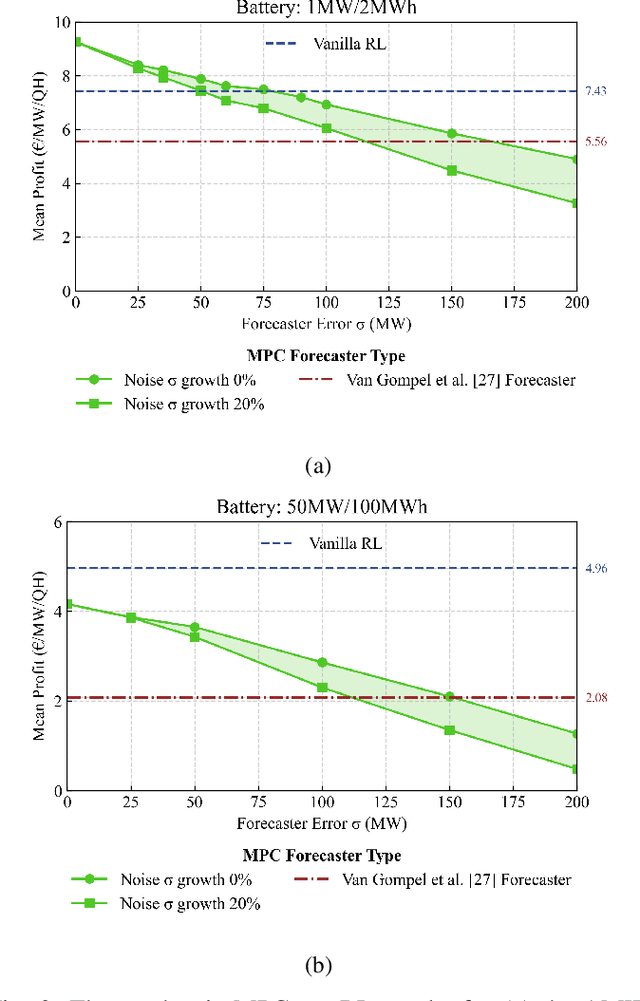
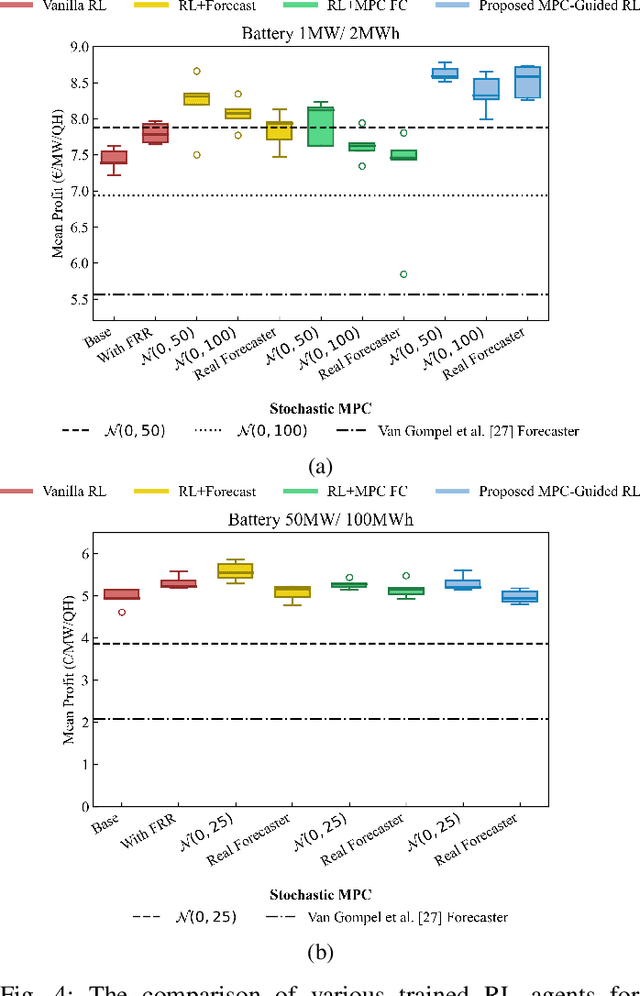
In Europe, profit-seeking balance responsible parties can deviate in real time from their day-ahead nominations to assist transmission system operators in maintaining the supply-demand balance. Model predictive control (MPC) strategies to exploit these implicit balancing strategies capture arbitrage opportunities, but fail to accurately capture the price-formation process in the European imbalance markets and face high computational costs. Model-free reinforcement learning (RL) methods are fast to execute, but require data-intensive training and usually rely on real-time and historical data for decision-making. This paper proposes an MPC-guided RL method that combines the complementary strengths of both MPC and RL. The proposed method can effectively incorporate forecasts into the decision-making process (as in MPC), while maintaining the fast inference capability of RL. The performance of the proposed method is evaluated on the implicit balancing battery control problem using Belgian balancing data from 2023. First, we analyze the performance of the standalone state-of-the-art RL and MPC methods from various angles, to highlight their individual strengths and limitations. Next, we show an arbitrage profit benefit of the proposed MPC-guided RL method of 16.15% and 54.36%, compared to standalone RL and MPC.
Efficient Text Encoders for Labor Market Analysis
May 30, 2025Labor market analysis relies on extracting insights from job advertisements, which provide valuable yet unstructured information on job titles and corresponding skill requirements. While state-of-the-art methods for skill extraction achieve strong performance, they depend on large language models (LLMs), which are computationally expensive and slow. In this paper, we propose \textbf{ConTeXT-match}, a novel contrastive learning approach with token-level attention that is well-suited for the extreme multi-label classification task of skill classification. \textbf{ConTeXT-match} significantly improves skill extraction efficiency and performance, achieving state-of-the-art results with a lightweight bi-encoder model. To support robust evaluation, we introduce \textbf{Skill-XL}, a new benchmark with exhaustive, sentence-level skill annotations that explicitly address the redundancy in the large label space. Finally, we present \textbf{JobBERT V2}, an improved job title normalization model that leverages extracted skills to produce high-quality job title representations. Experiments demonstrate that our models are efficient, accurate, and scalable, making them ideal for large-scale, real-time labor market analysis.