 Add to Chrome
 Add to Firefox
 Add to Edge
Foresight-England: Development of a National-Scale Generative AI Model of Electronic Health Records for Medical Event Prediction across the COVID-19 Pandemic
Aug 17, 2026
Foresight-England (Foresight-E) is the first national-scale generative foundation model of electronic health records (EHRs), developed as a research pilot strictly for COVID-19 research. We evaluated its ability to model the direct and indirect effects of the pandemic. Trained from scratch entirely within the NHS England Secure Data Environment, Foresight-E is a 243-million-parameter transformer decoder. It was trained and evaluated on de-identified, longitudinal EHRs of approximately 61 million individuals, integrating primary/secondary care, death registrations, and COVID-19 data. Training and validation used a 90% subset (54.9 million) spanning November 2018 to December 2022; the remaining 10% (6.1 million) was held out for evaluation. Foresight-E models patient timelines autoregressively, predicting the next medical event given their prior history. At inference, it operates zero-shot, predicting any concept in its ~40,000-code vocabulary without task-specific training. Our tokenisation scheme retains the clinical granularity of ICD-10, OPCS-4, and SNOMED CT codes, jointly representing absolute and relative timing. We designed an evaluation framework for 30-day COVID-19 hospitalisation and mortality, including subgroup analyses by demographic factors and vaccination status. To assess generalisation to unseen future data and the pandemic's indirect effects, we tested the model on medical events from 2023 (beyond its training period), benchmarking against logistic regression and XGBoost. As detailed in the Project Status section, NHS England has paused access to data for the Foresight-E project, meaning quantitative results are currently unavailable. Instead, we share our strategy for tokenisation, architecture, training, inference, and evaluation as a methodological template and case study in the challenges of building population-scale EHR foundation models.

Nomenclature Ontology for Medical And Disease names (NOMAD): taxonomy of types and origins of disease names
Jun 11, 2026The nomenclature of human disease has developed organically over the past centuries using Greek, Latin, and Arabic terminology and reflects the idiosyncrasies of different eras of medical discovery. Despite evident heterogeneity in naming practices, no systematic framework exists for characterising these conventions across all diseases. In this paper, we describe the Nomenclature Ontology for Medical And Disease names (NOMAD), a meta-taxonomy that classifies disease names according to their naming conventions. We developed a two-level taxonomy comprising 9 top-level categories and 20 subcategories and applied it to 22,548 index entries from the ICD-10-CM 2026 Alphabetical Index in a scalable three-stage machine learning-driven classification pipeline. Classification was multi-label, reflecting the compositional nature of medical nomenclature. We classified 99.1% of terms with a mean of 2.12 labels per entry. Anatomical categories were the most prevalent (63.8% of entries), followed by Descriptive (48.4%) and Pathophysiological (40.2%), while Eponymous and Geographical labels were less common than their cultural prominence might suggest (9.7% and 1.9% respectively). Among all Eponymous diseases, we identified only 57 (2.6%) of diseases named after a female person. We manually reviewed a random sample of n=2,255 entries (10%) for accuracy and calculated a full agreement rate of 70% and partial agreement rate of 26% (macro-averaged Cohen's Kappa score 0.832). Naming convention profiles varied substantially across ICD-10-CM chapters, reflecting specialty-specific epistemological traditions: infectious disease chapters were dominated by etiological labels and showed the highest proportion of geographical region related labels, the circulatory chapter by anatomical and pathophysiological labels, and mental and behavioural disorders showed the highest prevalence of socio-behavioral labels.
AutoForest: Automatically Generating Forest Plots from Biomedical Studies with End-to-End Evidence Extraction and Synthesis
Jun 01, 2026Systematic reviews rely on forest plots to synthesise quantitative evidence across biomedical studies, but generating them remains a fragmented and labour-intensive process. Researchers must interpret complex clinical texts, manually extract outcome data from trials, define appropriate interventions and comparators, harmonise inconsistent study designs, and carry out meta-analytic computations-typically using specialised software that demands structured inputs and domain expertise. While recent work has demonstrated that large language models can extract study-level data from unstructured text, no existing system automates the complete pipeline from raw documents to synthesised forest plots. To address this gap, we introduce AutoForest, the first end-to-end system that generates publication-ready forest plots directly from biomedical papers. Given one or more study papers, AutoForest automatically suggests ICO (Intervention, Comparator, Outcome) elements, extracts outcome data, performs statistical synthesis, and renders the final forest plot. We describe the system architecture, user interface and demonstrate its effectiveness on real-world examples through a user study involving clinicians, showing how AutoForest can accelerate evidence synthesis and substantially lower the barrier to conducting meta-analyses.
Diffsurv: Differentiable sorting for censored time-to-event data
Apr 26, 2023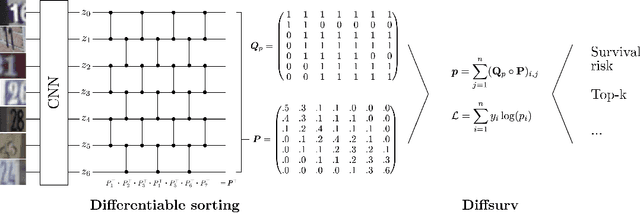

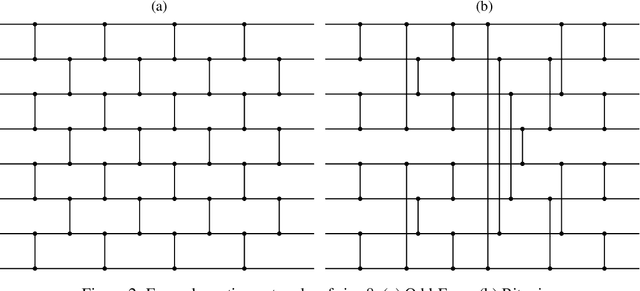
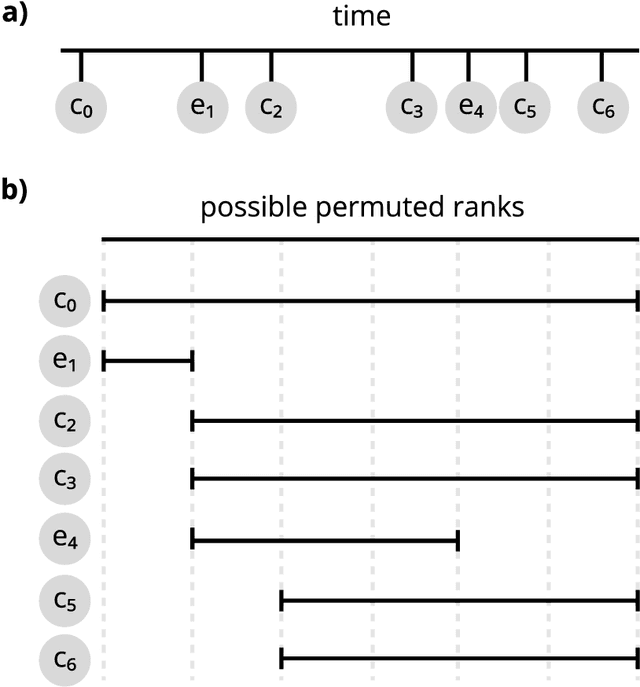
Survival analysis is a crucial semi-supervised task in machine learning with numerous real-world applications, particularly in healthcare. Currently, the most common approach to survival analysis is based on Cox's partial likelihood, which can be interpreted as a ranking model optimized on a lower bound of the concordance index. This relation between ranking models and Cox's partial likelihood considers only pairwise comparisons. Recent work has developed differentiable sorting methods which relax this pairwise independence assumption, enabling the ranking of sets of samples. However, current differentiable sorting methods cannot account for censoring, a key factor in many real-world datasets. To address this limitation, we propose a novel method called Diffsurv. We extend differentiable sorting methods to handle censored tasks by predicting matrices of possible permutations that take into account the label uncertainty introduced by censored samples. We contrast this approach with methods derived from partial likelihood and ranking losses. Our experiments show that Diffsurv outperforms established baselines in various simulated and real-world risk prediction scenarios. Additionally, we demonstrate the benefits of the algorithmic supervision enabled by Diffsurv by presenting a novel method for top-k risk prediction that outperforms current methods.
Application of Clinical Concept Embeddings for Heart Failure Prediction in UK EHR data
Nov 28, 2018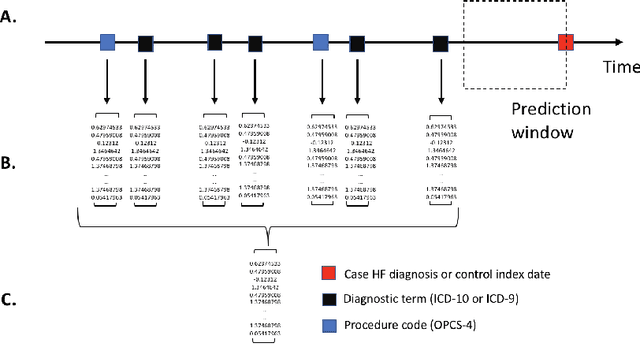
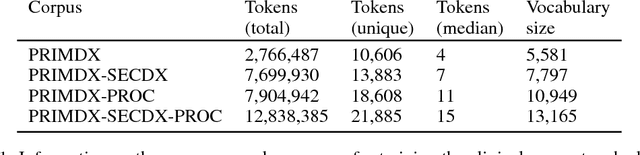
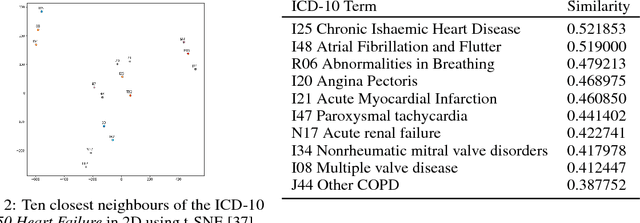
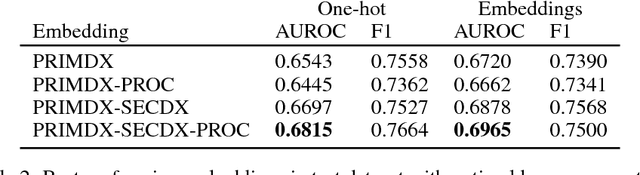
Electronic health records (EHR) are increasingly being used for constructing disease risk prediction models. Feature engineering in EHR data however is challenging due to their highly dimensional and heterogeneous nature. Low-dimensional representations of EHR data can potentially mitigate these challenges. In this paper, we use global vectors (GloVe) to learn word embeddings for diagnoses and procedures recorded using 13 million ontology terms across 2.7 million hospitalisations in national UK EHR. We demonstrate the utility of these embeddings by evaluating their performance in identifying patients which are at higher risk of being hospitalised for congestive heart failure. Our findings indicate that embeddings can enable the creation of robust EHR-derived disease risk prediction models and address some the limitations associated with manual clinical feature engineering.
Evaluation of Semantic Web Technologies for Storing Computable Definitions of Electronic Health Records Phenotyping Algorithms
Jul 24, 2017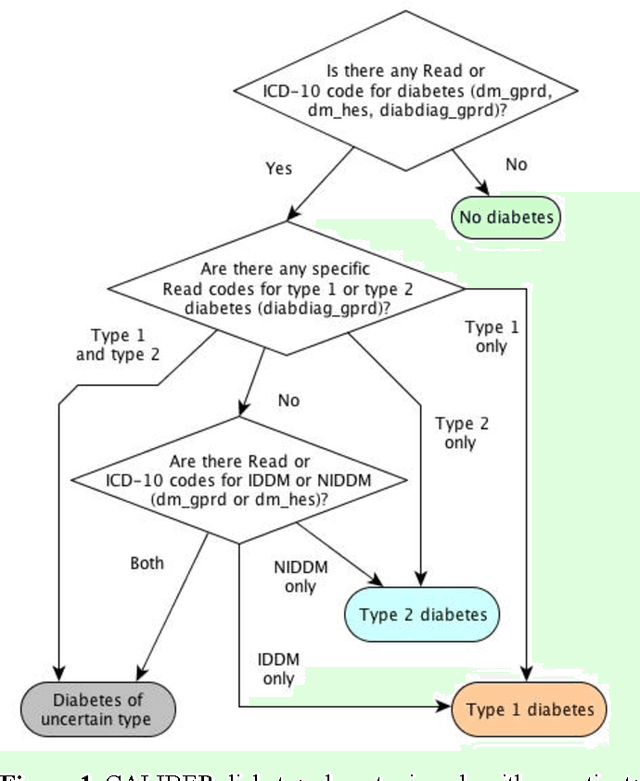
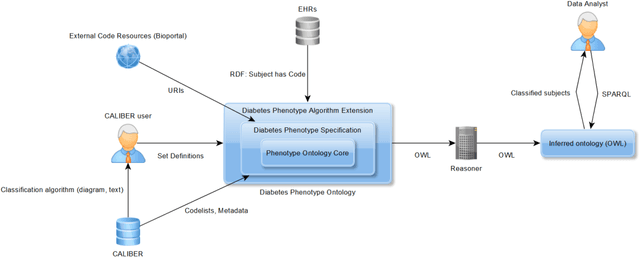
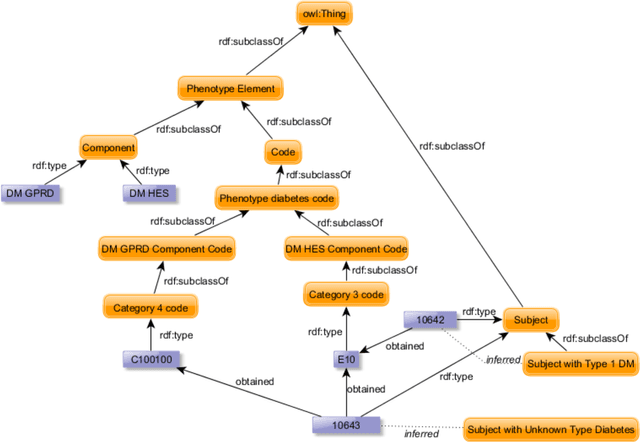
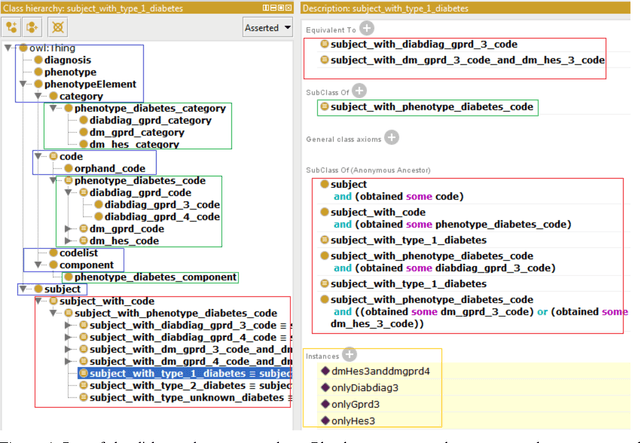
Electronic Health Records are electronic data generated during or as a byproduct of routine patient care. Structured, semi-structured and unstructured EHR offer researchers unprecedented phenotypic breadth and depth and have the potential to accelerate the development of precision medicine approaches at scale. A main EHR use-case is defining phenotyping algorithms that identify disease status, onset and severity. Phenotyping algorithms utilize diagnoses, prescriptions, laboratory tests, symptoms and other elements in order to identify patients with or without a specific trait. No common standardized, structured, computable format exists for storing phenotyping algorithms. The majority of algorithms are stored as human-readable descriptive text documents making their translation to code challenging due to their inherent complexity and hinders their sharing and re-use across the community. In this paper, we evaluate the two key Semantic Web Technologies, the Web Ontology Language and the Resource Description Framework, for enabling computable representations of EHR-driven phenotyping algorithms.