 Add to Chrome
 Add to Firefox
 Add to Edge
ClinicalAligner26AM: A Cross-Lingual Aligner for Dataset Translation; Evidences from the MultiClinCorpus Shared Task
Jun 07, 2026
Word-level cross-lingual alignment is central to annotation projection, translation auditing, and cross-lingual faithfulness estimation, yet existing neural aligners are rarely adapted to specialized domains. In this paper, we introduce ClinicalAligner26AM, a large-context multilingual aligner model for biomedical and clinical text initialized from ClinicalEncoder26AM. Our training recipe is inspired by AWESoME Align. We build our soft alignment target by sharpening with Sinkhorn-Knop optimal transport a cost matrix established for parallel clinical texts and conversations through the fusion of sentence-level, phrase-level, and token-level signals. We distill this sharpened alignment matrix directly into our student aligner, by encouraging its naive cosine-based token similarity scores to match this target. At inference time, we project source-span scores through the learned token alignment matrix and decode the longest valid high-scoring span in the target text, optionally supported by MultiClinNER predictions summarized in Appendix B. We evaluate CA26AM on the MultiClinCorpus shared task, which projects Spanish clinical entity annotations into six target languages. Our two submitted systems ranked respectively first and second across all languages and entity types, with character-weighted F1 scores above 0.95 in nearly all settings.

ClinicalEncoder26AM: A Multlilingual Diagnosable ColBERT Model; Evidences from the MultiClinNER Shared Task
May 27, 2026ClinicalEncoder26AM is a multilingual Diagnosable ColBERT for clinical and biomedical texts, which aligns at multiple levels its token-level semantic with ClinicalMap25, a clinical latent space inspired by BioLORD-2023 and enriched with synthetic and annotated supervision. The post-training recipe builds upon BGE-M3, and combines synthetic clinical notes, patient--doctor conversations, and annotated resources such as MedMentions, while considering both named-entity-level and sentence-level representations in a multi-adapter distillation, along with a ColBERT-style retrieval objective. In this system demonstration paper, we evaluate the model in the MultiClinNER shared task by finetuning it as a BIO tagger for patient symptoms, disorders, and procedure spans, using a lightweight two-layer CNN head to improve local boundary detection. The resulting system remains simple, processes most documents in a single 8192-token window, and achieves state-of-the-art multilingual entity recall, while achieving Top 5 overall across all entity types and languages in Character-weighted F1 scores. Training curves further show that ClinicalEncoder26AM is markedly more data-efficient than the base M3 model, supporting the usefulness of its clinical post-training for downstream information extraction. The model can be downloaded on https://huggingface.co/Parallia/ClinicalEncoder26AM-Diagnosable-Colbert-L2-for-multilingual-medical-texts
Diagnosable ColBERT: Debugging Late-Interaction Retrieval Models Using a Learned Latent Space as Reference
Apr 21, 2026Reliable biomedical and clinical retrieval requires more than strong ranking performance: it requires a practical way to find systematic model failures and curate the training evidence needed to correct them. Late-interaction models such as ColBERT provide a first solution thanks to the interpretable token-level interaction scores they expose between document and query tokens. Yet this interpretability is shallow: it explains a particular document--query pairwise score, but does not reveal whether the model has learned a clinical concept in a stable, reusable, and context-sensitive way across diverse expressions. As a result, these scores provide limited support for diagnosing misunderstandings, identifying irreasonably distant biomedical concepts, or deciding what additional data or feedback is needed to address this. In this short position paper, we propose Diagnosable ColBERT, a framework that aligns ColBERT token embeddings to a reference latent space grounded in clinical knowledge and expert-provided conceptual similarity constraints. This alignment turns document encodings into inspectable evidence of what the model appears to understand, enabling more direct error diagnosis and more principled data curation without relying on large batteries of diagnostic queries.
ChocoLlama: Lessons Learned From Teaching Llamas Dutch
Dec 10, 2024While Large Language Models (LLMs) have shown remarkable capabilities in natural language understanding and generation, their performance often lags in lower-resource, non-English languages due to biases in the training data. In this work, we explore strategies for adapting the primarily English LLMs (Llama-2 and Llama-3) to Dutch, a language spoken by 30 million people worldwide yet often underrepresented in LLM development. We collect 104GB of Dutch text ($32$B tokens) from various sources to first apply continued pretraining using low-rank adaptation (LoRA), complemented with Dutch posttraining strategies provided by prior work. For Llama-2, we consider using (i) the tokenizer of the original model, and (ii) training a new, Dutch-specific tokenizer combined with embedding reinitialization. We evaluate our adapted models, ChocoLlama-2, both on standard benchmarks and a novel Dutch benchmark, ChocoLlama-Bench. Our results demonstrate that LoRA can effectively scale for language adaptation, and that tokenizer modification with careful weight reinitialization can improve performance. Notably, Llama-3 was released during the course of this project and, upon evaluation, demonstrated superior Dutch capabilities compared to our Dutch-adapted versions of Llama-2. We hence apply the same adaptation technique to Llama-3, using its original tokenizer. While our adaptation methods enhanced Llama-2's Dutch capabilities, we found limited gains when applying the same techniques to Llama-3. This suggests that for ever improving, multilingual foundation models, language adaptation techniques may benefit more from focusing on language-specific posttraining rather than on continued pretraining. We hope this work contributes to the broader understanding of adapting LLMs to lower-resource languages, and to the development of Dutch LLMs in particular.
Trans-Tokenization and Cross-lingual Vocabulary Transfers: Language Adaptation of LLMs for Low-Resource NLP
Aug 08, 2024The development of monolingual language models for low and mid-resource languages continues to be hindered by the difficulty in sourcing high-quality training data. In this study, we present a novel cross-lingual vocabulary transfer strategy, trans-tokenization, designed to tackle this challenge and enable more efficient language adaptation. Our approach focuses on adapting a high-resource monolingual LLM to an unseen target language by initializing the token embeddings of the target language using a weighted average of semantically similar token embeddings from the source language. For this, we leverage a translation resource covering both the source and target languages. We validate our method with the Tweeties, a series of trans-tokenized LLMs, and demonstrate their competitive performance on various downstream tasks across a small but diverse set of languages. Additionally, we introduce Hydra LLMs, models with multiple swappable language modeling heads and embedding tables, which further extend the capabilities of our trans-tokenization strategy. By designing a Hydra LLM based on the multilingual model TowerInstruct, we developed a state-of-the-art machine translation model for Tatar, in a zero-shot manner, completely bypassing the need for high-quality parallel data. This breakthrough is particularly significant for low-resource languages like Tatar, where high-quality parallel data is hard to come by. By lowering the data and time requirements for training high-quality models, our trans-tokenization strategy allows for the development of LLMs for a wider range of languages, especially those with limited resources. We hope that our work will inspire further research and collaboration in the field of cross-lingual vocabulary transfer and contribute to the empowerment of languages on a global scale.
In-Context Learning for Extreme Multi-Label Classification
Jan 22, 2024Multi-label classification problems with thousands of classes are hard to solve with in-context learning alone, as language models (LMs) might lack prior knowledge about the precise classes or how to assign them, and it is generally infeasible to demonstrate every class in a prompt. We propose a general program, $\texttt{Infer--Retrieve--Rank}$, that defines multi-step interactions between LMs and retrievers to efficiently tackle such problems. We implement this program using the $\texttt{DSPy}$ programming model, which specifies in-context systems in a declarative manner, and use $\texttt{DSPy}$ optimizers to tune it towards specific datasets by bootstrapping only tens of few-shot examples. Our primary extreme classification program, optimized separately for each task, attains state-of-the-art results across three benchmarks (HOUSE, TECH, TECHWOLF). We apply the same program to a benchmark with vastly different characteristics and attain competitive performance as well (BioDEX). Unlike prior work, our proposed solution requires no finetuning, is easily applicable to new tasks, alleviates prompt engineering, and requires only tens of labeled examples. Our code is public at https://github.com/KarelDO/xmc.dspy.
BioLORD-2023: Semantic Textual Representations Fusing LLM and Clinical Knowledge Graph Insights
Nov 27, 2023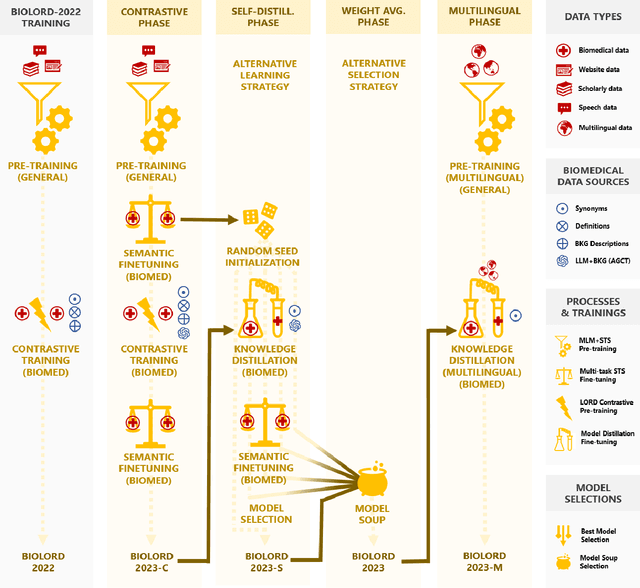
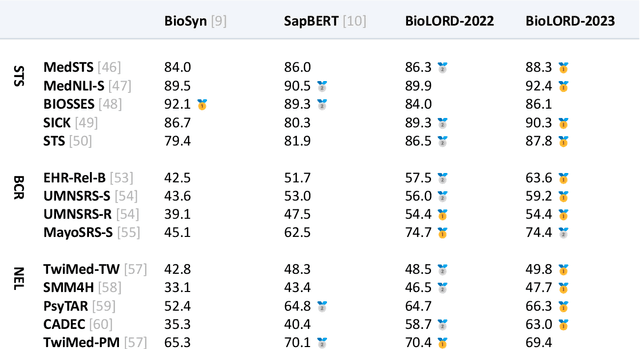
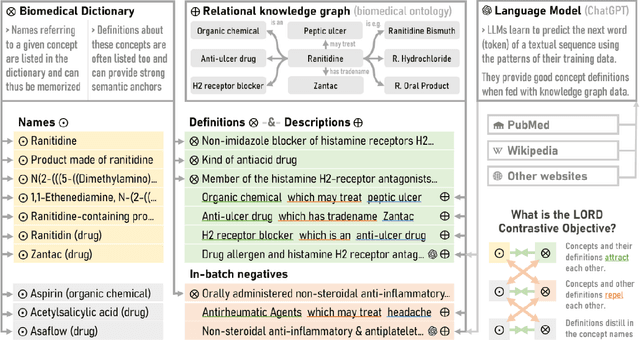
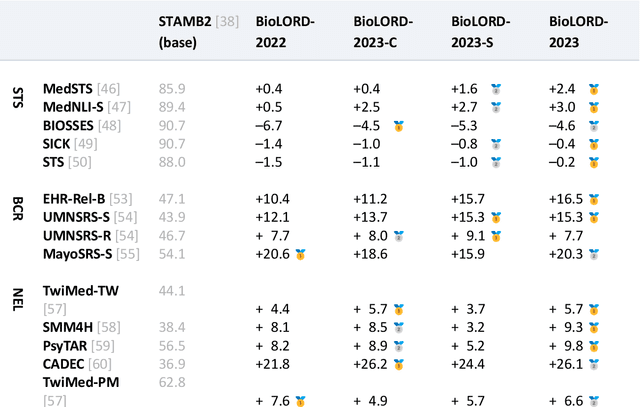
In this study, we investigate the potential of Large Language Models to complement biomedical knowledge graphs in the training of semantic models for the biomedical and clinical domains. Drawing on the wealth of the UMLS knowledge graph and harnessing cutting-edge Large Language Models, we propose a new state-of-the-art approach for obtaining high-fidelity representations of biomedical concepts and sentences, consisting of three steps: an improved contrastive learning phase, a novel self-distillation phase, and a weight averaging phase. Through rigorous evaluations via the extensive BioLORD testing suite and diverse downstream tasks, we demonstrate consistent and substantial performance improvements over the previous state of the art (e.g. +2pts on MedSTS, +2.5pts on MedNLI-S, +6.1pts on EHR-Rel-B). Besides our new state-of-the-art biomedical model for English, we also distill and release a multilingual model compatible with 50+ languages and finetuned on 7 European languages. Many clinical pipelines can benefit from our latest models. Our new multilingual model enables a range of languages to benefit from our advancements in biomedical semantic representation learning, opening a new avenue for bioinformatics researchers around the world. As a result, we hope to see BioLORD-2023 becoming a precious tool for future biomedical applications.
Tik-to-Tok: Translating Language Models One Token at a Time: An Embedding Initialization Strategy for Efficient Language Adaptation
Oct 05, 2023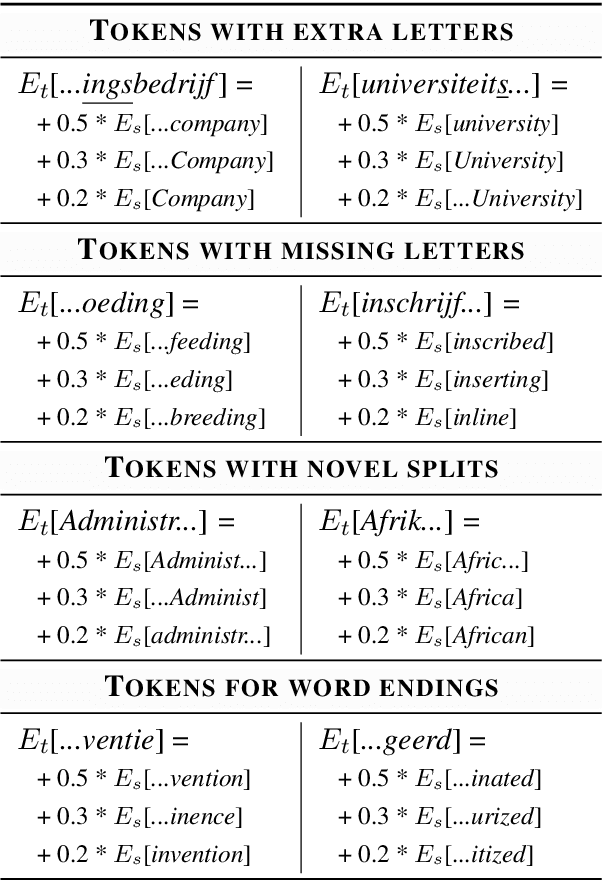
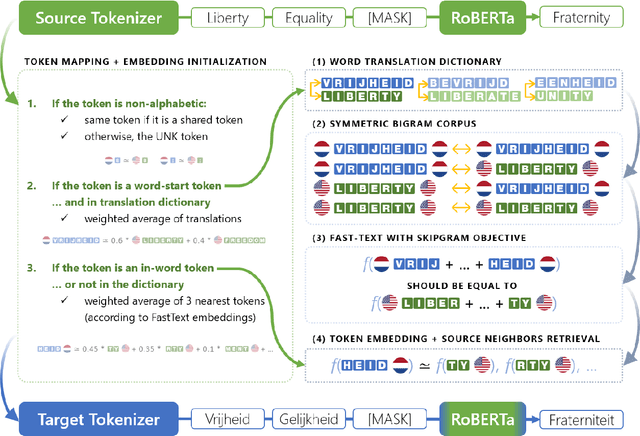
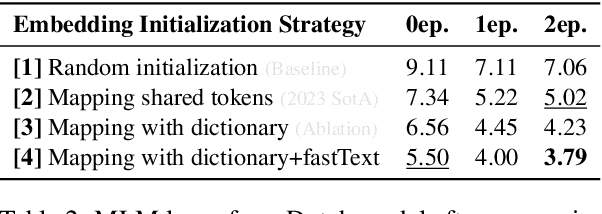
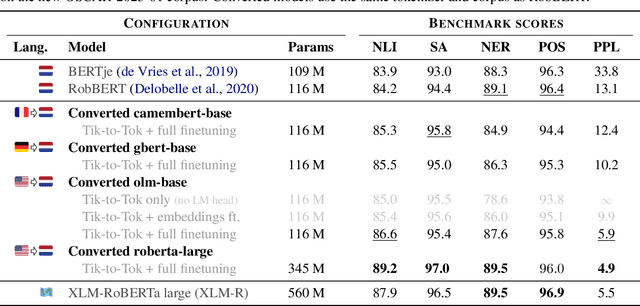
Training monolingual language models for low and mid-resource languages is made challenging by limited and often inadequate pretraining data. In this study, we propose a novel model conversion strategy to address this issue, adapting high-resources monolingual language models to a new target language. By generalizing over a word translation dictionary encompassing both the source and target languages, we map tokens from the target tokenizer to semantically similar tokens from the source language tokenizer. This one-to-many token mapping improves tremendously the initialization of the embedding table for the target language. We conduct experiments to convert high-resource models to mid- and low-resource languages, namely Dutch and Frisian. These converted models achieve a new state-of-the-art performance on these languages across all sorts of downstream tasks. By reducing significantly the amount of data and time required for training state-of-the-art models, our novel model conversion strategy has the potential to benefit many languages worldwide.
Boosting Adverse Drug Event Normalization on Social Media: General-Purpose Model Initialization and Biomedical Semantic Text Similarity Benefit Zero-Shot Linking in Informal Contexts
Jul 31, 2023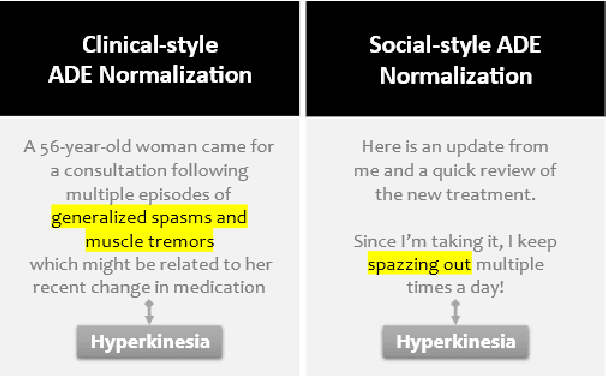
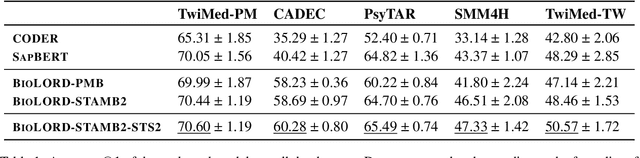

Biomedical entity linking, also known as biomedical concept normalization, has recently witnessed the rise to prominence of zero-shot contrastive models. However, the pre-training material used for these models has, until now, largely consisted of specialist biomedical content such as MIMIC-III clinical notes (Johnson et al., 2016) and PubMed papers (Sayers et al., 2021; Gao et al., 2020). While the resulting in-domain models have shown promising results for many biomedical tasks, adverse drug event normalization on social media texts has so far remained challenging for them (Portelli et al., 2022). In this paper, we propose a new approach for adverse drug event normalization on social media relying on general-purpose model initialization via BioLORD (Remy et al., 2022) and a semantic-text-similarity fine-tuning named STS. Our experimental results on several social media datasets demonstrate the effectiveness of our proposed approach, by achieving state-of-the-art performance. Based on its strong performance across all the tested datasets, we believe this work could emerge as a turning point for the task of adverse drug event normalization on social media and has the potential to serve as a benchmark for future research in the field.
Automatic Glossary of Clinical Terminology: a Large-Scale Dictionary of Biomedical Definitions Generated from Ontological Knowledge
Jun 01, 2023Background: More than 400,000 biomedical concepts and some of their relationships are contained in SnomedCT, a comprehensive biomedical ontology. However, their concept names are not always readily interpretable by non-experts, or patients looking at their own electronic health records (EHR). Clear definitions or descriptions in understandable language are often not available. Therefore, generating human-readable definitions for biomedical concepts might help make the information they encode more accessible and understandable to a wider public. Objective: In this article, we introduce the Automatic Glossary of Clinical Terminology (AGCT), a large-scale biomedical dictionary of clinical concepts generated using high-quality information extracted from the biomedical knowledge contained in SnomedCT. Methods: We generate a novel definition for every SnomedCT concept, after prompting the OpenAI Turbo model, a variant of GPT 3.5, using a high-quality verbalization of the SnomedCT relationships of the to-be-defined concept. A significant subset of the generated definitions was subsequently judged by NLP researchers with biomedical expertise on 5-point scales along the following three axes: factuality, insight, and fluency. Results: AGCT contains 422,070 computer-generated definitions for SnomedCT concepts, covering various domains such as diseases, procedures, drugs, and anatomy. The average length of the definitions is 49 words. The definitions were assigned average scores of over 4.5 out of 5 on all three axes, indicating a majority of factual, insightful, and fluent definitions. Conclusion: AGCT is a novel and valuable resource for biomedical tasks that require human-readable definitions for SnomedCT concepts. It can also serve as a base for developing robust biomedical retrieval models or other applications that leverage natural language understanding of biomedical knowledge.