 Add to Chrome
 Add to Firefox
 Add to Edge
Foresight-England: Development of a National-Scale Generative AI Model of Electronic Health Records for Medical Event Prediction across the COVID-19 Pandemic
Aug 17, 2026
Foresight-England (Foresight-E) is the first national-scale generative foundation model of electronic health records (EHRs), developed as a research pilot strictly for COVID-19 research. We evaluated its ability to model the direct and indirect effects of the pandemic. Trained from scratch entirely within the NHS England Secure Data Environment, Foresight-E is a 243-million-parameter transformer decoder. It was trained and evaluated on de-identified, longitudinal EHRs of approximately 61 million individuals, integrating primary/secondary care, death registrations, and COVID-19 data. Training and validation used a 90% subset (54.9 million) spanning November 2018 to December 2022; the remaining 10% (6.1 million) was held out for evaluation. Foresight-E models patient timelines autoregressively, predicting the next medical event given their prior history. At inference, it operates zero-shot, predicting any concept in its ~40,000-code vocabulary without task-specific training. Our tokenisation scheme retains the clinical granularity of ICD-10, OPCS-4, and SNOMED CT codes, jointly representing absolute and relative timing. We designed an evaluation framework for 30-day COVID-19 hospitalisation and mortality, including subgroup analyses by demographic factors and vaccination status. To assess generalisation to unseen future data and the pandemic's indirect effects, we tested the model on medical events from 2023 (beyond its training period), benchmarking against logistic regression and XGBoost. As detailed in the Project Status section, NHS England has paused access to data for the Foresight-E project, meaning quantitative results are currently unavailable. Instead, we share our strategy for tokenisation, architecture, training, inference, and evaluation as a methodological template and case study in the challenges of building population-scale EHR foundation models.

Validating transformers for redaction of text from electronic health records in real-world healthcare
Oct 05, 2023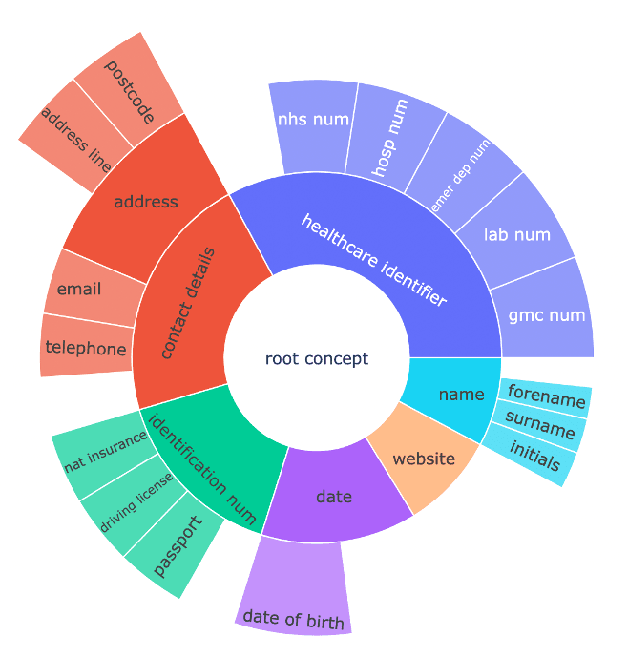
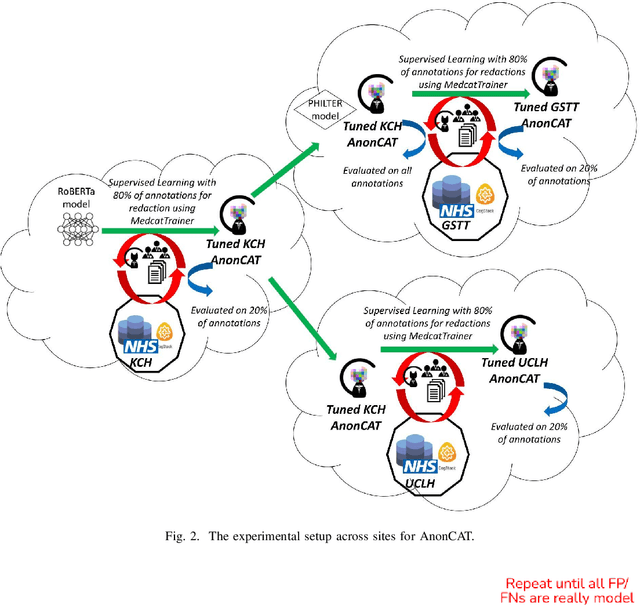
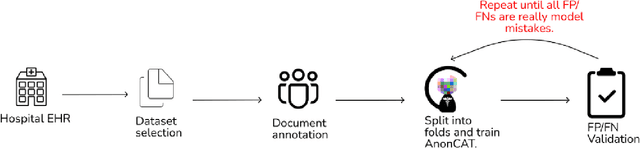
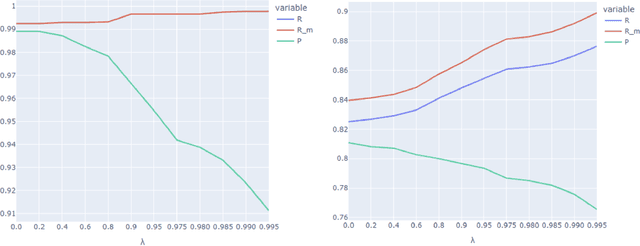
Protecting patient privacy in healthcare records is a top priority, and redaction is a commonly used method for obscuring directly identifiable information in text. Rule-based methods have been widely used, but their precision is often low causing over-redaction of text and frequently not being adaptable enough for non-standardised or unconventional structures of personal health information. Deep learning techniques have emerged as a promising solution, but implementing them in real-world environments poses challenges due to the differences in patient record structure and language across different departments, hospitals, and countries. In this study, we present AnonCAT, a transformer-based model and a blueprint on how deidentification models can be deployed in real-world healthcare. AnonCAT was trained through a process involving manually annotated redactions of real-world documents from three UK hospitals with different electronic health record systems and 3116 documents. The model achieved high performance in all three hospitals with a Recall of 0.99, 0.99 and 0.96. Our findings demonstrate the potential of deep learning techniques for improving the efficiency and accuracy of redaction in global healthcare data and highlight the importance of building workflows which not just use these models but are also able to continually fine-tune and audit the performance of these algorithms to ensure continuing effectiveness in real-world settings. This approach provides a blueprint for the real-world use of de-identifying algorithms through fine-tuning and localisation, the code together with tutorials is available on GitHub (https://github.com/CogStack/MedCAT).