 Add to Chrome
 Add to Firefox
 Add to Edge
Foresight-England: Development of a National-Scale Generative AI Model of Electronic Health Records for Medical Event Prediction across the COVID-19 Pandemic
Aug 17, 2026
Foresight-England (Foresight-E) is the first national-scale generative foundation model of electronic health records (EHRs), developed as a research pilot strictly for COVID-19 research. We evaluated its ability to model the direct and indirect effects of the pandemic. Trained from scratch entirely within the NHS England Secure Data Environment, Foresight-E is a 243-million-parameter transformer decoder. It was trained and evaluated on de-identified, longitudinal EHRs of approximately 61 million individuals, integrating primary/secondary care, death registrations, and COVID-19 data. Training and validation used a 90% subset (54.9 million) spanning November 2018 to December 2022; the remaining 10% (6.1 million) was held out for evaluation. Foresight-E models patient timelines autoregressively, predicting the next medical event given their prior history. At inference, it operates zero-shot, predicting any concept in its ~40,000-code vocabulary without task-specific training. Our tokenisation scheme retains the clinical granularity of ICD-10, OPCS-4, and SNOMED CT codes, jointly representing absolute and relative timing. We designed an evaluation framework for 30-day COVID-19 hospitalisation and mortality, including subgroup analyses by demographic factors and vaccination status. To assess generalisation to unseen future data and the pandemic's indirect effects, we tested the model on medical events from 2023 (beyond its training period), benchmarking against logistic regression and XGBoost. As detailed in the Project Status section, NHS England has paused access to data for the Foresight-E project, meaning quantitative results are currently unavailable. Instead, we share our strategy for tokenisation, architecture, training, inference, and evaluation as a methodological template and case study in the challenges of building population-scale EHR foundation models.

Contextualised concept embedding for efficiently adapting natural language processing models for phenotype identification
Mar 13, 2019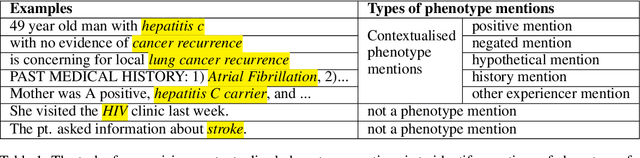
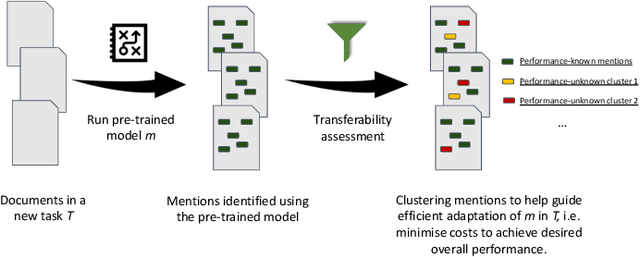
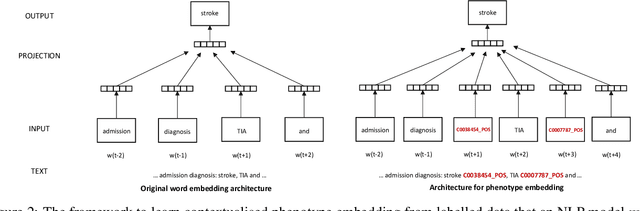
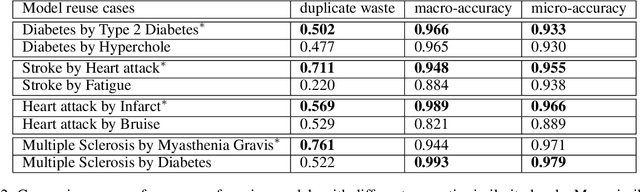
Many efforts have been put to use automated approaches, such as natural language processing (NLP), to mine or extract data from free-text medical records to picture comprehensive patient profiles for delivering better health-care. Reusing NLP models in new settings, however, remains cumbersome - requiring validation and/or retraining on new data iteratively to achieve convergent results. In this paper, we formally define and analyse the NLP model adaptation problem, particularly in phenotype identification tasks, and identify two types of common unnecessary or wasted efforts: duplicate waste and imbalance waste. A distributed representation approach is proposed to represent familiar language patterns for an NLP model by learning phenotype embeddings from its training data. Computations on these language patterns are then introduced to help avoid or reduce unnecessary efforts by combining both geometric and semantic similarities. To evaluate the approach, we cross validate NLP models developed for six physical morbidity studies (23 phenotypes; 17 million documents) on anonymised medical records of South London Maudsley NHS Trust, United Kingdom. Two metrics are introduced to quantify the reductions for both duplicate and imbalance wastes. We conducted various experiments on reusing NLP models in four phenotype identification tasks. Our approach can choose a best model for a given new task, which can identify up to 76% mentions needing no validation & model retraining, meanwhile, having very good performances (93-97% accuracy). It can also provide guidance for validating and retraining the model for novel language patterns in new tasks, which can help save around 80% of the efforts required in blind model-adaptation approaches.
Named Entity Recognition for Electronic Health Records: A Comparison of Rule-based and Machine Learning Approaches
Mar 10, 2019

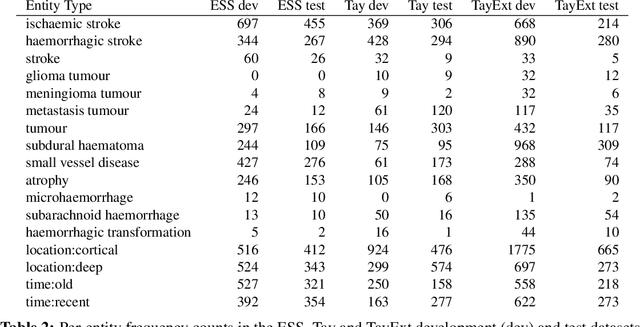
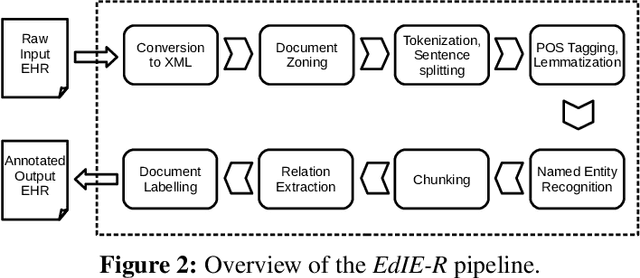
This work investigates multiple approaches to Named Entity Recognition (NER) for text in Electronic Health Record (EHR) data. In particular, we look into the application of (i) rule-based, (ii) deep learning and (iii) transfer learning systems for the task of NER on brain imaging reports with a focus on records from patients with stroke. We explore the strengths and weaknesses of each approach, develop rules and train on a common dataset, and evaluate each system's performance on common test sets of Scottish radiology reports from two sources (brain imaging reports in ESS -- Edinburgh Stroke Study data collected by NHS Lothian as well as radiology reports created in NHS Tayside). Our comparison shows that a hand-crafted system is the most accurate way to automatically label EHR, but machine learning approaches can provide a feasible alternative where resources for a manual system are not readily available.