 Add to Chrome
 Add to Firefox
 Add to Edge
LOGIGEN: Logic-Driven Generation of Verifiable Agentic Tasks
Feb 28, 2026
The evolution of Large Language Models (LLMs) from static instruction-followers to autonomous agents necessitates operating within complex, stateful environments to achieve precise state-transition objectives. However, this paradigm is bottlenecked by data scarcity, as existing tool-centric reverse-synthesis pipelines fail to capture the rigorous logic of real-world applications. We introduce \textbf{LOGIGEN}, a logic-driven framework that synthesizes verifiable training data based on three core pillars: \textbf{Hard-Compiled Policy Grounding}, \textbf{Logic-Driven Forward Synthesis}, and \textbf{Deterministic State Verification}. Specifically, a Triple-Agent Orchestration is employed: the \textbf{Architect} compiles natural-language policy into database constraints to enforce hard rules; the \textbf{Set Designer} initializes boundary-adjacent states to trigger critical policy conflicts; and the \textbf{Explorer} searches this environment to discover causal solution paths. This framework yields a dataset of 20,000 complex tasks across 8 domains, where validity is strictly guaranteed by checking exact state equivalence. Furthermore, we propose a verification-based training protocol where Supervised Fine-Tuning (SFT) on verifiable trajectories establishes compliance with hard-compiled policy, while Reinforcement Learning (RL) guided by dense state-rewards refines long-horizon goal achievement. On $τ^2$-Bench, LOGIGEN-32B(RL) achieves a \textbf{79.5\% success rate}, substantially outperforming the base model (40.7\%). These results demonstrate that logic-driven synthesis combined with verification-based training effectively constructs the causally valid trajectories needed for next-generation agents.

SWE-Hub: A Unified Production System for Scalable, Executable Software Engineering Tasks
Feb 28, 2026Progress in software-engineering agents is increasingly constrained by the scarcity of executable, scalable, and realistic data for training and evaluation. This scarcity stems from three fundamental challenges in existing pipelines: environments are brittle and difficult to reproduce across languages; synthesizing realistic, system-level bugs at scale is computationally expensive; and existing data predominantly consists of short-horizon repairs, failing to capture long-horizon competencies like architectural consistency. We introduce \textbf{SWE-Hub}, an end-to-end system that operationalizes the data factory abstraction by unifying environment automation, scalable synthesis, and diverse task generation into a coherent production stack. At its foundation, the \textbf{Env Agent} establishes a shared execution substrate by automatically converting raw repository snapshots into reproducible, multi-language container environments with standardized interfaces. Built upon this substrate, \textbf{SWE-Scale} engine addresses the need for high-throughput generation, combining cross-language code analysis with cluster-scale validation to synthesize massive volumes of localized bug-fix instances. \textbf{Bug Agent} generates high-fidelity repair tasks by synthesizing system-level regressions involving cross-module dependencies, paired with user-like issue reports that describe observable symptoms rather than root causes. Finally, \textbf{SWE-Architect} expands the task scope from repair to creation by translating natural-language requirements into repository-scale build-a-repo tasks. By integrating these components, SWE-Hub establishes a unified production pipeline capable of continuously delivering executable tasks across the entire software engineering lifecycle.
QianfanHuijin Technical Report: A Novel Multi-Stage Training Paradigm for Finance Industrial LLMs
Dec 30, 2025Domain-specific enhancement of Large Language Models (LLMs) within the financial context has long been a focal point of industrial application. While previous models such as BloombergGPT and Baichuan-Finance primarily focused on knowledge enhancement, the deepening complexity of financial services has driven a growing demand for models that possess not only domain knowledge but also robust financial reasoning and agentic capabilities. In this paper, we present QianfanHuijin, a financial domain LLM, and propose a generalizable multi-stage training paradigm for industrial model enhancement. Our approach begins with Continual Pre-training (CPT) on financial corpora to consolidate the knowledge base. This is followed by a fine-grained Post-training pipeline designed with increasing specificity: starting with Financial SFT, progressing to Finance Reasoning RL and Finance Agentic RL, and culminating in General RL aligned with real-world business scenarios. Empirical results demonstrate that QianfanHuijin achieves superior performance across various authoritative financial benchmarks. Furthermore, ablation studies confirm that the targeted Reasoning RL and Agentic RL stages yield significant gains in their respective capabilities. These findings validate our motivation and suggest that this fine-grained, progressive post-training methodology is poised to become a mainstream paradigm for various industrial-enhanced LLMs.
Learning from Training Dynamics: Identifying Mislabeled Data Beyond Manually Designed Features
Dec 20, 2022
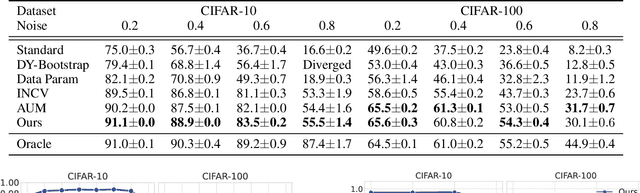
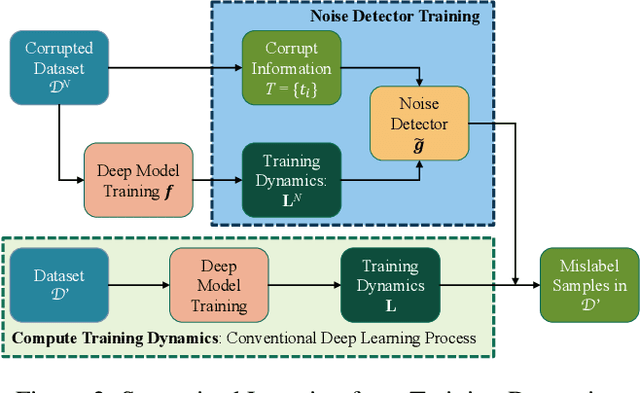
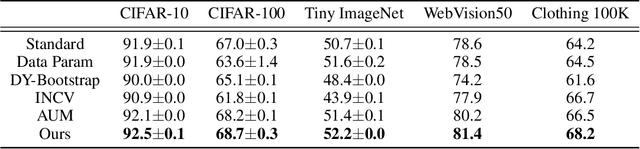
While mislabeled or ambiguously-labeled samples in the training set could negatively affect the performance of deep models, diagnosing the dataset and identifying mislabeled samples helps to improve the generalization power. Training dynamics, i.e., the traces left by iterations of optimization algorithms, have recently been proved to be effective to localize mislabeled samples with hand-crafted features. In this paper, beyond manually designed features, we introduce a novel learning-based solution, leveraging a noise detector, instanced by an LSTM network, which learns to predict whether a sample was mislabeled using the raw training dynamics as input. Specifically, the proposed method trains the noise detector in a supervised manner using the dataset with synthesized label noises and can adapt to various datasets (either naturally or synthesized label-noised) without retraining. We conduct extensive experiments to evaluate the proposed method. We train the noise detector based on the synthesized label-noised CIFAR dataset and test such noise detector on Tiny ImageNet, CUB-200, Caltech-256, WebVision and Clothing1M. Results show that the proposed method precisely detects mislabeled samples on various datasets without further adaptation, and outperforms state-of-the-art methods. Besides, more experiments demonstrate that the mislabel identification can guide a label correction, namely data debugging, providing orthogonal improvements of algorithm-centric state-of-the-art techniques from the data aspect.