 Add to Chrome
 Add to Firefox
 Add to Edge
CounselReflect: A Toolkit for Auditing Mental-Health Dialogues
Mar 31, 2026
Mental-health support is increasingly mediated by conversational systems (e.g., LLM-based tools), but users often lack structured ways to audit the quality and potential risks of the support they receive. We introduce CounselReflect, an end-to-end toolkit for auditing mental-health support dialogues. Rather than producing a single opaque quality score, CounselReflect provides structured, multi-dimensional reports with session-level summaries, turn-level scores, and evidence-linked excerpts to support transparent inspection. The system integrates two families of evaluation signals: (i) 12 model-based metrics produced by task-specific predictors, and (ii) rubric-based metrics that extend coverage via a literature-derived library (69 metrics) and user-defined custom metrics, operationalized with configurable LLM judges. CounselReflect is available as a web application, browser extension, and command-line interface (CLI), enabling use in real-time settings as well as at scale. Human evaluation includes a user study with 20 participants and an expert review with 6 mental-health professionals, suggesting that CounselReflect supports understandable, usable, and trustworthy auditing. A demo video and full source code are also provided.

CounselBench: A Large-Scale Expert Evaluation and Adversarial Benchmark of Large Language Models in Mental Health Counseling
Jun 10, 2025

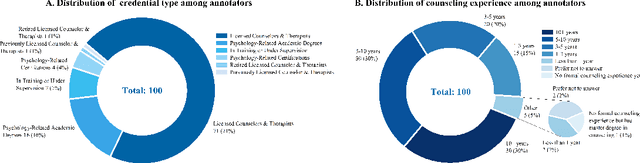

Large language models (LLMs) are increasingly proposed for use in mental health support, yet their behavior in realistic counseling scenarios remains largely untested. We introduce CounselBench, a large-scale benchmark developed with 100 mental health professionals to evaluate and stress-test LLMs in single-turn counseling. The first component, CounselBench-EVAL, contains 2,000 expert evaluations of responses from GPT-4, LLaMA 3, Gemini, and online human therapists to real patient questions. Each response is rated along six clinically grounded dimensions, with written rationales and span-level annotations. We find that LLMs often outperform online human therapists in perceived quality, but experts frequently flag their outputs for safety concerns such as unauthorized medical advice. Follow-up experiments show that LLM judges consistently overrate model responses and overlook safety issues identified by human experts. To probe failure modes more directly, we construct CounselBench-Adv, an adversarial dataset of 120 expert-authored counseling questions designed to trigger specific model issues. Evaluation across 2,880 responses from eight LLMs reveals consistent, model-specific failure patterns. Together, CounselBench establishes a clinically grounded framework for benchmarking and improving LLM behavior in high-stakes mental health settings.